
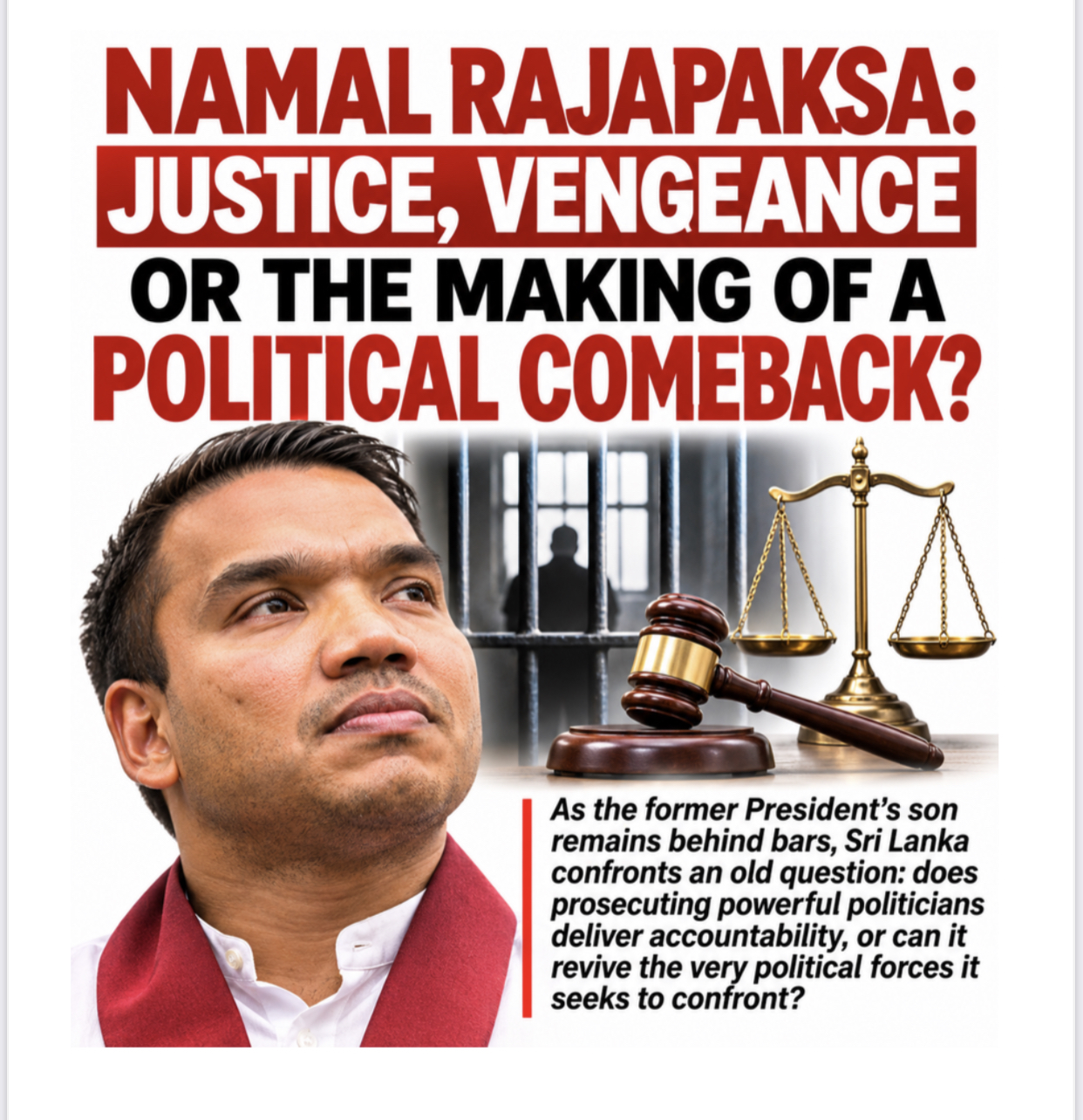
As the former President’s son remains behind bars, Sri Lanka confronts an old question: does prosecuting powerful politicians deliver accountability, or can it revive the very political forces it seeks to confront?
Namal Rajapaksa is in remand custody, confronting legal proceedings that could have consequences extending well beyond the courtroom. For a politician whose family dominated Sri Lankan politics for much of the past two decades, the circumstances represent a dramatic reversal.
But does incarceration necessarily mean political decline?
Submit Your Press Release
Get your company news, announcements, launches, appointments and events in front of a wider audience.


Sri Lanka’s history suggests that the relationship between prosecution, public sympathy and political survival is considerably more complicated.
Rajapaksa remains in custody despite having secured bail in the controversial Krrish transaction case on November 3. Separate proceedings prevented his release, and on November 18 the Colombo High Court suspended the earlier bail order following an application by the Commission to Investigate Allegations of Bribery or Corruption.
These are judicial developments, not findings of guilt. The distinction is fundamental.
The allegations must be examined through evidence, tested by competent courts and determined according to law. Neither a prominent surname nor political office establishes guilt. Equally, neither should provide immunity from investigation.
Yet beyond the legal proceedings lies a political question.
Will Sri Lankans view these developments as evidence of a justice system finally confronting powerful political interests, or will some perceive them as politically motivated persecution?
There is no reliable basis for assuming that the electorate shares a single interpretation.
Those demanding accountability for alleged corruption may regard the proceedings as evidence that political influence no longer guarantees protection. Rajapaksa’s supporters may question their timing, proportionality or motivation.
Others may simply wait for the courts to establish the facts.
History provides a revealing comparison.
In October 1980, President J. R. Jayewardene’s United National Party government used the findings of a Special Presidential Commission to deprive former Prime Minister Sirimavo Bandaranaike of her civic rights and expel her from Parliament.
The action followed allegations of abuse of power during her administration.
Bandaranaike maintained that the proceedings were politically motivated. Her opponents presented them as accountability for misconduct.
Her civic rights were restored in January 1986. She subsequently contested the 1988 presidential election, losing to Ranasinghe Premadasa, before returning as Prime Minister in November 1994 following her daughter Chandrika Bandaranaike Kumaratunga’s election as President.
That was approximately seventeen years after she had last held the premiership in 1977.
The historical lesson is not that every prosecuted politician eventually returns to power. It is that political exclusion, even when prolonged, does not necessarily extinguish political influence.
Bandaranaike retained an established party organisation, a recognisable political identity and a substantial constituency. Her return also depended upon changing political circumstances and the success of her daughter.
Namal Rajapaksa’s circumstances are different.
He belongs to a political dynasty whose reputation has been profoundly affected by Sri Lanka’s economic collapse and the extraordinary events of 2022. The Rajapaksa name continues to command loyalty in some quarters while attracting intense criticism in others.
Whether his legal difficulties alter those attitudes remains an open question.
There is also an important difference between the two historical situations.
Bandaranaike’s civic rights were removed through a political and parliamentary process following a special commission. Rajapaksa faces proceedings within the ordinary judicial system, where prosecutors must establish their allegations and judicial decisions remain subject to legal challenge.
Conflating the two would be misleading.
Nevertheless, the comparison raises an enduring concern about the relationship between political power and justice.
Sri Lanka has repeatedly witnessed allegations of corruption and abuse of authority directed against prominent figures, particularly following changes of government. Investigations attract publicity, arrests dominate headlines and competing political narratives emerge.
But the public interest ultimately depends upon something less dramatic and considerably more important: the lawful conclusion of proceedings.
An arrest is not a conviction. Remand is not punishment following conviction. Bail is not an acquittal.
These distinctions must remain central to public understanding.
The government also has an interest in ensuring that investigations are conducted independently, without political interference or selective enforcement. Prosecutors must act on evidence rather than political expectations, and defendants must enjoy the full protection of due process.
The judiciary, meanwhile, must be free to decide matters without pressure from either government or opposition.
For Rajapaksa, the political consequences will unfold alongside the legal proceedings, but they should not determine them.
His supporters may continue to mobilise around his circumstances. Critics may demand answers about the allegations. Neither reaction establishes the truth of the charges.
The more revealing question is whether Sri Lanka’s institutions can demonstrate that the same standards apply to powerful politicians, their opponents and ordinary citizens.
That requires timely investigations, transparent proceedings, consistent application of bail provisions and judicial decisions grounded in law.
It also requires political leaders to refrain from treating criminal proceedings as instruments of public relations.
Be that as it may, Sirimavo Bandaranaike’s experience offers a warning against assuming that removing a politician from public office or political activity necessarily ends a political career.
But history offers no guarantee of resurrection either.
Namal Rajapaksa’s future remains uncertain. His legal position will be determined through judicial proceedings, while his political standing will depend upon developments that cannot yet be measured.
The immediate responsibility belongs not to political strategists but to the institutions entrusted with administering justice.
Sri Lanka deserves neither political vengeance disguised as accountability nor impunity disguised as political persecution.
It deserves evidence, due process and judgments that withstand scrutiny. For ultimately, the question is larger than Namal Rajapaksa.
Can Sri Lanka demonstrate that justice is neither a privilege of political power nor a weapon against those who have lost it?



