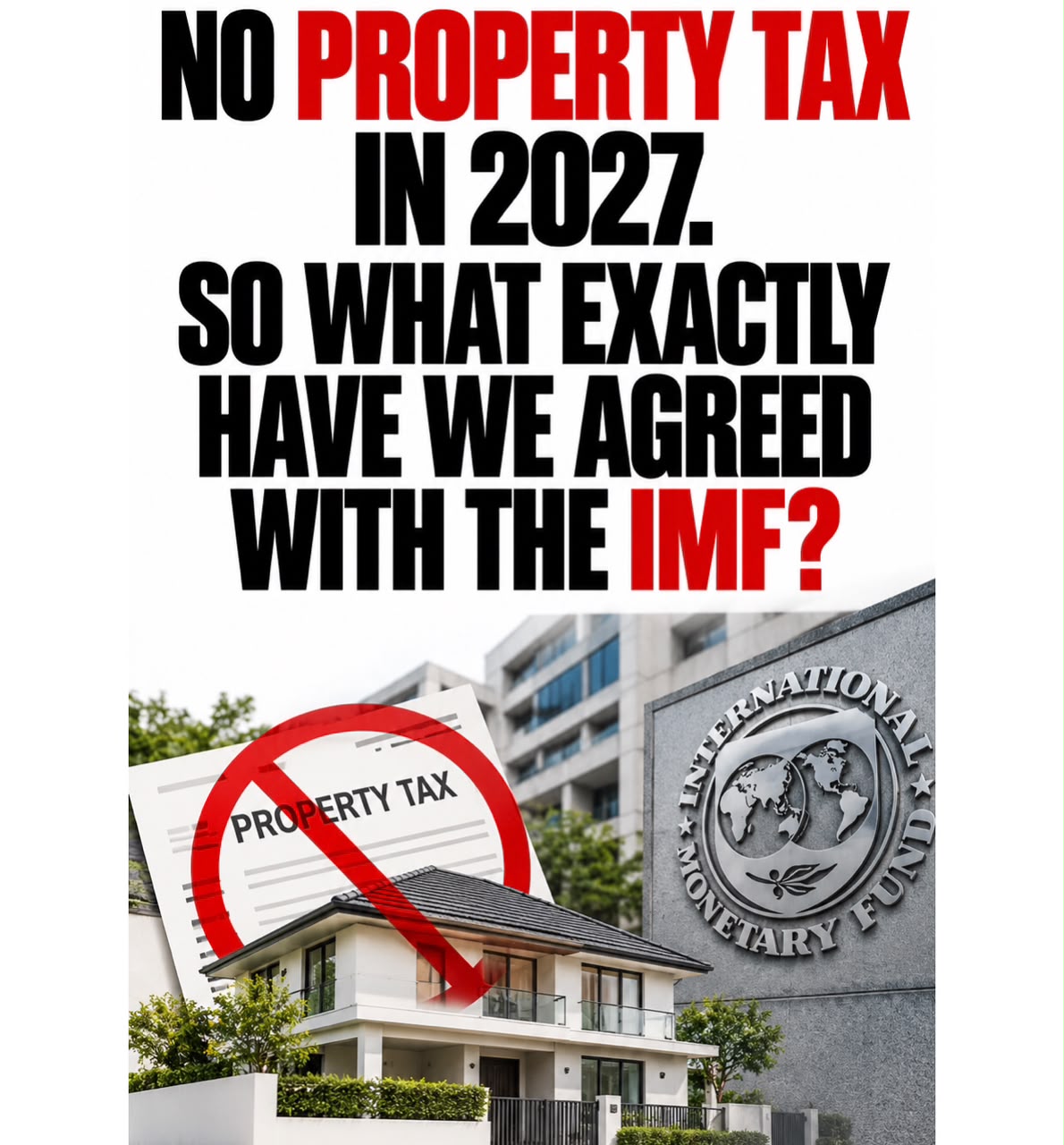
President Anura Kumara Dissanayake says there will be no property tax in the 2027 Budget. Homeowners may welcome that. But Sri Lanka’s IMF programme contemplated precisely such a revenue measure, leaving one rather important question: has the commitment disappeared, or merely the date?
President Anura Kumara Dissanayake has given Sri Lankan homeowners some good news. His Government will not introduce the controversial property tax in the 2027 Budget.
His argument has an obvious appeal. A person earns an income and pays tax upon it, saves what remains and eventually uses those savings to build or buy a home. Why, the President asks in effect, should the State arrive again and tax the property bought with already-taxed income?
Submit Your Press Release
Get your company news, announcements, launches, appointments and events in front of a wider audience.


Fair question. There is another one.
What exactly has Sri Lanka now agreed with the International Monetary Fund?
The proposed tax did not originate with the present Government. Property-based taxation formed part of the revenue reforms associated with Sri Lanka’s IMF programme, although implementation became complicated by practical, legal and constitutional difficulties.
One version that subsequently emerged was an imputed rental income tax. The phrase is sufficiently bureaucratic to conceal what made it politically troublesome.
A homeowner would not necessarily have to receive rent to create a taxable value. The State could calculate what the property might theoretically earn if rented and treat that notional benefit as income for tax purposes.
In other words, you could potentially be taxed on rent you never received from a house you never rented.
Unsurprisingly, the proposal was never going to be an easy political sell.
Implementation has already moved from its earlier timetable and the President has now made clear that it will not feature in the 2027 Budget. But there is an important difference between abandoning a tax and postponing one, and the President himself has spoken of deferral.
That distinction matters because Sri Lanka remains within an IMF programme built around revenue targets, primary expenditure controls and debt sustainability. A government can renegotiate measures with the Fund and propose alternatives, but revenue expected from one source normally has to be found somewhere else if the broader fiscal arithmetic remains unchanged.
So has the IMF formally accepted that this measure will not be introduced in 2027? If so, what replaces the anticipated revenue? If nothing replaces it, has the revenue target itself changed? And if the tax has merely been postponed, when does the Government expect the question to return?
There is also a more sophisticated discussion to be had than simply deciding whether property taxation is good or bad.
A properly designed property tax need not mean sending a large bill to every family that owns a modest home. Thresholds, exemptions and progressive rates can distinguish between an ordinary owner-occupied residence and somebody holding several extremely valuable properties.
Equally, governments should recognise that ownership of an appreciating asset does not necessarily mean the owner has the cash flow to pay another annual tax. An elderly pensioner living in a house that has increased dramatically in value may be property-rich and income-poor.
These are policy choices and they deserve an honest argument.
Sri Lanka has spent the past few years increasing taxes because the State desperately needed revenue. Much of that adjustment was unavoidable after decades during which governments simultaneously promised services, subsidies and tax concessions while borrowing to fill the difference.
But taxpayers are entitled to know where the adjustment ends.
President Dissanayake has answered one part of that question. There will be no property tax in the 2027 Budget.
Now the Government should answer the other part.
Is the property tax gone, or is it merely waiting for another Budget?