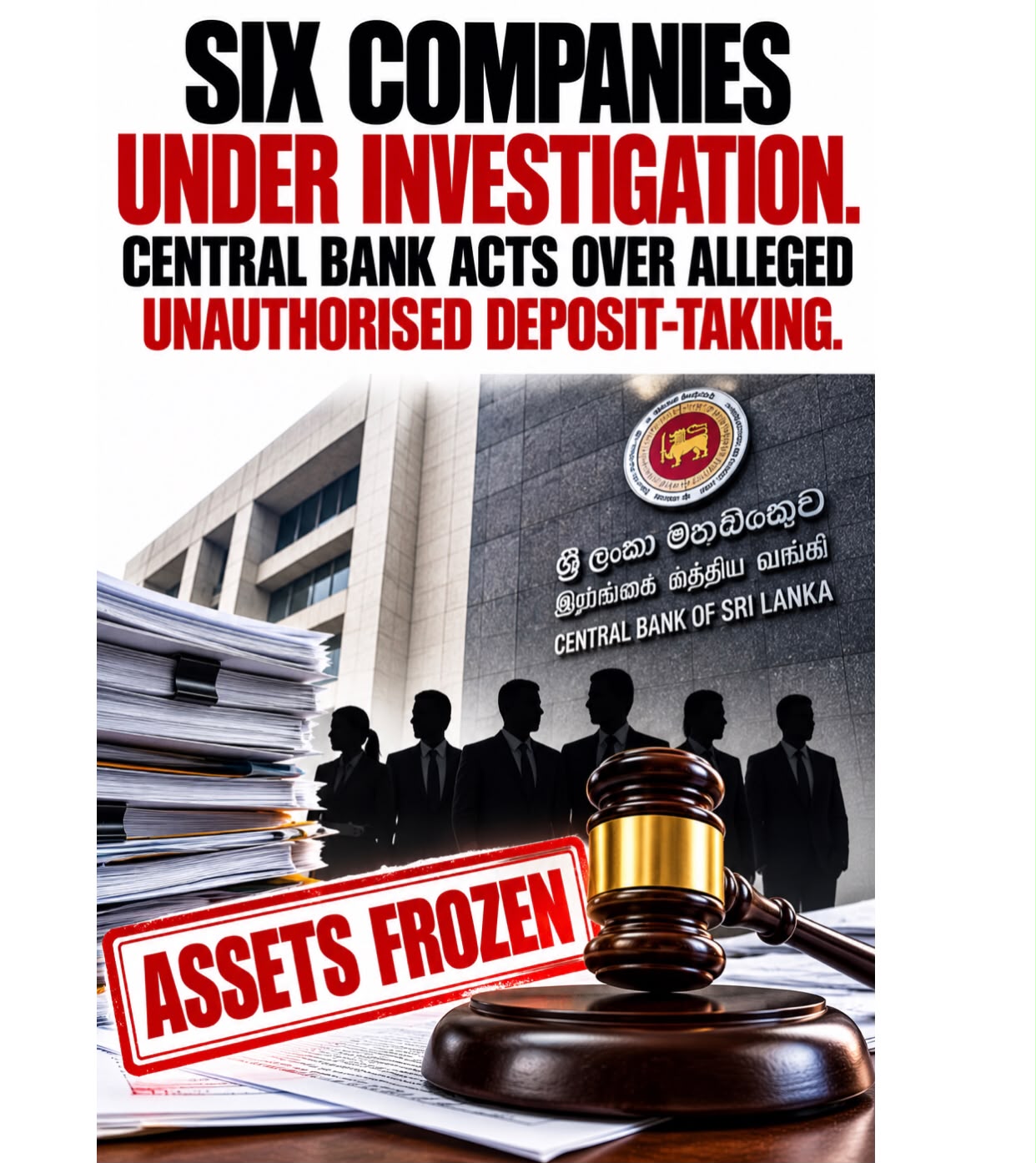
The Central Bank has frozen the assets of six companies and their directors while investigating alleged unauthorised finance business and deposit-taking. The Colombo High Court has confirmed and extended the orders. But one crucial number remains missing: how much money may have been taken from the public?
The Central Bank of Sri Lanka has deployed one of the stronger weapons available to a financial regulator: freezing assets before they can be disposed of, transferred or otherwise dealt with.
Six companies and their directors are presently subject to freezing orders issued under Section 44 of the Finance Business Act No. 42 of 2011. The Colombo High Court has subsequently confirmed and extended those orders.
Submit Your Press Release
Get your company news, announcements, launches, appointments and events in front of a wider audience.


The six are Kasagala Green Plantation (Private) Limited, Ceylon Green Life Plantation (Private) Limited, Singhe Capital Investment Limited, Pro Shop Advertising Holdings (Private) Limited, Athens International Education Centre (Private) Limited and Eyon Lanka Investment & Film Production International Company (Private) Limited. Some published versions of the names contain spelling variations; NEWSLINE has used the spellings reported in the more detailed coverage of the Central Bank action.
What makes the announcement particularly significant is that this is not merely a general warning about suspicious investment schemes.
According to the information released, the Central Bank has determined that four of the companies – Singhe Capital Investment, Pro Shop Advertising Holdings, Athens International Education Centre and Eyon Lanka Investment & Film Production International Company – had carried on finance business and/or accepted deposits in contravention of the Finance Business Act. Investigations concerning Kasagala Green Plantation and Ceylon Green Life Plantation remain ongoing.
That distinction is important. An investigation is not a finding of wrongdoing, and NEWSLINE makes no such assumption regarding the two companies still being investigated.
But there is an obvious public-interest question surrounding the four where the regulator says it has already made a determination.
How much money are we talking about?
The Central Bank’s announcement did not disclose the value of the frozen assets. More importantly for ordinary Sri Lankans, it did not disclose how much money may have been collected from members of the public.
Those numbers matter.
Sri Lanka has repeatedly experienced financial schemes that appear attractive because they promise returns substantially above those available from conventional deposits. The temptation becomes particularly powerful during periods when household incomes are under pressure and people are looking for ways to protect savings from inflation.
But the fundamental protection in accepting a lower return from a regulated bank or finance company is precisely that regulation.
Under Sri Lankan law, public deposits may generally be accepted only by institutions authorised under the Banking Act or Finance Business Act, or entities specifically exempted by law. The Central Bank has again urged the public to verify that an institution is authorised before handing over money.
There is another important sentence in the regulator’s statement.
The Central Bank says it is investigating several other companies and individuals following complaints concerning possible unauthorised finance business or deposit-taking.
That suggests the six companies disclosed this week may not represent the end of the matter.
And that raises a regulatory question as important as the legal one.
How quickly can the Central Bank identify an unauthorised deposit-taking operation?
A business soliciting investments today does not necessarily resemble the finance companies of twenty years ago. Money can be raised through social media, personal networks, property schemes, plantation investments, purported trading opportunities and arrangements deliberately described as something other than deposits.
The terminology can change. The economic substance may not.
The regulator therefore faces a difficult balancing exercise. It cannot simply freeze the property of a business because somebody complains about it. Companies and their directors have legal rights, and regulatory action must be based upon evidence and exercised within the law.
But waiting too long creates a different danger.
If an entity is unlawfully accepting deposits, every additional month potentially allows more members of the public to place their savings at risk. By the time an operation collapses, a freezing order may preserve only what remains rather than what was originally collected.
That is why the missing numbers are so important in this case.
How many people placed money with the companies concerned? What was the aggregate amount? What value of assets has now been frozen? When did the Central Bank first receive complaints? How long did each investigation take before the freezing orders were obtained?
And where a contravention has already been determined, what happens to the people whose money may be involved?
The Central Bank deserves credit when it acts to protect the financial system and the public. Freezing assets can prevent them disappearing while investigations and legal processes continue. But regulatory success cannot ultimately be measured by the number of freezing orders issued.
It must also be measured by how early the regulator detected the problem, how much public money was protected and whether affected depositors can eventually recover what belongs to them.
Six companies are now frozen.
The next figure Sri Lanka deserves to know is the value of the money at stake.