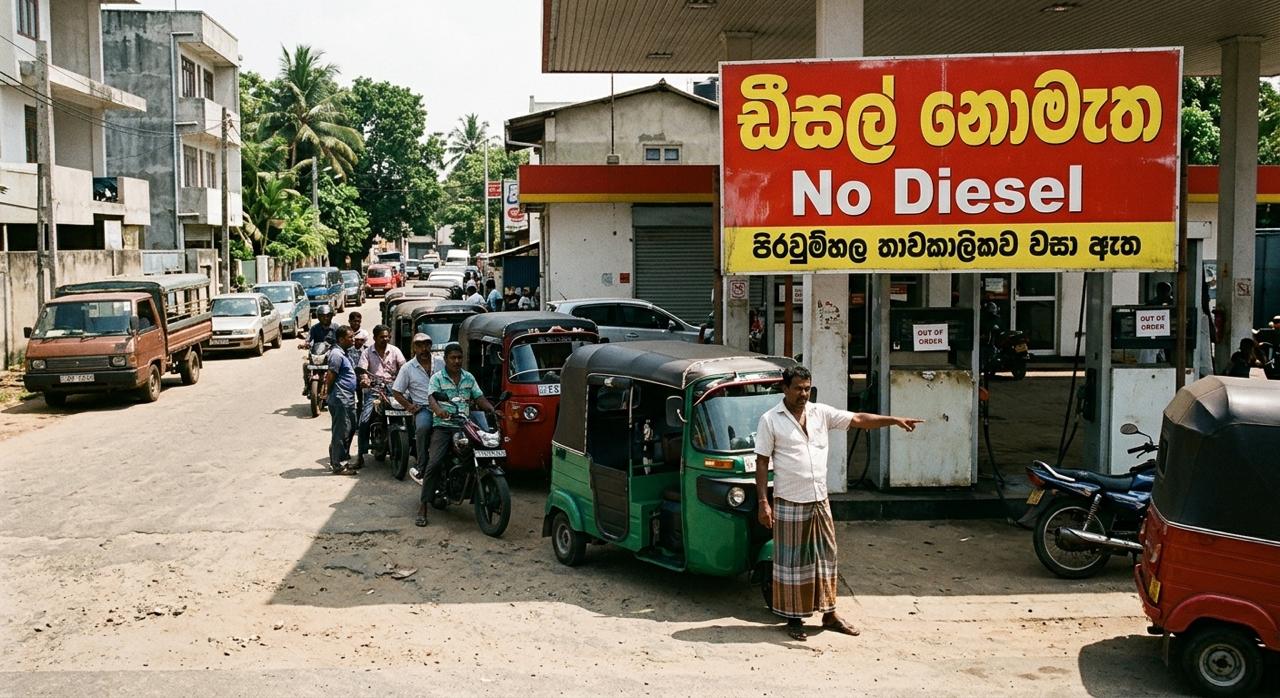
Eleven consecutive quarters of growth, US$6.9 billion in reserves and stronger public finances tell one story. Eight per cent inflation, external shocks and an unfinished IMF review tell another. Sri Lanka has stabilised. The harder question is whether stability can now survive without permanent crisis management.
There was plenty in the International Monetary Fund’s latest assessment for the Government to welcome. Sri Lanka’s economy expanded by 4.2 per cent in the second quarter of 2026, completing eleven consecutive quarters of growth. Gross official reserves reached US$6.9 billion at the end of August, the banking system remains well capitalised and profitable, and fiscal performance during the first half of the year was described as strong.
Those are substantial changes from the country that ran out of usable foreign exchange during the economic collapse.
Submit Your Press Release
Get your company news, announcements, launches, appointments and events in front of a wider audience.


But there is an important sentence buried beneath the encouraging numbers.
The Seventh Review has not yet been concluded.
The IMF team led by Mission Chief Evan Papageorgiou visited Sri Lanka from September 10 to 23 for discussions on both the Seventh Review of the Extended Fund Facility and the 2026 Article IV Consultation. At the end of that mission, the Fund said discussions would continue in the near term with the objective of reaching agreement on the parameters and policies required to complete the review.
That distinction matters. Productive discussions are not a staff-level agreement, and a staff-level agreement is itself not final Executive Board approval.
The IMF nevertheless paints a considerably stronger macroeconomic picture than Sri Lanka faced only a few years ago. Debt restructuring is described as largely completed. Reserves have increased. Economic activity continues to expand. The Fund also believes Sri Lanka remains on a trajectory that could permit a return to international capital markets around 2027.
But the warnings deserve at least as much attention as the compliments.
Headline inflation reached 8 per cent year-on-year in August, driven partly by the global oil-price shock. The Fund identified uncertainty surrounding the Middle East war, global trade policy and El Niño as downside risks. It called for continued revenue mobilisation, a broader tax base, rationalisation of exemptions and incentives, stronger tax administration, cost-recovery energy pricing and improved execution of public capital expenditure.
It also recommended retaining the 5 per cent inflation target and existing accountability band for now, arguing that Sri Lanka still needs flexibility because of volatile food and energy prices.
That brings the economic debate back to the distance between the national balance sheet and the household balance sheet.
GDP can grow by 4.2 per cent while a family still struggles with food, electricity, transport and taxation. Foreign reserves can rise while disposable income remains under pressure. A Government can satisfy demanding fiscal targets without every citizen experiencing the recovery at the same speed.
None of those propositions invalidates the recovery. They explain why macroeconomic recovery and social recovery must be measured separately.
There is another uncomfortable question approaching.
The IMF programme cannot remain Sri Lanka’s economic governing mechanism indefinitely. The present EFF runs towards 2027. If international capital-market access is restored, Sri Lanka will again encounter something it knows extremely well: the ability to borrow abroad.
That ability is not necessarily a prize.
Sri Lanka previously demonstrated how dangerous international borrowing becomes when debt is accumulated without sufficient productive capacity and foreign-exchange earnings to service it. Regaining access to global markets should therefore be regarded not simply as proof of rehabilitation but as a new test of fiscal discipline.
The country that emerges from an IMF programme must be capable of saying no to debt it does not need.
So the latest IMF statement deserves neither celebration nor dismissal. Sri Lanka has travelled a considerable distance from economic collapse. The numbers demonstrate that.
But the Seventh Review remains unfinished, inflation has returned as a concern, external risks are considerable and the Fund is still asking for structural reforms that successive governments have found politically difficult.
Stability has been achieved at considerable cost.
The question now is whether Sri Lanka can turn that stability into higher productivity, investment, exports and household prosperity – without eventually borrowing its way back into the problem from which it has only just escaped.