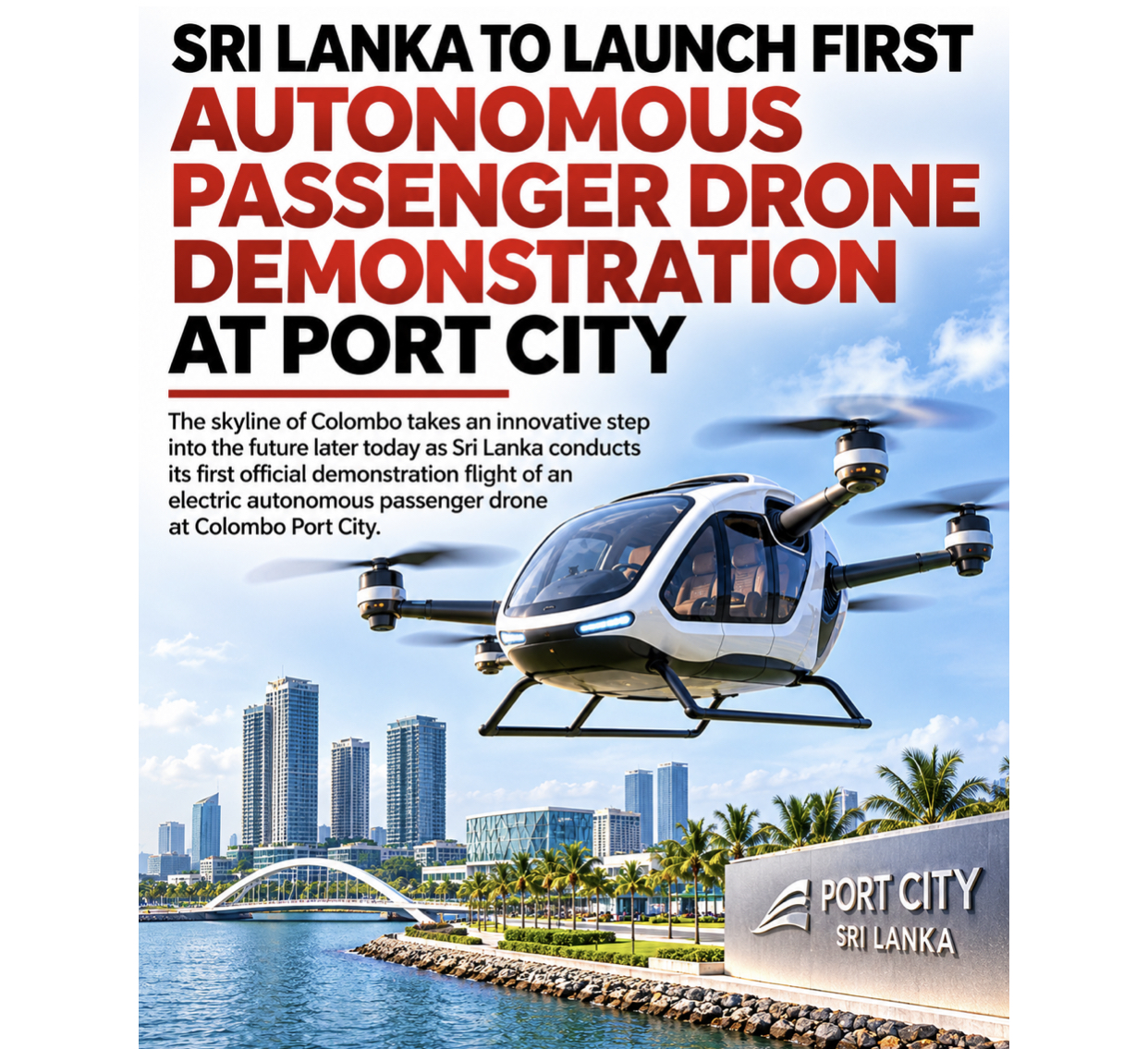
The skyline of Colombo takes an innovative step into the future later today as Sri Lanka conducts its first official demonstration flight of an electric autonomous passenger drone at Colombo Port City.
The flight, featuring the Chinese-manufactured EHangEH216-S autonomous aerial vehicle, marks the launch of a comprehensive six-month pilot project designed to evaluate zero-emission urban air mobility across the island. Operating without an onboard pilot, the two-seater aircraft relies on sixteen independent propellers, twelve high-capacity battery units, and centralized ground-control systems equipped with automated fail-safe protocols. Today’s flight showcases how electric vertical take-off and landing technology can transform Sri Lanka’s transport landscape, opening up skyways for high-end tourism, rapid urban commuting, and emergency medical logistics.
The initiative is a collaborative push between government regulatory bodies and international technology partners. Key institutions, including the Civil Aviation Authority of Sri Lanka, the Ministry of Defence, the Sri Lanka Air Force, the Telecommunications Regulatory Commission, and the Port City Economic Commission, have established strict safety protocols to support the trials. Officials view the technology as a potential game-changer for regional connectivity. Commercial routes linking Colombo directly to Bandaranaike International Airport, as well as iconic heritage sites like Sigiriya and coastal hubs in Jaffna, are already under preliminary feasibility review.
Submit Your Press Release
Get your company news, announcements, launches, appointments and events in front of a wider audience.


Beyond immediate visual spectacle, the adoption of autonomous electric aviation signals a broader modernization push for Sri Lanka’s travel sector. Operating on green electrical power, these flying taxis offer a quiet, zero-emission alternative to traditional combustion transport, aligning perfectly with global eco-tourism trends. If the initial six-month testing phase at Port City satisfies domestic safety audits and airspace management requirements, commercial passenger operations could take off within the next two to three years.
Putting a computer in the cockpit is a bold flex for a country where the coastal train lines still run on colonial-era delays. If this flying taxi can bypass Colombo’s bumper-to-bumper rush hour gridlock without getting stuck behind an erratic three-wheeler, it might just become the most popular commute on the island.