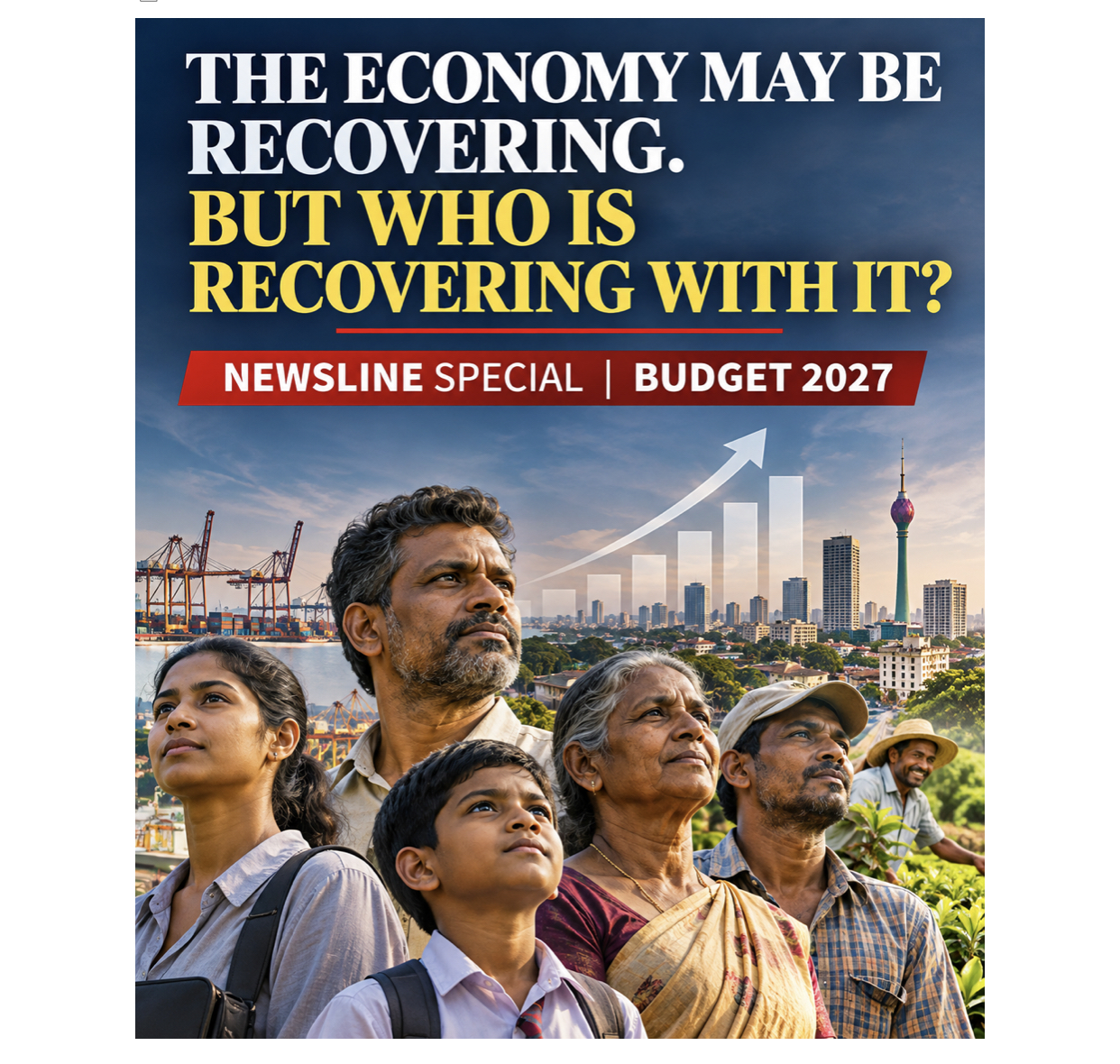
As Sri Lanka prepares for another national Budget, the real test is no longer whether the country can satisfy its creditors. It is whether economic recovery can restore the dignity, purchasing power and financial security of the people who have paid the highest price for it.
Sri Lanka approaches Budget 2027 with an uncomfortable question that cannot be answered by economic statistics alone. Has the country’s recovery reached ordinary people, or has it remained largely confined to government balance sheets, international financial institutions and the reassuring language of economic stability? It is a question that deserves an answer grounded in household experience rather than political rhetoric.
A country can improve its foreign reserves, strengthen revenue collection, reduce inflation and restore confidence among international lenders without necessarily improving the daily circumstances of its citizens. Economic indicators may signal that the worst of a national crisis has passed, but they cannot, by themselves, establish that the people who endured that crisis have recovered. The distinction is particularly important in Sri Lanka, where the economic collapse inflicted considerable damage on household savings, incomes and financial security.
Submit Your Press Release
Get your company news, announcements, launches, appointments and events in front of a wider audience.


For a family struggling to pay electricity bills, purchase medicine, finance a child’s education or put nutritious meals on the table, economic recovery is not an abstract achievement. It must be experienced through greater purchasing power, dependable employment, affordable essential services and some reasonable confidence in tomorrow. That is the challenge confronting President Anura Kumara Dissanayake and his administration as the country prepares for another annual Budget.
The Government inherited an economy battered by years of fiscal indiscipline, unsustainable borrowing, poor governance and ultimately sovereign default. Stabilisation was unavoidable, and difficult decisions had to be taken to restore fiscal credibility and international confidence. Any responsible assessment must acknowledge the importance of these measures, even where their consequences have been painful.
Yet stabilisation is not the destination. It is the foundation upon which a broader and more equitable recovery must be constructed. The purpose of restoring the national economy cannot simply be to produce healthier financial statements while leaving large sections of the population struggling to regain the living standards they once enjoyed.
Sri Lanka’s economic adjustment has depended heavily on taxation, expenditure restraint and policies designed to restore fiscal sustainability. These measures have helped support the stabilisation process, but their distributional consequences require far greater attention. The burden of adjustment has not necessarily fallen equally upon those with the greatest ability to bear it.
Indirect taxation illustrates the problem particularly clearly. A wealthy household and a family dependent upon a modest monthly salary may pay the same rate of tax on a taxable purchase, although the financial consequences are dramatically different. For one household, the additional expenditure may be barely noticeable, while for another it may mean sacrificing something essential.
Utility charges present a similar dilemma. Financially sustainable electricity and water services are necessary, and permanently subsidising inefficient operations cannot provide a credible long-term solution. Nevertheless, the consequences of tariff structures for lower-income households and small enterprises must be considered alongside the financial requirements of the institutions providing those services.
The answer is not to abandon fiscal discipline or return to indiscriminate subsidies that the country cannot afford. Such an approach would risk undermining the progress already achieved and eventually impose further costs upon the same population it was intended to assist. The more responsible alternative is to design taxation, tariffs and targeted assistance in ways that protect essential consumption while preserving the financial stability of the State.
One of the weaknesses of Sri Lanka’s economic debate is its overwhelming dependence upon national indicators. Growth, inflation, revenue, expenditure and debt are necessary measures of performance, but they reveal relatively little about the financial resilience of individual households. A more complete assessment would examine what remains of family income after essential monthly expenses have been met.
How much disposable income does a typical household retain after paying for food, housing, electricity, transport, education and healthcare? How has that amount changed since the economic crisis, and how does it compare with the period before the collapse? These are questions that can be investigated through existing household surveys, labour-market information and more regular publication of carefully designed affordability indicators.
The Department of Census and Statistics, the Central Bank and relevant social protection agencies already possess considerable statistical expertise. Rather than creating another expensive institution, the Government could establish a coordinated household economic security assessment using existing administrative and survey data. A regularly published measure of household affordability, disaggregated by income group and region, would give policymakers and the public a clearer understanding of whether recovery is being shared.
Such an exercise would also expose the difference between falling inflation and falling prices. When inflation declines, the general price level does not necessarily return to where it stood before the crisis. Prices may simply be increasing more slowly, leaving households to confront permanently higher living costs unless their incomes recover sufficiently.
This distinction is fundamental to understanding public dissatisfaction during periods of improving economic performance. A government may accurately report that inflation has been brought under control while a household may equally accurately report that it remains unable to afford what it purchased several years earlier. Both statements can be true, and responsible economic management must recognise the difference.
Budget 2027 therefore presents an opportunity to shift the national conversation from recovery as a statistical achievement to recovery as a measurable improvement in people’s lives. That does not require abandoning commitments to creditors or disregarding the country’s fiscal limitations. It requires greater discipline in deciding how available public resources are allocated and how effectively they are used.
Healthcare offers one immediate opportunity. Investment in functioning diagnostic equipment, reliable medicine supplies and effective hospital management can improve access to treatment without necessarily requiring the construction of expensive new facilities. Better procurement, preventive maintenance and transparent monitoring of essential medical services could produce substantial public benefits from resources already committed to the health sector.
Education and public transport offer similar possibilities. A more reliable transport system can reduce the financial and time costs imposed upon working families, while improvements in educational access and quality can strengthen long-term earning potential. These are not merely social expenditures but investments in productivity, employment and economic participation.
The Government should also place greater emphasis on small and medium enterprises, which provide livelihoods across the country and have considerable potential to generate employment outside the major urban centres. Access to finance, predictable regulation, timely government payments and reduced administrative obstacles may be more valuable to many businesses than expensive incentive schemes. A practical Budget should identify specific barriers to enterprise and establish measurable commitments to removing them.
Agriculture requires particular attention because rural household security depends not only upon production but also upon storage, transport, market access and the prices farmers ultimately receive. Public investment in irrigation maintenance, agricultural logistics and transparent market information could improve productivity and reduce losses without perpetuating dependence upon poorly targeted subsidies. These are areas in which relatively modest improvements in implementation can have meaningful consequences for household incomes.
There is also an urgent need to examine the efficiency of public expenditure. Every rupee lost through waste, unnecessary procurement costs, administrative duplication or poorly executed projects represents money unavailable for essential public services. Stronger expenditure monitoring, competitive procurement and the publication of measurable project outcomes should therefore be regarded as central elements of economic reform rather than optional exercises in good governance.
The administration has an opportunity to demonstrate that fiscal responsibility and social fairness are complementary rather than competing objectives. Protecting vulnerable households need not mean abandoning financial discipline, just as maintaining financial discipline should not become an excuse for overlooking the consequences of policy decisions. The challenge is to identify interventions that are affordable, properly targeted and capable of producing verifiable improvements.
The Opposition has responsibilities of its own. Criticising the burden of taxation or the inadequacy of public services is legitimate, but credible alternatives must explain how proposed relief would be financed and what expenditure would be reduced or revenue replaced. Sri Lanka has already experienced the consequences of economic promises made without sufficient regard for their long-term affordability.
Political competition should therefore centre upon the quality of proposed solutions rather than the volume of accusations exchanged. The Government deserves recognition where policies produce demonstrable progress and criticism where they fail to deliver. Equally, opposition proposals should be assessed on their economic merits rather than accepted or rejected according to political allegiance.
The country would benefit from a Budget process that makes these comparisons easier. Alongside the conventional presentation of revenue and expenditure, the Ministry of Finance could publish a concise assessment of how major proposals are expected to affect households at different income levels. Such an exercise would strengthen transparency and encourage a more informed national discussion about the choices facing the country.
A further improvement would be the publication of clear performance targets for major public expenditure programmes. Citizens should be able to establish whether additional healthcare spending has reduced waiting times, whether transport investment has improved reliability and whether support for enterprise has generated sustainable employment. Announcing an allocation is not the same as delivering a result, and the distinction should become a central measure of government performance.
Sri Lanka cannot afford another period in which economic progress is judged primarily by the confidence of financial markets while public frustration continues to accumulate. Investor confidence and international credibility are important because they support growth, investment and employment. Their ultimate value, however, must be assessed through the opportunities and improvements they help create for the population.
The coming Budget will not resolve every structural weakness in the economy, nor should citizens be encouraged to expect an immediate return to the conditions that prevailed before the crisis. Sustainable recovery takes time, particularly in a country confronting substantial debt obligations and competing demands upon limited public resources. What people can reasonably expect is a credible direction, transparent priorities and measurable evidence that their sacrifices are producing benefits.
For the administration, this is an opportunity to move beyond demonstrating that the economy has been stabilised and towards establishing that recovery can be shared. For the Opposition, it is an opportunity to contribute realistic alternatives rather than rely upon public dissatisfaction alone. For the country, it is a chance to place household security at the centre of economic policy without repeating the mistakes that contributed to the collapse.
Be that as it may, the ultimate measure of economic recovery is not how confidently a government can announce that the country is doing better. It is how convincingly an ordinary family can say the same thing.
That is the test Budget 2027 must meet.