
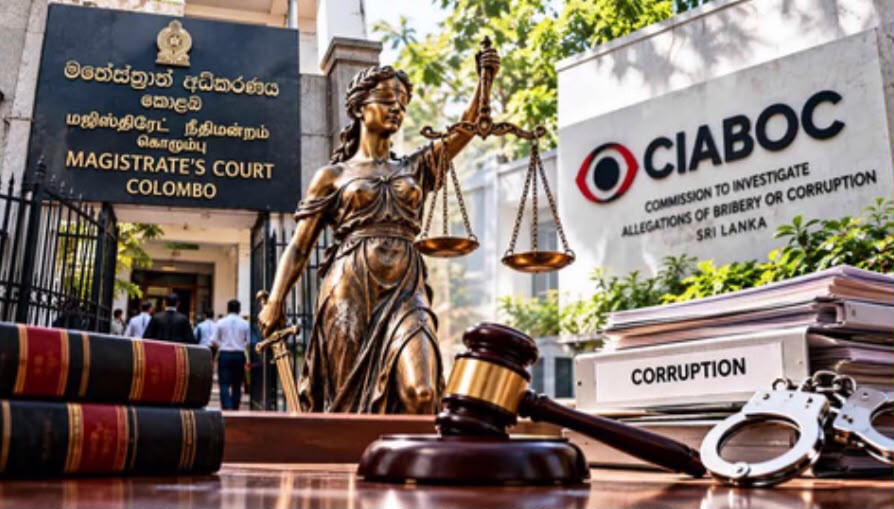
The government’s proposal to establish Bribery Commission offices in all nine provinces promises to bring anti-corruption investigations closer to the public. But expanding investigative powers and administrative reach without equally strong safeguards raises a fundamental question. Who ensures that the Commission itself remains independent, accountable and free from political interference, particularly when the governing party commands a two-thirds parliamentary majority?
Sri Lanka’s determination to confront corruption has become one of the defining political commitments of the National People’s Power administration. President Anura Kumara Dissanayake’s government was elected on promises to dismantle the networks of political patronage, financial irregularity and institutional protection that have undermined public confidence in successive administrations. The proposed expansion of the Commission to Investigate Allegations of Bribery or Corruption into all nine provinces appears consistent with that objective, potentially making investigations more accessible to citizens who have traditionally been required to deal with institutions concentrated in Colombo.
But institutional expansion is not necessarily institutional reform. A larger investigative organisation may be more effective at detecting wrongdoing, but it may also become more vulnerable to misuse if its independence, accountability and internal safeguards are inadequate. The question is therefore not simply whether the Bribery Commission should operate throughout the country, but whether its growing authority will be accompanied by mechanisms capable of preventing political interference, selective investigations and misconduct within the Commission itself.
Submit Your Press Release
Get your company news, announcements, launches, appointments and events in front of a wider audience.


The Anti-Corruption Act No. 9 of 2023 established a substantially revised legal framework for the Commission, strengthening its investigative responsibilities and providing for greater institutional independence. The legislation also introduced important provisions relating to asset declarations, corruption prevention and the investigation of offences involving public officials. These reforms were intended to address longstanding weaknesses in Sri Lanka’s anti-corruption architecture.
Yet legislation is only as effective as the institutions responsible for implementing it. The existence of statutory independence does not automatically guarantee operational independence, particularly in a political environment where appointments, budgets and administrative decisions may be influenced by those exercising executive and parliamentary authority.
The Commission’s members are appointed through a constitutional process involving the Constitutional Council. That arrangement is intended to provide a measure of protection against direct political control. Nevertheless, the effectiveness of such safeguards depends upon the independence of those participating in the appointment process, the transparency of selection criteria and the willingness of Parliament to exercise genuine oversight.
Sri Lanka’s present parliamentary arithmetic makes these questions especially important. With 159 members, the governing NPP possesses sufficient strength to dominate ordinary parliamentary proceedings and secure constitutional amendments requiring a two-thirds majority. That electoral mandate is legitimate, but it also places an exceptional responsibility upon the government to demonstrate that institutions exercising coercive State powers remain independent of party interests.
The proposed provincial expansion creates several practical questions requiring public answers. How will provincial directors and senior investigators be appointed? What qualifications and experience will be required? Will appointments be made through independently supervised recruitment procedures, or will senior officials retain broad discretion over provincial postings and promotions?
Equally important is the question of investigative autonomy. Can a provincial office initiate an investigation involving a politically influential individual without obtaining approval from officials vulnerable to political pressure? What happens when allegations concern a serving minister, a senior government official or a person closely associated with the governing party?
The Commission must be capable of investigating members of the present administration with precisely the same determination it applies to former ministers and opposition politicians. Anything less would transform anti-corruption enforcement from an instrument of public accountability into a mechanism of political advantage.
There is also the problem of selective enforcement. Corruption investigations frequently involve complex financial transactions, extensive documentation and considerable delays. Investigators must exercise judgment when determining which allegations warrant immediate attention and how limited resources should be allocated.
Those decisions can have profound political consequences. An investigation announced against a prominent opposition politician may generate extensive publicity long before a court determines whether any offence has been committed. Conversely, allegations involving politically connected individuals may attract considerably less attention if investigators fail to pursue them with equal urgency.
The public therefore needs greater transparency concerning the Commission’s investigative performance. Annual reports should provide meaningful information about complaints received, investigations commenced, cases referred for prosecution, proceedings concluded and outcomes achieved. Wherever legally possible, the information should distinguish between different categories of public office and identify delays without compromising ongoing investigations or the rights of suspects.
A further question concerns the accountability of investigators themselves. What independent mechanism exists for a citizen to complain that a Bribery Commission officer has demanded an improper payment, abused investigative authority, disclosed confidential information or deliberately obstructed an investigation?
Internal disciplinary procedures are necessary, but they cannot provide the only answer. An institution investigating allegations of corruption must also be subject to credible external scrutiny when its own officers are accused of misconduct.
This does not mean creating another politically controlled organisation with authority to interfere in legitimate investigations. It means establishing clear, independent and legally enforceable procedures through which allegations against investigators can be examined without undermining the Commission’s operational independence.
The distinction between accountability and interference is critical. Ministers and parliamentarians should not be permitted to direct investigations, demand confidential information or influence prosecutorial decisions. But Parliament must retain the authority to examine the Commission’s expenditure, administrative performance and compliance with its statutory obligations.
The Commission’s financial independence also deserves scrutiny. An investigative institution dependent upon annual budgetary decisions can become vulnerable if its funding is reduced, delayed or subjected to conditions that compromise its ability to function. A credible anti-corruption framework requires adequate resources allocated through transparent procedures, with expenditure subject to proper audit. The proposed provincial offices could make a significant difference to citizens living outside the Western Province. Complaints involving local authorities, provincial institutions, land administration, public procurement and the delivery of government services frequently arise far from Colombo. Easier access to investigators may encourage reporting and reduce the practical difficulties associated with pursuing allegations.
But accessibility must be accompanied by protection for complainants and witnesses. Citizens who report corruption involving influential local officials may face intimidation, employment consequences or other forms of retaliation. Effective whistleblower protection is therefore indispensable if the provincial expansion is to produce genuine accountability rather than simply increase the number of offices displaying the Commission’s name.
There is also a danger that the public will begin to measure anti-corruption success by the number of arrests, investigations and court appearances rather than the quality of evidence and the outcomes of prosecutions. Arresting a prominent individual may generate considerable political attention, but an investigation that cannot withstand judicial scrutiny contributes little to lasting accountability.
The Commission must be judged by the professionalism of its investigations, the fairness of its procedures and its ability to establish wrongdoing through admissible evidence. Its credibility cannot depend upon whether the individuals under investigation are popular or unpopular, politically powerful or politically marginalised.
Sri Lanka’s history provides ample reason for caution. Successive governments have promised to eliminate corruption, and several have initiated investigations against individuals associated with their predecessors. Yet the persistence of allegations across administrations suggests that the underlying institutional weaknesses have not been adequately addressed.
The present government has an opportunity to break that pattern. It can demonstrate that anti-corruption institutions are intended to protect the Republic rather than serve the political interests of whichever administration happens to control Parliament.
That requires a willingness to accept scrutiny of the government’s own conduct. It also requires recognition that an independent investigative institution may sometimes reach conclusions inconvenient to those who appointed its leadership or approved its funding.
Be that as it may, the establishment of nine provincial offices will mean little if the public cannot be confident that investigations are conducted without fear, favour or political calculation. Expanding the Commission’s geographical reach is comparatively straightforward. Establishing safeguards that make its independence credible, enforceable and durable is considerably more demanding.
President Dissanayake’s administration should therefore explain what additional protections will accompany the proposed expansion. The public deserves to know how investigators will be selected, how misconduct allegations will be handled, how whistleblowers will be protected and how Parliament will scrutinise institutional performance without interfering in individual cases.
The ultimate test is not whether the Bribery Commission can investigate those who have lost political power. It is whether the same institution can investigate those who currently possess it.
Sri Lanka does not need an anti-corruption organisation that changes its enthusiasm whenever the government changes.
It needs one whose independence is sufficiently secure that even the most powerful politician cannot determine whom it investigates, what evidence it follows or which conclusions it reaches.



