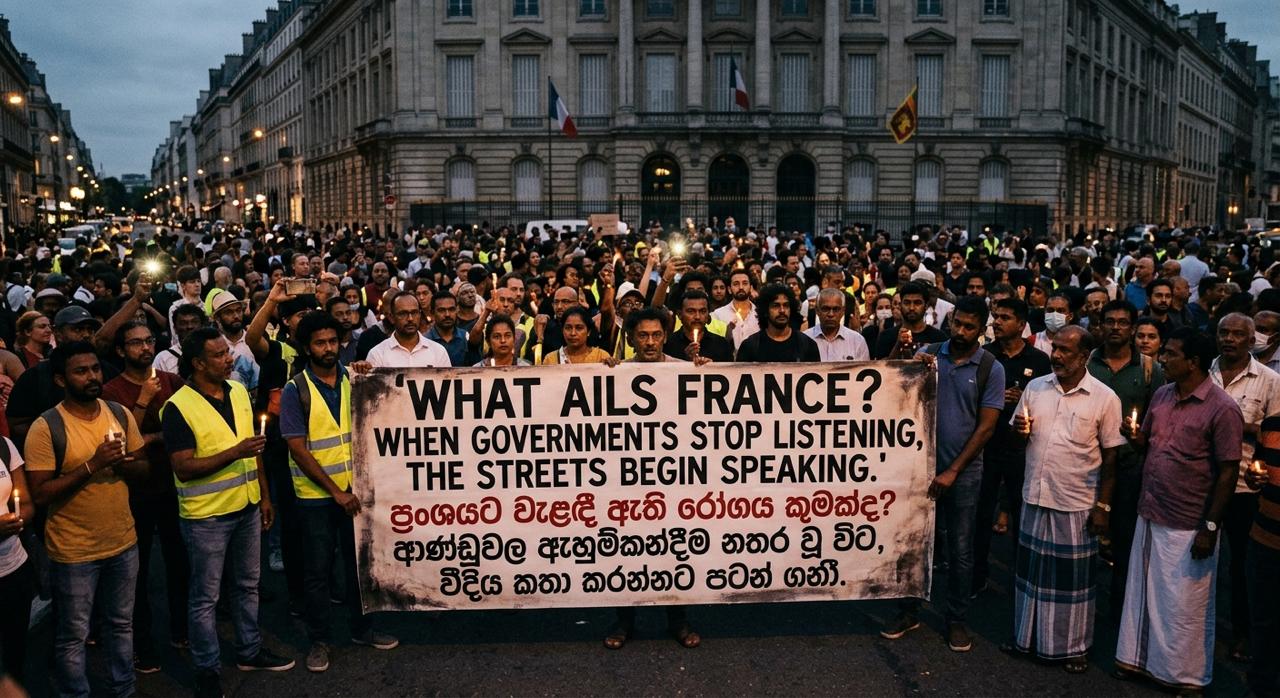
France’s latest upheaval is about considerably more than inflation, policing or President Emmanuel Macron. It concerns the widening distance between those who govern and those who must live with the consequences. Sri Lanka should recognise the warning, particularly when demonstrations in Colombo are so readily interpreted through the narrow prism of party politics.
There is something profoundly unsettling about watching a wealthy European democracy struggle to contain the anger of its own citizens. France, the country that gave the modern world one of its most enduring declarations of liberty, equality and fraternity, is once again discovering that political ideals are considerably easier to proclaim than to deliver. Its streets are filled with people who believe the institutions established to protect their interests are increasingly incapable of doing so.
The immediate grievances are familiar. The cost of living is rising, wages are struggling to keep pace, public services are under pressure and young people increasingly question whether the opportunities enjoyed by previous generations will remain available to them. France has extensive social protections by international standards, but their existence does not eliminate public dissatisfaction when citizens believe those protections are being steadily eroded.
Submit Your Press Release
Get your company news, announcements, launches, appointments and events in front of a wider audience.


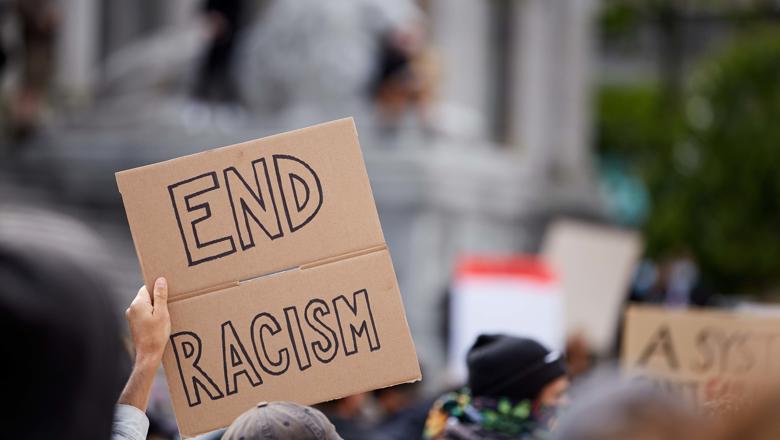
There is also a deeper question concerning political representation. Citizens vote, governments change and political leaders announce reforms, yet many of the underlying economic pressures remain. When parliamentary democracy appears unable to translate public dissatisfaction into meaningful policy change, people increasingly turn to demonstrations as an alternative means of making themselves heard.
That does not justify violence. Burning down a town hall will not improve a school, and looting a supermarket will not increase anyone’s pension. The destruction witnessed in France deserves unequivocal condemnation, particularly because it risks discrediting the legitimate grievances of hundreds of thousands who demonstrated peacefully.
But condemning violence is not the same as understanding its origins. Governments that concentrate exclusively on the criminality of a minority while ignoring the grievances of the majority risk repeating precisely the political failures that produced the demonstrations. Public order is indispensable, but public confidence cannot be restored by policing alone.
Sri Lanka has considerable reason to examine these developments carefully. Our own experience in 2022 demonstrated how quickly economic hardship, institutional distrust and public frustration can combine into a movement capable of overturning an apparently secure political establishment. The Aragalaya was not merely a protest against shortages of fuel, food and medicine. It was an indictment of a political system whose failures had accumulated over many years.
More recently, Colombo has witnessed demonstrations described in some quarters as anti-government protests. Such descriptions may be politically convenient, but they do not necessarily explain who participated, what grievances motivated them or whether those grievances were legitimate. A protest organised by political opponents does not automatically become invalid, just as a demonstration supported by government sympathisers does not automatically acquire moral superiority.
The recent mobilisation against proposed anti-terrorism legislation illustrates the difficulty. Citizens concerned about detention powers, civil liberties and the future of the Prevention of Terrorism Act are entitled to demand answers irrespective of their political affiliations. A government that once criticised excessive State authority cannot reasonably dismiss those concerns merely because it now exercises that authority.
This is where France and Sri Lanka encounter a common democratic test. The legitimacy of a government is established through elections, but its democratic character is demonstrated through its conduct between elections. A parliamentary majority provides the authority to govern; it does not establish a monopoly over wisdom, patriotism or public opinion.
President Anura Kumara Dissanayake’s administration enjoys a substantial parliamentary mandate. That mandate carries a corresponding responsibility to listen to citizens who disagree with its policies, including those whose political sympathies lie elsewhere. The Opposition, meanwhile, must demonstrate that its objections are grounded in genuine public concerns rather than the familiar ambition of returning to office.
France also reminds us that economic indicators do not necessarily reflect the daily experiences of ordinary people. Governments may celebrate growth, revenue collection and improving financial stability while households struggle with food prices, transport costs, education and healthcare. A nation can appear healthier in its official statistics while considerable numbers of its citizens feel poorer and less secure.
The danger begins when governments mistake statistical improvement for public satisfaction. Economic recovery is essential, but it must ultimately be judged by whether people can live with dignity, educate their children and obtain essential services without surrendering an unreasonable proportion of their incomes.
Be that as it may, the greatest lesson from France is not that governments should fear demonstrations. It is that governments should fear becoming so detached from their citizens that demonstrations appear to be the only remaining means of communication.
Sri Lanka has already experienced the consequences of such detachment. It would be a remarkable failure of political memory if those who benefited from the public demand for change were eventually to regard public dissent as an inconvenience.
Democracy does not become stronger when citizens remain silent. It becomes stronger when governments are sufficiently confident, accountable and responsive to allow citizens to speak, particularly when what they have to say is uncomfortable.