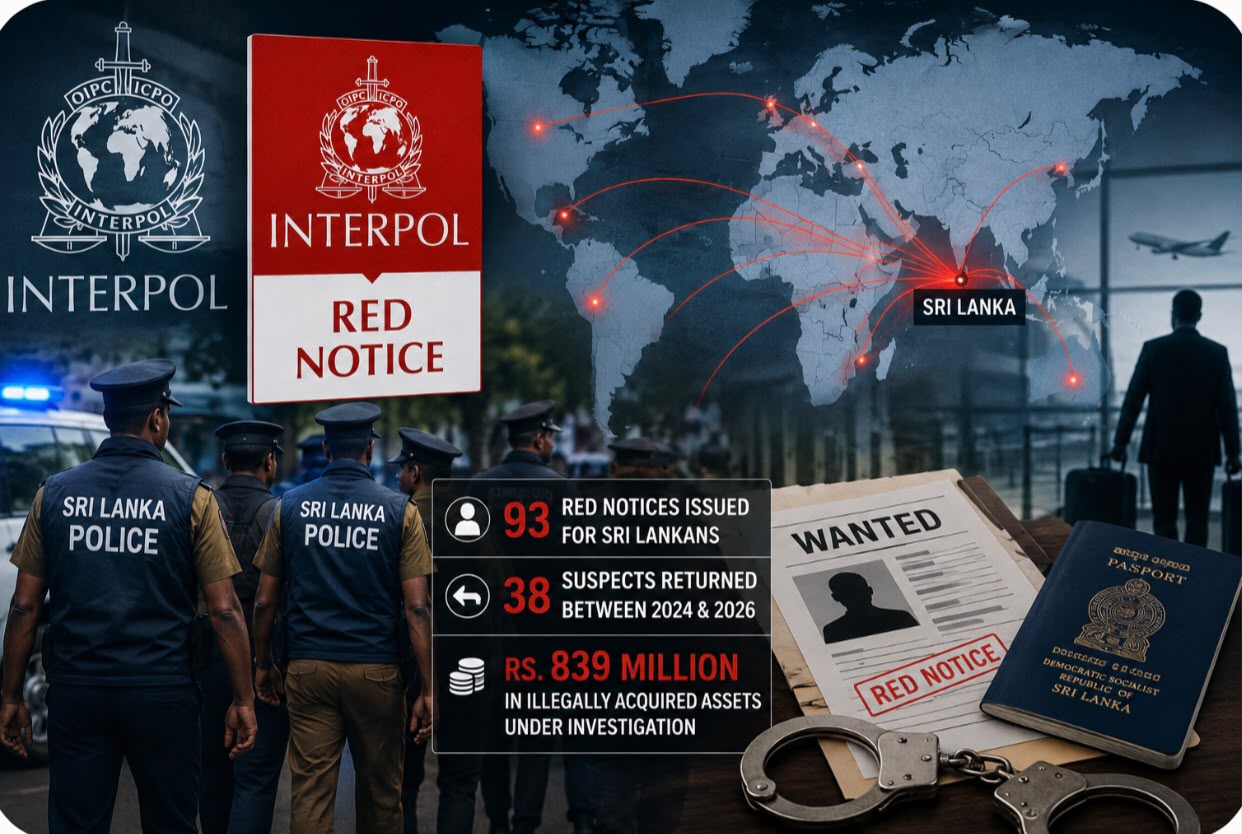
Police widen overseas hunt for wanted suspects as 38 are brought back and authorities pursue Rs.839 million in allegedly illicit assets
COLOMBO, Thursday – Sri Lankan Police have obtained Interpol Red Notices for 93 suspects believed to be hiding overseas, significantly widening an international effort to bring back individuals wanted in connection with serious crimes committed in the country.
Police Spokesman ASP F.U. Wootler disclosed the figures Thursday while outlining progress under the authorities’ continuing operations against organised crime and other serious criminal activity.
Submit Your Press Release
Get your company news, announcements, launches, appointments and events in front of a wider audience.


According to Police, 38 wanted suspects have already been brought back to Sri Lanka through Interpol-related processes between 2024 and 2026, demonstrating an increasing reliance on international law-enforcement cooperation to pursue suspects who have left the country.
A Red Notice alerts law-enforcement agencies internationally that an individual is wanted by the requesting country and seeks that person’s location and provisional arrest pending extradition, surrender or other legal proceedings. It is not, by itself, an international arrest warrant, and any arrest remains governed by the law of the country in which the suspect is located.
The disclosure comes amid increasing attempts by Sri Lankan authorities to pursue alleged organised-crime figures operating or taking refuge overseas.
Recent operations involving Malaysia and other jurisdictions have highlighted both the opportunities and difficulties involved in such investigations, since Sri Lankan officers operating abroad must depend upon cooperation from local authorities and comply with the legal procedures of the countries concerned.
Police also revealed another significant element of the campaign: following the money.
Since January, legal proceedings have been initiated seeking to bring into State custody assets valued at approximately Rs.839 million which authorities allege were acquired through illegal activity.
That could prove at least as important as the arrests themselves.
Organised criminal networks depend not merely upon individuals but upon money, property, vehicles, businesses and financial structures capable of sustaining their operations. Removing suspects without dismantling those financial networks risks leaving the machinery behind for others to inherit.
The disclosure that 93 Sri Lankans are presently being pursued internationally also demonstrates the extent to which serious crime has ceased to be an exclusively domestic policing problem.
Sri Lanka’s challenge will therefore be measured not by the number of Red Notices issued, but ultimately by how many wanted suspects are lawfully returned, prosecuted – and, where the evidence permits, convicted.
Be that as it may, for 93 wanted Sri Lankans believed to be beyond the country’s shores, the net has just become considerably wider.