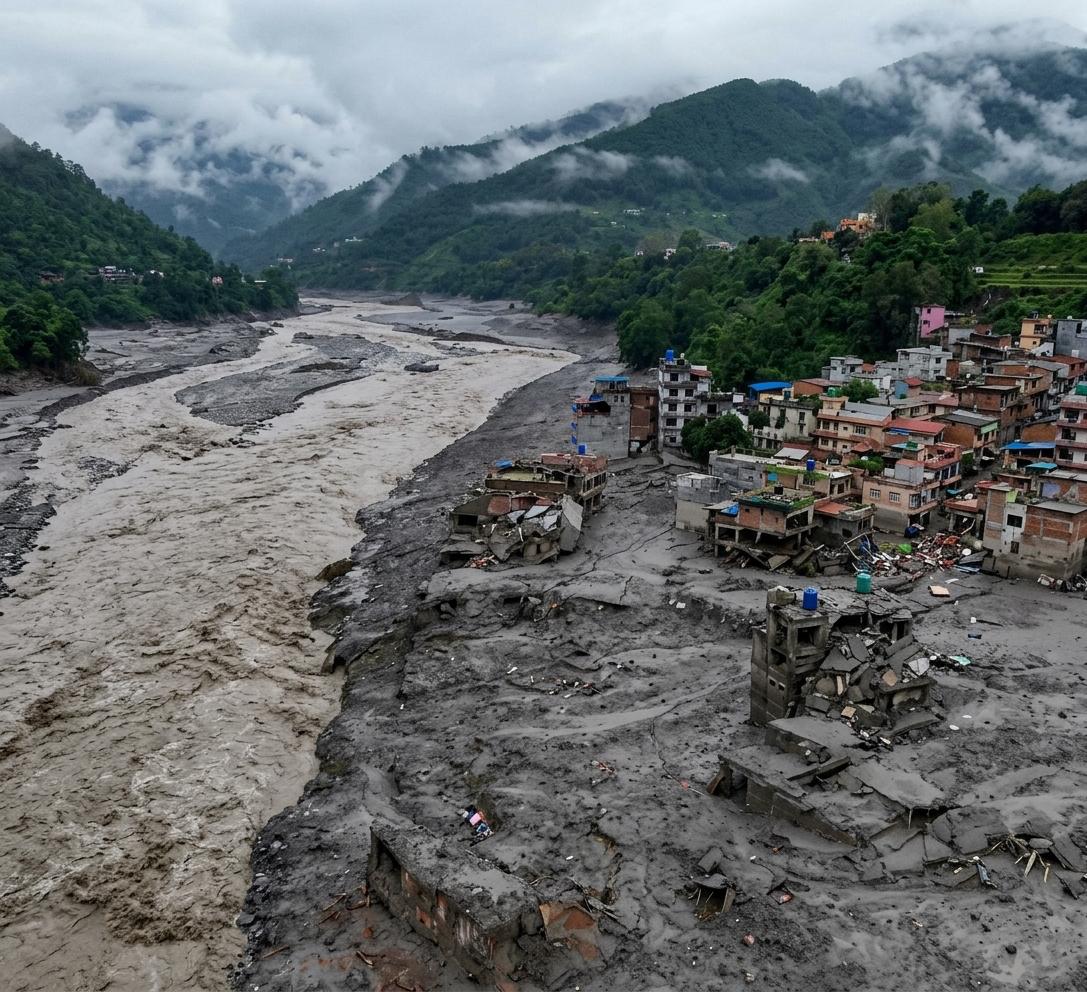
A high-altitude rock and ice avalanche shears off a remote Himalayan peak, crashes thousands of feet into a river valley, and unleashes a wall of water and debris capable of sweeping away everything from international border crossings to local bridges. It sounds like the plot of an apocalyptic disaster flick, except the script was written by climate reality and played out across Nepal’s river basins with terrifying regularity.
The catastrophic torrents that tore through the Trishuli and Bhote Koshi river systems, followed by subsequent landslide-dam breaches along the Budhi Gandaki, have left behind a sobering trail of devastation. Thousands of lives lost or displaced, entire settlements reduced to rubble, and critical infrastructure swallowed by river silt.
The numbers are staggeringly grim, but behind the statistics lies a far more uncomfortable question: why does the international community continue to treat the predictable wrath of Himalayan glacial melts as an unforeseen act of God?
Submit Your Press Release
Get your company news, announcements, launches, appointments and events in front of a wider audience.


Nepal contributes a microscopic fraction to global greenhouse emissions, yet it consistently finds itself in the crosshairs of extreme climate events.As global temperatures creep upward, frozen mountain masses once thought to be permanent are behaving like ticking time bombs.
When a massive chunk of glacier ice collapses, it creates temporary barrier lakes that burst without warning, turning tranquil mountain streams into raging rivers of mud, boulders, and sheer destruction in a matter of minutes. This isn’t merely bad weather.
It is a dynamic change in regional topography driven by warming trends that no local municipal authority can stem with a few hastily deployed sandbags.To their credit, warning systems did fire off during the crisis, hitting thousands of cellphones with automated flood alerts within a single minute in a feat of modern disaster management.
But an SMS alert, no matter how prompt, cannot relocate an entire riverbank village when thousands of tons of debris are rushing down a vertical gradient at highway speeds.
The aftermath presents a painfully familiar routine: diplomatic calls from foreign ministries issuing formal statements appealing for climate resilience funds, multilateral agencies drafting multi-billion-dollar reconstruction blueprints, and the global news cycle moving on long before the mud actually dries.
Nepal’s leadership has been quick to remind the global stage that the nation is bearing a disproportionate share of climate consequences.It is a fair point, but it also raises a sharper critique closer to home.
International climate aid often arrives as a reactive bandage rather than a proactive defense.Infrastructure in fragile mountain terrains continues to be built with short-term economic gains in mind rather than long-term climate resilience.
Roads, bridges, and telecom towers are routinely reconstructed in the exact pathways of historical flood channels, setting up a costly, institutionalized cycle of building, watching things wash away, and repeating the process all over again.
The mountain waters will eventually recede, and the debris will be cleared.
But calling these Himalayan outbursts unprecedented is rapidly becoming a convenient excuse for global inaction.
The immediate responsibility is to rebuild infrastructure that actually accounts for a volatile geography, secure sustainable climate compensation, and treat high-altitude environmental monitoring not as an academic luxury, but as vital civil security.The mountains have given their warning loud and clear. The real disaster would be failing to read the writing on the valley walls.