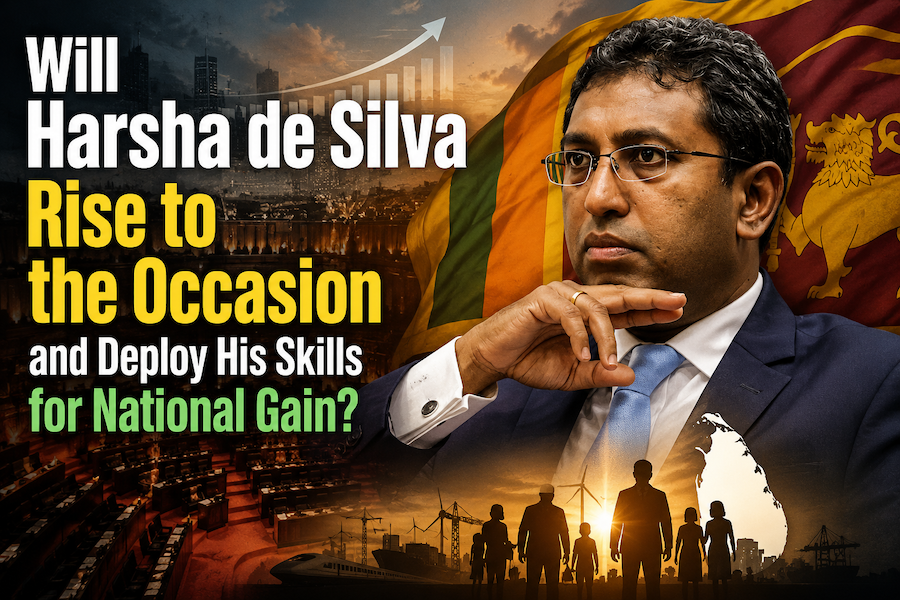
Few Sri Lankan politicians today occupy quite the position that Dr. Harsha de Silva does. To some, he represents one of the country’s more articulate economic minds – internationally connected, market- aware, data-driven and capable of translating highly complex fiscal and financial matters into language ordinary citizens can actually understand. At a time when economic jargon often alienates the very public affected by policy, that skill alone carries considerable value.
To others however, Harsha de Silva remains a figure who has often stood sufficiently close to power to influence national outcomes, yet sufficiently distant from executive authority to avoid carrying full responsibility for the failures, contradictions and economic miscalculations of successive administrations. That duality has followed him throughout much of his political career.
Be that as it may, Sri Lanka’s present economic and institutional predicament may increasingly require precisely the type of hybrid figure Harsha de Silva claims to be: economist, reform advocate, parliamentary watchdog and international interlocutor rolled into one.
Submit Your Press Release
Get your company news, announcements, launches, appointments and events in front of a wider audience.


The real question now may not be whether he possesses technical competence. The question may instead be whether he is prepared – and politically able – to deploy that competence fully in the national interest.
At a moment when the country remains under extraordinary economic pressure, Sri Lanka appears trapped within a dangerous vacuum between technocratic understanding and political execution. There are many politicians in Sri Lanka. There are far fewer policymakers.
And fewer still capable of simultaneously commanding credibility among international lenders, development institutions, investors, corporate leaders and ordinary citizens struggling beneath taxation and cost-of-living pressures.
That may be why Harsha de Silva’s present role has become increasingly difficult to ignore, particularly within parliamentary oversight structures such as COPF where questions surrounding governance banking supervision, public finance leakages, procurement systems and institutional accountability are now intersecting directly with wider concerns over national economic stability itself.
Recent hearings alone have exposed uncomfortable realities regarding the condition of Sri Lanka’s institutional oversight architecture. Questions have emerged regarding banking supervision, public finance controls, procurement systems, regulatory independence and whether institutions themselves possess either the technical capacity or institutional assertiveness necessary to identify risks before they evolve into full-scale national crises.
Within several of those hearings, Harsha de Silva has at times appeared visibly frustrated by explanations presented before Parliament. The public notices such moments carefully. Markets notice them too. Investors today are not merely studying IMF benchmarks, reserve levels or sovereign restructuring ratios anymore. Increasingly they are studying whether Sri Lanka’s institutions themselves function credibly beneath the surface.
Can Parliament genuinely interrogate power? Can regulators act independently? Can institutions identify systemic failures before they metastasize? Can political leaders confront uncomfortable truths without partisan calculation interfering? These questions matter enormously because confidence ultimately depends not merely upon macroeconomic numbers, but upon whether systems themselves are perceived as trustworthy and competent.
And Harsha de Silva now appears to stand directly at the intersection of those questions.
Yet there remains an equally important cautionary reality. Sri Lanka has historically produced many eloquent reformers. Far fewer reform executors. The island’s political graveyard is littered with excellent speeches, donor presentations, policy frameworks and televised declarations that ultimately collapsed against the harder realities of political compromise, patronage networks, institutional inertia and electoral calculation.
That may now become the real test confronting Harsha de Silva. Can he move beyond commentary into consequential influence? Can parliamentary exposure actually translate into institutional reform? Can he contribute toward building a rules-based economic environment where governance standards apply consistently regardless of political affiliation, corporate influence or institutional status?
And perhaps most critically of all, can he maintain credibility simultaneously with international actors and with an exhausted domestic population that has grown increasingly skeptical of elite economic management altogether?
Because Sri Lanka’s public mood has changed profoundly since 2022. Citizens no longer automatically trust individuals merely because they speak the language of economics fluently. People now demand outcomes. They demand affordability, stability, predictability, jobs, institutional fairness and visible evidence that sacrifice is producing national recovery rather than merely sustaining political systems.
The reserve of public patience appears to be running dangerously low.
Be that as it may, there remains little doubt that Sri Lanka still requires individuals capable of understanding sovereign risk, debt markets, investor psychology, trade dynamics and global finance at a sophisticated level. The modern global economy has become too competitive for amateurism. If Sri Lanka is to recover sustainably rather than cosmetically, it will require policymakers capable of operating simultaneously in Colombo, Washington, Delhi, Beijing, Singapore and international capital markets without losing strategic balance.
Harsha de Silva appears to possess many of those capabilities. The unanswered question is whether he possesses – or is prepared to exercise – the political courage necessary to push beyond selective reform into genuine systemic change.
Because ultimately the country may not remember who delivered the sharpest parliamentary exchanges or the most effective soundbites. It may instead remember who helped restore credibility at a moment when the republic itself appeared financially fragile, institutionally weakened and strategically uncertain.
And in that sense, Sri Lanka’s future may ultimately depend not merely on whether individuals possess skill, but whether they choose to deploy it fully in the national interest.