
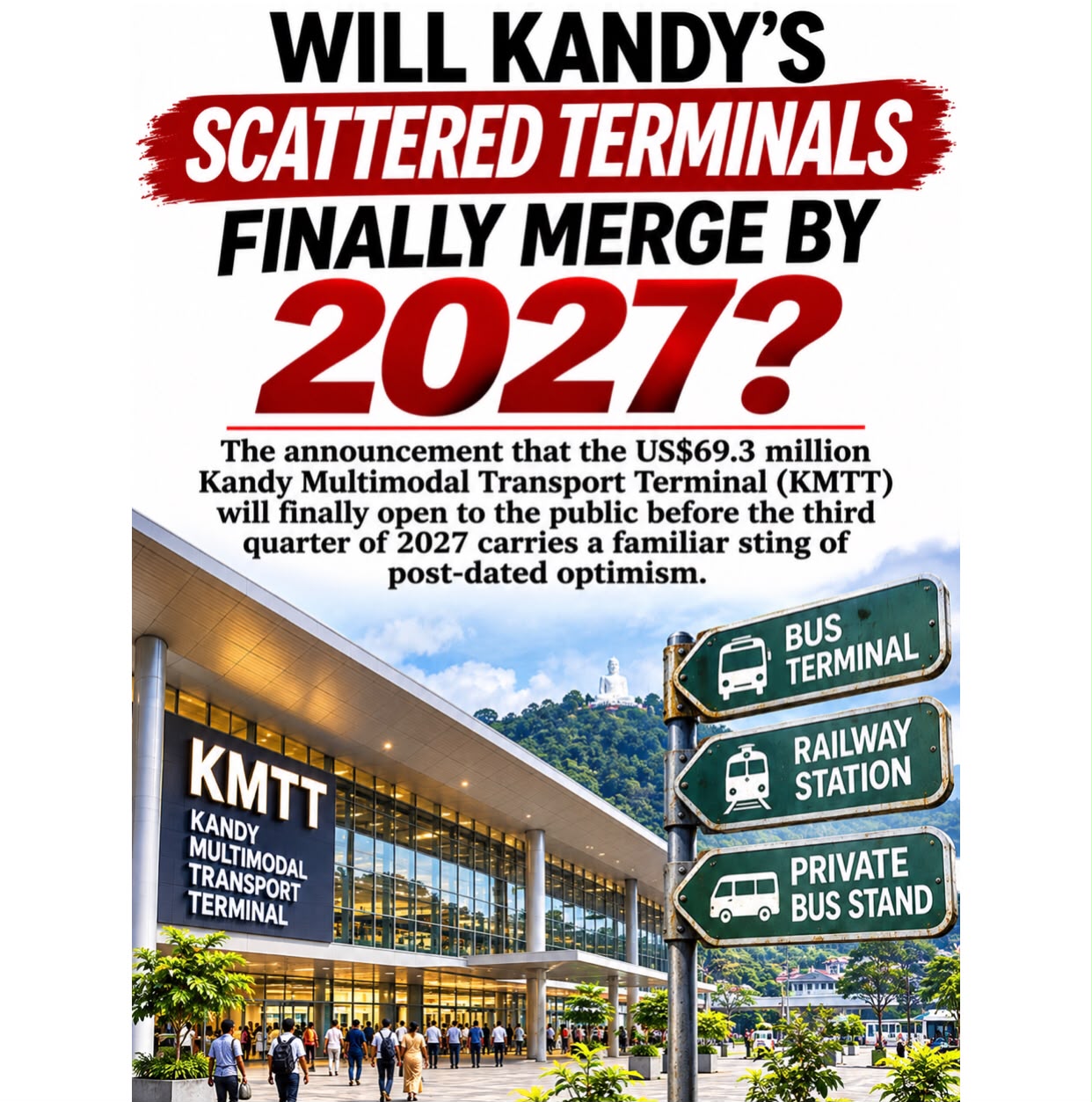
The announcement that the 69.3 million dollar Kandy Multimodal Transport Terminal (KMTT) will finally open to the public before the third quarter of 2027 carries a familiar sting of post-dated optimism. Speaking during a recent site inspection, Deputy Minister of Transport and Highways Dr. Prasanna Gunasena outlined a phased blueprint that relies on gradual terminal relocations, newly widened four-lane feeder roads, and satellite bus hubs along major entry corridors. Yet, with official projections placing visible traffic relief as far off as 2029 or 2030, the city’s residents and business owners are left dealing with a bitter reality: a decade of administrative stalls, broken promises, and self-inflicted urban gridlock.
To understand how Kandy’s predicament, we must look at the geography of a city trapped in a topographical bowl. Nestled between the Hantana mountain range and the Mahaweli River, Kandy’s historic heritage core was never designed to absorb the over 380,000 commuters and 50,000 vehicles entering its narrow arterial roads daily. Rather than modernizing transport infrastructure to match this growth, state planners created a sprawling, unorganized transit nightmare.
The multi-bus-terminal model became Kandy’s fundamental urban flaw. Instead of a single hub, nine separate, makeshift bus stands, ranging from Goods Shed to Torrington, Market, and the Clock Tower, were scattered across the city center. Hundreds of intercity and regional buses were forced to crisscross the city’s bottlenecks simply to transfer passengers or idle along narrow curbsides. The result was immediate and severe: average vehicular speeds during peak hours plummeted to an agonizing 5 kilometers per hour, turning a brief trip across town into a multi-hour ordeal.
Submit Your Press Release
Get your company news, announcements, launches, appointments and events in front of a wider audience.


The economic cost of this structural failure has been massive. Studies on Kandy’s traffic gridlock revealed that commuters lose up to 27 percent of their monthly productive working hours trapped in traffic queues. For a regional commercial capital, that translates to millions of lost man-hours, wasted fuel, and inflated logistics costs for local supply chains. Tourism, Kandy’s primary economic engine, suffered as visitors spent more time stuck in fumes along William Gopallawa Mawatha than visiting cultural sites. Investors routinely bypassed the hill capital for regions with reliable transport networks, freezing high-value commercial development.
The very project designed to fix this mess, the World Bank-funded KMTT at Goods Shed, spent years bogged down in bureaucratic paralysis. Originally envisioned under earlier urban master plans, the project faced endless delays driven by political shifts, land acquisition disputes, and institutional friction between municipal authorities and central government ministries.
The final blow came with the 2022 economic crisis. As foreign exchange reserves collapsed and Sri Lanka defaulted on external debt, construction ground to a complete halt. The designated site sat idle, while the surrounding roads deteriorated into temporary parking zones for idling private and SLTB buses.
Now, as the government resumes work and promises satellite stations along major feeder routes to feed into the newly set 2027 opening target, the one thing we can all say in unison is, it’s about time. For over a decade, Kandy was forced to pay the price of state inefficiency in lost revenue, ruined productivity, and suffocating gridlock. Moving nine bus terminals out of the city center is an overdue rescue operation for an economy choked by its own road.



