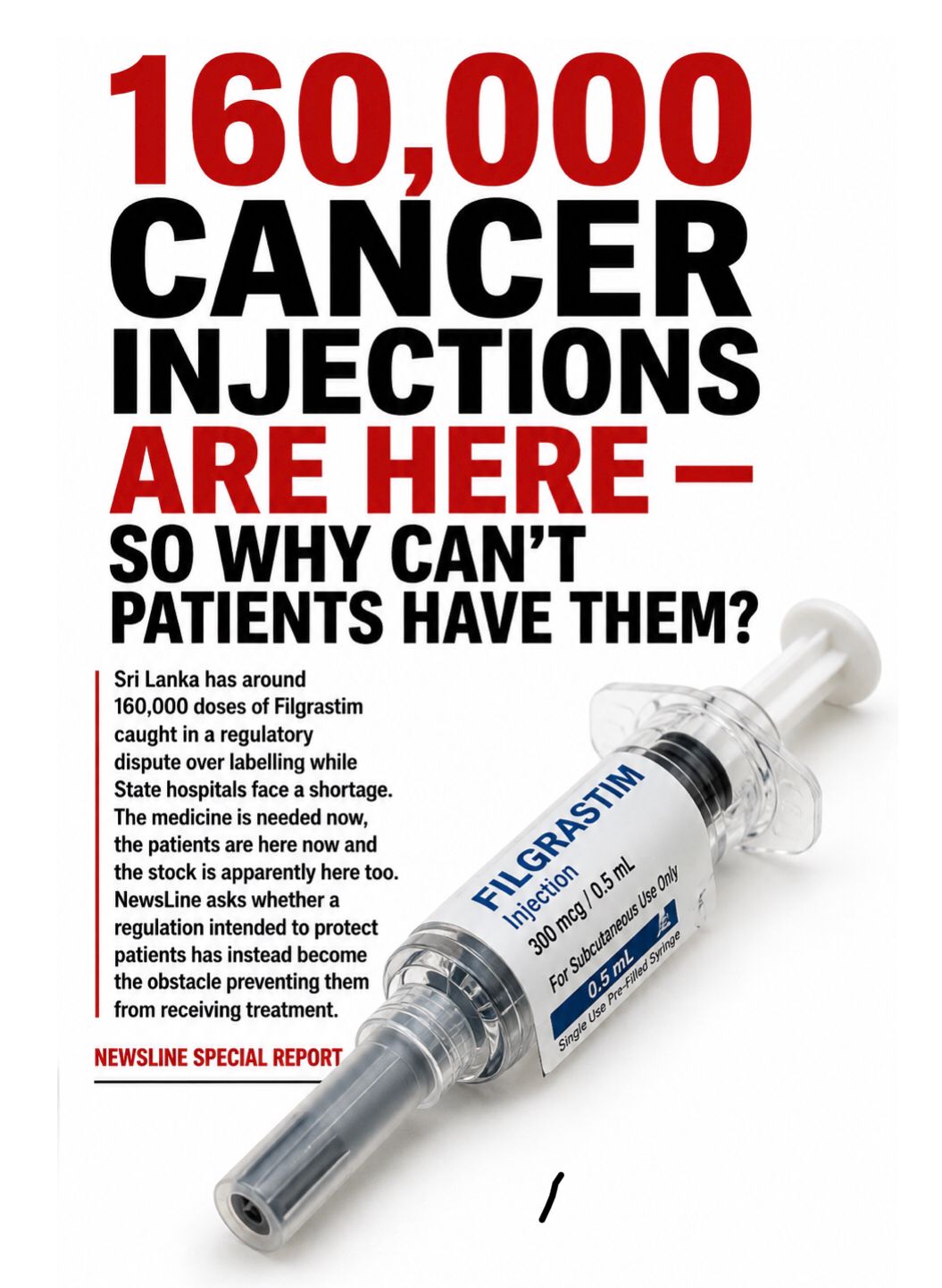
Sri Lanka has around 160,000 doses of Filgrastim caught in a regulatory dispute while State hospitals face a shortage. The patients are here. The medicine is here. NewsLine asks whether rules designed to protect patients have instead become the obstacle preventing them from receiving treatment.
Newsline Special Reporter
Somewhere within Sri Lanka’s medical supply system sits a consignment of approximately 160,000 doses of Filgrastim, a medicine used to protect cancer patients whose immune systems can be severely weakened by chemotherapy.

Sri Lanka requires approximately 27,500 vials a month. Apeksha Hospital in Maharagama alone uses around 9,000. The annual national requirement is approximately 300,000 doses.
Yet a consignment which arrived in Sri Lanka on July 28 remains in quarantine.
Health Minister Dr Nalinda Jayatissa has acknowledged the shortage and the problem holding up the stock: the individual pre-filled syringes do not carry labels required under National Medicines Regulatory Authority specifications.
That distinction matters.
The publicly stated objection concerns labelling. The Minister has not said the medicine failed a quality test, was improperly manufactured or was found unsafe.
Nobody, least of all NewsLine, suggests pharmaceutical safety standards should be relaxed because a medicine is urgently needed. The NMRA exists precisely to protect patients from substandard, counterfeit and unsafe medicines.
But regulation must surely be capable of distinguishing between unsafe medicine and safe medicine caught in a labelling dispute.
Indeed, the Minister has said discussions were taking place over whether the stock could be used on the recommendation of oncologists and haematologists. That alone suggests there is a legitimate professional question about whether these 160,000 doses can safely be released.
There is also an important allegation requiring an immediate answer.
Dr Chamal Sanjeewa, Chairman of the Doctors’ Trade Union Alliance for Medical and Civil Rights, has publicly alleged that permission had previously been given for the medicine to be imported without the particular label now at the centre of the dispute.
NewsLine has not independently seen the regulatory document establishing that claim.
There is an easy solution: publish the paperwork.
If no such approval existed, the NMRA should say so unequivocally. If an approval, waiver or understanding did exist, however, a much more serious question arises.
How did 160,000 doses come to be manufactured, shipped and delivered to Sri Lanka only to become unusable after arrival because of a labelling issue apparently considered earlier in the process?
NewsLine understands that the supplier contracted with the State Pharmaceuticals Corporation and that the product and packaging supplied were approved by the SPC in the form in which they were delivered.
We further understand that the supplier has written authorisation relating to the labelling used for this supply.
The supplier, when contacted by NewsLine, confirmed our understanding of the sequence of events.
The tender specification, approved product information, labelling requirements, correspondence with the supplier and any waiver or exemption should now be published.
This medicine was purchased with public money for patients in the public health service. There is no persuasive public-interest argument for secrecy.
Three State Bodies – One Patient Waiting
At the centre of this extraordinary merry-go-round are three State institutions: the SPC, the NMRA and the Medical Supplies Division.
One procures. Another regulates. Another distributes.
Yet the medicine remains where cancer patients cannot use it.
The Health Minister has indicated that relabelling could take at least eight weeks, while resolution of the broader problem could take considerably longer.
At a national requirement approaching 900 doses a day, Sri Lanka could require approximately 50,000 doses during an eight-week delay alone.
The absurdity becomes difficult to ignore.
If three arms of the same State have issued different requirements or interpretations, surely the first responsibility of the Health Minister is to bring them into one room with the supplier, oncologists and haematologists and resolve the matter.
Not in three months.
Now.
Because bureaucracy counts time in working days. Cancer does not.
Then There Is Kanthi
Consider “Kanthi”, 67, living deep in Sri Lanka’s south and undergoing cancer treatment.
When medicine is available normally, a patient such as Kanthi may be able to obtain the required injection and have it administered closer to home under appropriate medical supervision.
When supplies disappear and treatment becomes concentrated at Maharagama, she may instead face the long journey to Apeksha Hospital simply to obtain a dose.
For a healthy person, that journey might be inconvenient.
For a 67-year-old undergoing cancer treatment, it is another exhausting burden imposed upon somebody already fighting for her life.
And Kanthi is hardly alone.
As many as 75,000 patients could potentially be affected while the machinery of government attempts to resolve a dispute over labels.
The Government Knows How to Move When It Wants to
There is a striking contrast with another issue currently occupying the Government.
President Anura Kumara Dissanayake has demonstrated considerable determination in pursuing his administration’s proposal concerning the retirement ages of superior court judges.
Whatever one’s view of that proposal, the Government has shown that when it considers an objective important, it can pursue it vigorously and accept the political consequences.
Cancer patients might reasonably ask for some of that determination.
The comparison is not between judges and cancer patients. The issues are entirely different.
The comparison is between the urgency government can summon for one objective and the apparent inability of its machinery to resolve another.
A constitutional amendment can survive another week while lawyers argue, judges deliberate and politicians debate.
Cancer does not suspend itself while ministries exchange letters.
Pick Up the Telephone
NewsLine attempted to contact Health Minister Dr Nalinda Jayatissa and Health Ministry Secretary Dr Anil Jasinghe for their comments. Despite several attempts, our calls went unanswered.
That is unfortunate because this situation appears to demand something remarkably uncomplicated: leadership.
Convene the NMRA, SPC, MSD, supplier and the relevant medical specialists. Put the documentation on the table. Establish whether the medicine satisfies the required safety, quality and manufacturing standards.
Then decide.
Could an NMRA-approved supplementary label lawfully be applied locally under strict supervision? Could every syringe be reconciled against its batch number and outer packaging? Could the manufacturer certify the stock? Could independent testing provide any further assurance required before release?
Those are questions for regulators, oncologists, haematologists and pharmaceutical experts – not newspapers.
But somebody in authority must bring those people together and demand an answer.
If the medicine is unsafe, say so publicly, reject it and replace it immediately.
If the law absolutely prevents corrective labelling in Sri Lanka, identify the provision that prevents it and urgently procure replacement supplies.
But if the medicine is safe, properly manufactured, traceable and capable of being brought into regulatory compliance locally without compromising patient safety, every additional day of delay becomes increasingly difficult to justify.
Regulation CaSri Lanka’s determination to clean up pharmaceutical procurement deserves support. The medicines sector has endured enough controversy for rigorous regulation to be essential.
Strict regulation, however, cannot become administrative paralysis.
The purpose of every tender condition, NMRA regulation, procurement guideline and inspection procedure is ultimately the same: to ensure that a patient receives safe and effective medicine, properly purchased with public money.
The system cannot become so preoccupied with protecting the procedure that it forgets the person the procedure exists to protect.
That person is Kanthi.
She does not particularly care which department approved a sticker, which committee rejected it or whose signature appears beneath a specification.
She wants to know whether the medicine her doctor says she needs will be there when she needs it.
Every additional day of life for a cancer patient is precious.nnot Become Paralysis
Government cannot manufacture those days later and return them when the paperwork is complete.
And What Of Accountability?
There is another uncomfortable dimension which senior officials would be unwise to dismiss.
Sri Lanka has recently witnessed, in the cases concerning former Defence Secretary Hemasiri Fernando and former IGP Pujith Jayasundera, the potentially grave legal consequences that can arise from alleged failures by public officials to act in circumstances where they bear responsibility.
The facts here are entirely different and no comparison of criminal liability should be presumed.
But the broader lesson about public office is impossible to miss.
Responsibility is not confined to what an official does. In appropriate circumstances, the consequences of what an official fails to do may also require scrutiny.
Health Ministry Secretary Dr Anil Jasinghe, NMRA Chairman Dr Ananda Wijewickrama and Deputy Director General of the Medical Supplies Division Dr S. P. A. L. Ranaweera therefore face questions which go beyond administrative inconvenience.
What did each know?
When did each know it?
What could each have done?
And what has each actually done to resolve the shortage?
If seriously ill patients suffer because an avoidable administrative deadlock was allowed to continue, those are questions which may eventually be asked somewhere considerably more consequential than the pages of NewsLine.
The possibility of litigation, including proceedings invoking fundamental rights, can hardly be regarded as fanciful if patients contend that State action or inaction has unlawfully deprived them of access to essential treatment. Whether any such application could succeed would, of course, depend upon the evidence and the law.
But government should not require a Supreme Court case to discover common sense.
Be that as it may, the central public-interest question is devastatingly simple.
Sri Lanka apparently has 160,000 doses of a medicine urgently required by cancer patients at precisely the moment State hospitals are short of that medicine.
If the injections are unsafe, tell the country why and replace them immediately.
If they are safe, President Dissanayake, his Health Minister, the Health Ministry, NMRA, SPC and MSD must explain why a dispute involving a label cannot be safely, lawfully and urgently resolved in Sri Lanka.
For officials, three months may be a timetable.
For Kanthi and thousands like her, it may be time they simply do not have.