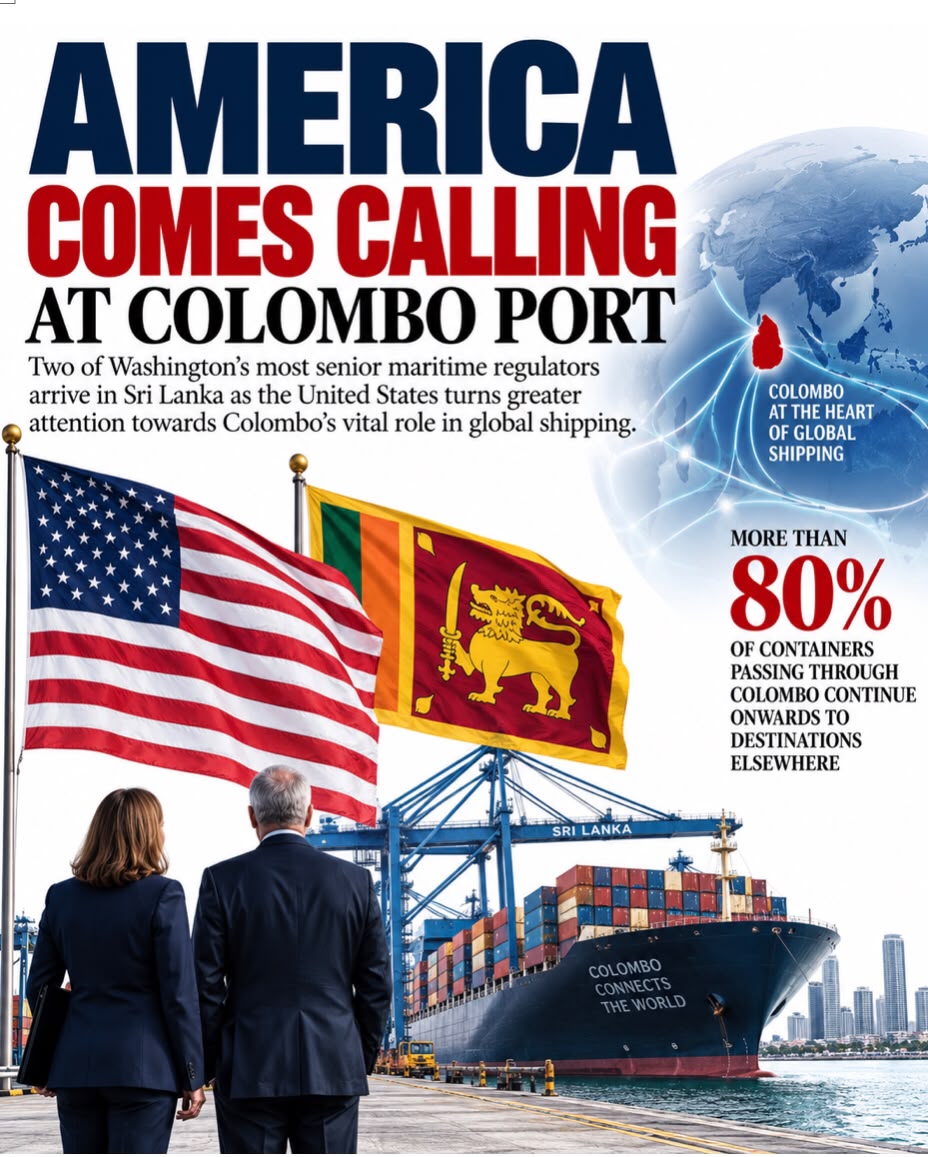
Two of Washington’s most senior maritime regulators arrive in Sri Lanka as the United States turns greater attention towards Colombo’s extraordinary position astride the Indian Ocean’s shipping lanes. More than 80 percent of containers passing through Colombo are headed somewhere else – and therein lies both Sri Lanka’s opportunity and its vulnerability.
Sri Lanka’s geographical position has been described as an advantage so often that it has almost become a cliché. This week, however, two senior American maritime regulators arrive in Colombo with the island’s place in global shipping very much on their agenda.
Laura DiBella, Chairman of the United States Federal Maritime Commission, and Commissioner Robert J. Harvey are visiting Sri Lanka from September 6 to 10 for discussions with senior Government officials and maritime-sector leaders.

The Federal Maritime Commission is not simply another American trade delegation. It is the independent US regulator overseeing international ocean transportation affecting American exporters, importers and consumers, giving this visit considerably more significance than an ordinary round of diplomatic meetings.
DiBella is also due to address the Colombo International Maritime and Logistics Conference on September 9, while Harvey will participate in its discussions.
The statistic accompanying the visit tells the more important story. According to the US Embassy, more than 80 percent of containers moving through Colombo continue onwards to destinations elsewhere in the world.
In other words, Colombo’s importance is substantially larger than Sri Lanka’s own import and export economy. The port survives and competes because international shipping lines find it useful as a transshipment point sitting close to one of the busiest maritime corridors on earth.
That is an extraordinary national asset.
It is also one Sri Lanka cannot afford to take for granted.
Ports across the region are investing heavily in capacity, automation, logistics and connectivity. India in particular has been developing its own port infrastructure and transshipment capability, meaning Colombo cannot assume indefinitely that geography alone will guarantee business.
The American visit therefore arrives at an interesting moment.
Washington says the discussions will focus on maritime trade, investment and the shipping networks connecting American businesses and consumers with markets throughout the Indo-Pacific. Behind that diplomatic language lies the growing strategic importance attached by major powers to resilient supply chains and the sea routes running through the Indian Ocean.
Sri Lanka must be careful not to turn every commercial relationship into a geopolitical contest. Colombo Port works precisely because ships from everywhere can use it, and its long-term commercial value depends upon maintaining that openness.
China is deeply embedded in Sri Lanka’s port landscape, India is overwhelmingly important to Colombo’s transshipment business, and the United States remains one of Sri Lanka’s most important export markets. The sensible national strategy is therefore not choosing one partner against another but making Sri Lanka indispensable to all of them.
That requires more than speeches about becoming a maritime hub.
Shipping lines require speed, reliability, competitive charges, sufficient terminal capacity, efficient Customs procedures and confidence that containers will move through Colombo without unnecessary delay. Investors require regulatory predictability and an environment in which major infrastructure decisions survive changes of government.
The arrival of America’s maritime regulators should therefore be viewed as an opportunity rather than merely another diplomatic visit.
Sri Lanka possesses something that cannot be manufactured, borrowed or imported: its location.
The challenge is turning that accident of geography into lasting national income before competitors elsewhere in the region turn Colombo’s advantage into yesterday’s opportunity.
Be that as it may.