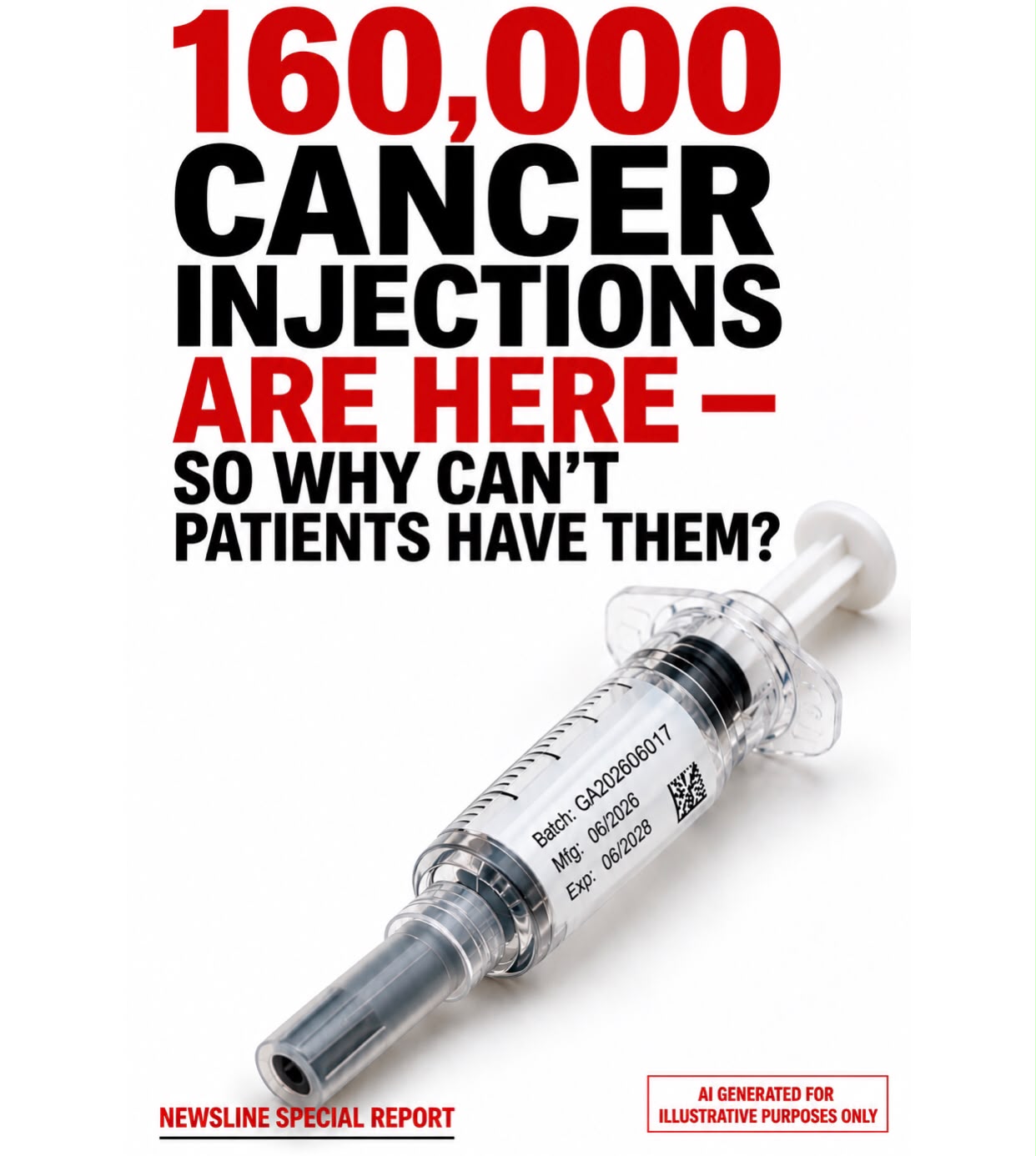
A cancer medicine shortage. Around 160,000 pre-filled Filgrastim syringes sitting in quarantine. A dispute principally over labelling. Yet the manufacturer, product, importer, shipment and batches can apparently all be traced and the medicine can be independently tested. NEWSLINE asks why cancer patients are still waiting.
Around 160,000 pre-filled syringes of Filgrastim remain unavailable to Sri Lanka’s cancer patients while the Regulator grapples principally with a labelling problem. There is no argument that pharmaceutical labelling matters: it is an essential part of ensuring that medicines are properly identified, traced and safely used.
But there is an increasingly important distinction between a labelling defect and an inability to establish the identity, quality and provenance of a medicine. If the identity of these syringes can be traced through their batch numbers, reconciled with their outer packaging and import documentation, authenticated by the manufacturer and finally confirmed through independent analytical testing, NEWSLINE asks why that process has not been pursued with considerably greater urgency.
Submit Your Press Release
Get your company news, announcements, launches, appointments and events in front of a wider audience.


World Health Organization guidance identifies a range of information relevant to pharmaceutical labelling, including, as appropriate, the product name, active ingredient and amount, batch number, expiry date, storage and handling requirements, directions and warnings, and the identity of the manufacturer or supplier. WHO guidance also recognises the distinction between primary packaging containing or immediately enclosing the medicine and the secondary or outer packaging.
That distinction goes to the heart of the Filgrastim controversy. NEWSLINE understands that the individual outer carton identifies the medicine as Filgrastim and carries the required product particulars, while the blister or primary packaging of the pre-filled syringe carries the strength, manufacturing date, expiry date and batch number but does not separately state the generic name Filgrastim.
That omission is the apparent labelling defect which finds its origin in the approval garnted by one government agency namely the SPC State Pharmaceutical Corporation – and should not simply be brushed aside. The question, however, is whether it renders the medicine unidentifiable, particularly when WHO itself places considerable importance on batch information as a means of pharmaceutical traceability and advises that batch numbers and expiry dates on primary packaging should be checked against those appearing on secondary packaging.
NEWSLINE therefore asked the manufacturer whether the batch number printed on the primary packaging could be traced through its production records to establish the identity of the medicine. The manufacturer’s answer was yes, and it explained to NEWSLINE how its batch-coding system operates.
Take, for example, the batch number GA202606017 appearing on the primary packaging. According to the manufacturer, GA identifies the product as Filgrastim; 2026 identifies the year of manufacture; 06 identifies the month of manufacture, June; while 017 is the serial component of the batch number, which changes with production according to the manufacturer’s annual coding sequence.
If that explanation is correct, GA202606017 is not simply a random collection of letters and numbers. It is a coded product and manufacturing identifier which, according to the manufacturer, can be traced directly through its production records.
That is significant because although the word Filgrastim does not appear on the primary packaging, the manufacturer says the letters GA contained within the batch number themselves identify the product as Filgrastim. The Regulator does not have to accept that explanation on trust; it can require the manufacturer formally to decode the complete batch number and produce the corresponding manufacturing and batch records.
The Regulator can establish whether GA does indeed identify Filgrastim, whether 2026 corresponds with the manufacturing year, whether 06 represents June and whether 017 corresponds with the appropriate production sequence. It can then compare that complete batch identification against the individual outer carton, Certificate of Analysis and the Regulatory customs and shipping documentation accompanying the consignment.
There are several other layers of traceability. This medicine did not arrive anonymously in Sri Lanka or emerge from an unidentified supplier: there is a manufacturer registered within Sri Lanka’s regulatory system, a manufacturing site subject to regulatory requirements and a Regulator registered product with marketing authorisation.
There is also an authorised Sri Lankan local agent, an established pharmaceutical importer carrying its own regulatory responsibilities. The medicine was imported through official channels for supply to the State health sector, requiring the appropriate product registration, The Regulator’s import authorisation and accompanying commercial, customs and shipping documentation.
NEWSLINE understands that the manufacturer has confirmed that this particular consignment was supplied to Sri Lanka through its authorised local agent. NEWSLINE further learns that the same manufacturer has previously supplied more than 225,000 pre-filled syringes of Filgrastim to the Sri Lankan Government, meaning that there should already be a substantial regulatory, importation, batch and pharmacovigilance history against which the present consignment can be compared.
The Regulator therefore has several separate means of establishing the identity and provenance of these syringes. It can establish what the registered manufacturer produced and exported, what the authorised Sri Lankan agent ordered and imported, and whether the batch identification on the primary packaging corresponds with the batch number and product identification on the outer carton.
Those numbers can in turn be reconciled against the Certificate of Analysis, manufacturer’s production records, product registration, import licence and shipping documentation. Sri Lanka Customs and the Regulator can additionally cross-check relevant import documentation through the official customs and regulatory systems, including ASYCUDA where applicable.
If there is a break anywhere in that chain, identify it. If the batch numbers do not correspond, if GA202606017 cannot be traced to Filgrastim, or if the manufacturer’s records do not reconcile with the product that arrived in Sri Lanka, those would be serious matters requiring investigation.
But if that documentary trail does reconcile, there remains an even more important safeguard available to the Regulator : independent scientific testing. NEWSLINE understands that the importer is prepared to bear the cost of sending representative samples to an appropriately accredited independent laboratory capable of carrying out the necessary analytical tests.
If there is doubt that these syringes contain Filgrastim, establish scientifically whether they contain Filgrastim. If there is doubt about the strength, test it; if there are concerns about quality, purity, sterility or other applicable specifications, undertake whatever validated analyses the Regulator considers necessary.
If the product fails those tests, do not release it. If the documentation does not reconcile or there is credible evidence that the medicine is counterfeit, substituted, contaminated, keep it away from patients.
That is precisely what medicines regulation is supposed to achieve. But the reverse must surely also apply: if independent analytical evidence confirms the identity, strength and required quality of the medicine, the manufacturer authenticates the batch, the batch number on the primary packaging corresponds with the outer carton and the Regulatory and shipping documentation establishes its provenance, the Regulator should explain what remaining patient-safety concern prevents it from considering an appropriate regulatory mechanism for release.
Strip away the arguments between institutions and consider what is already before the Regulator . There is a Regulator – recognised manufacturer, a Regulator – registered Filgrastim product, an authorised Sri Lankan agent, an official importation, a manufacturer confirming the shipment, an outer carton identifying Filgrastim and primary packaging carrying the strength, manufacturing date, expiry date and a batch number which, according to the manufacturer, itself encodes the identity and production history of the medicine.
There is also a manufacturer which has previously supplied more than 225,000 pre-filled Filgrastim syringes to the Government, and an importer now prepared to pay for independent analytical testing. None of those facts makes the apparent omission of the generic name from the primary packaging disappear, but neither should a labelling defect automatically be treated as evidence that a medicine is unsafe, counterfeit or incapable of identification.
The NMRA is Sri Lanka’s medicines regulator. Its responsibility is not merely to identify a regulatory breach but to determine what that breach means for the quality, safety and efficacy of the medicine and, ultimately, for the patient.
There is no justification for compromising patient safety in order to get these syringes into hospitals. There is equally no justification for bureaucracy becoming a substitute for science when a desperately needed cancer medicine is already sitting in Sri Lanka.
Trace GA202606017 through the manufacturer’s records. Match it against the outer carton, Certificate of Analysis, import licence and shipping documentation; obtain formal authentication directly from the registered manufacturer and take representative samples under proper regulatory control for independent analytical testing.
Then decide.
The issue is therefore no longer simply whether there is a labelling defect. There plainly appears to be one.
The far more important question is why, after all this time, Sri Lanka still does not have the definitive scientific answer needed to decide whether 160,000 syringes can reach the cancer patients waiting for them.
A complex product – immunoglobulin – had in the recent past regulatory compliance issues. One had correct labelling with Both were assessed by the Regulator, in the interest of the patient. One was subject to a total product recall. The other was recalled, revoked in the interest of the patient.
NewsLine has the information pertaining to both instances.
The complex product – Filgrastim – which has as its issue a labelling deficiency – which “Kanthi” is very much expecting to be resolved soon – so she can hopefully live at least a day longer.
Be that as it may.