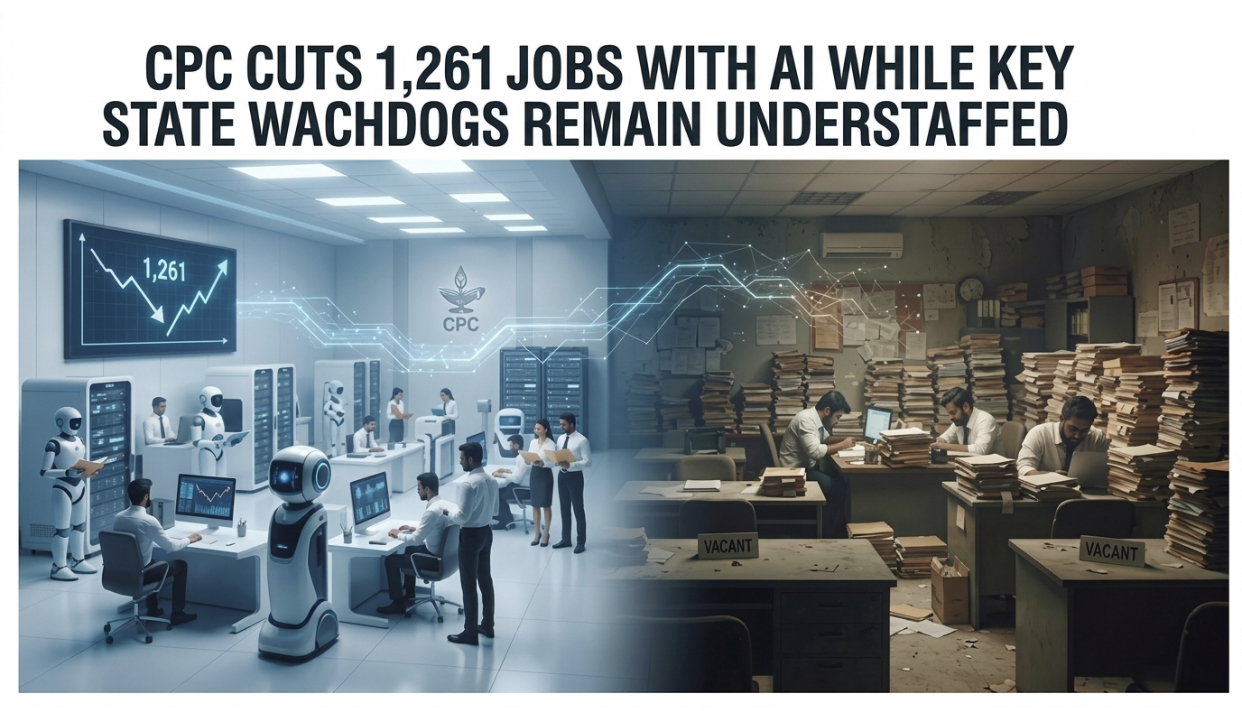
Sri Lanka’s public sector is slimming down, though whether that diet represents strategic modernization or administrative drift depends entirely on which corridor of Colombo you inspect. On one side sits the Ceylon Petroleum Corporation, which has trimmed its headcount by more than 38% since 2024, falling from 3,292 employees to 2,031, by handing routine administration, translation, and bowser scheduling over to artificial intelligence and SAP enterprise software. On the other sits the wider public service, where newly released 2026 cadre figures reveal an uneven contraction that leaves vital oversight bodies understaffed while certain ministries quietly operate above their approved limits.
Speaking at the WION Digital Sri Lanka Summit 2026 in Colombo, CPC and Ceylon Petroleum Storage Terminals Limited Managing Director Dr. Mayura Neththikumarage offered a blunt case study in targeted automation. Gone are the days of handwritten departmental memos passed down a chain of typists and translators, or mismatched spare-part ledgers slowing maintenance. Fuel station operators now place orders and transfer payments via a mobile application wired directly into SAP, triggering automatic invoicing at 6:00 a.m. daily in a fully paperless workflow. More notably, an automated AI queue now governs fuel bowser dispatch strictly by order timestamp, neutralizing the time-honoured Sri Lankan tradition of influential callers leaning on staff to jump the line. Having first adopted SAP in 2010, CPC is now migrating to a cloud-based SAP S/4HANA RISE platform.
Across the broader state apparatus, however, headcount reductions look far less algorithmic and considerably more lopsided. Even after excluding anomalies at the Judicial Service Commission and the Presidential Secretariat, the public service shed roughly 18,700 employees over the past year. Yet the losses have hit frontline delivery and accountability institutions hardest. National schools lost 1,208 staff, the Samurdhi Department dropped by 1,448, and the Sri Lanka Ports Authority shed 441 employees during a year marked by Colombo port congestion. Uniformed security personnel fell by 856 against an approved cadre of 102,112, despite Cabinet assurances in March that defence and public security would absorb the bulk of 15,839 approved vacancies.
Submit Your Press Release
Get your company news, announcements, launches, appointments and events in front of a wider audience.


Nowhere is the staffing mismatch sharper than in institutions tasked with enforcing the law and policing the state. Despite Treasury pledges under the National Anti-Corruption Action Plan 2025-2029 to bolster institutional capacity, the Commission to Investigate Allegations of Bribery or Corruption operates with just 223 staff against an approved cadre of 972, down from 238 a year earlier, having filled only four of its 463 tertiary-level posts. The Attorney General’s Department carries 218 senior officers against 548 approved positions. Meanwhile, flagship regulators exist largely on paper. The Gambling Regulatory Authority reports zero staff for its 23 approved posts, and the Data Protection Authority left all 41 positions vacant in 2025 with no updated headcount reported this year.
At the same time, austerity appears selective. Fifteen state institutions, excluding the Rural Development Ministry, employ 973 people above their approved ceilings, including the Ministry of Transport, Highways and Urban Development, which carries 531 staff against 457 approved posts, and the Court of Appeal with 139 against 132. Lanka Sathosa, having exceeded its cap by 608 employees in 2025, simply had its approved cadre expanded by 1,238 to 4,246. Adding further fog to the ledger, the Judicial Service Commission’s reported staff plunged from 9,251 to 5,256, with primary-grade workers dropping from 4,002 to 557, even as its approved cadre jumped to 15,058, while the Presidential Secretariat listed 1,130 approved posts without disclosing actual headcount.
CPC’s experience demonstrates that cutting bureaucracy works when technology replaces discretion and paper shuffling. Elsewhere in government, shrinking the payroll without filling prosecutorial benches, regulatory desks, or port shifts risks trading bloated inefficiency for institutional paralysis.