
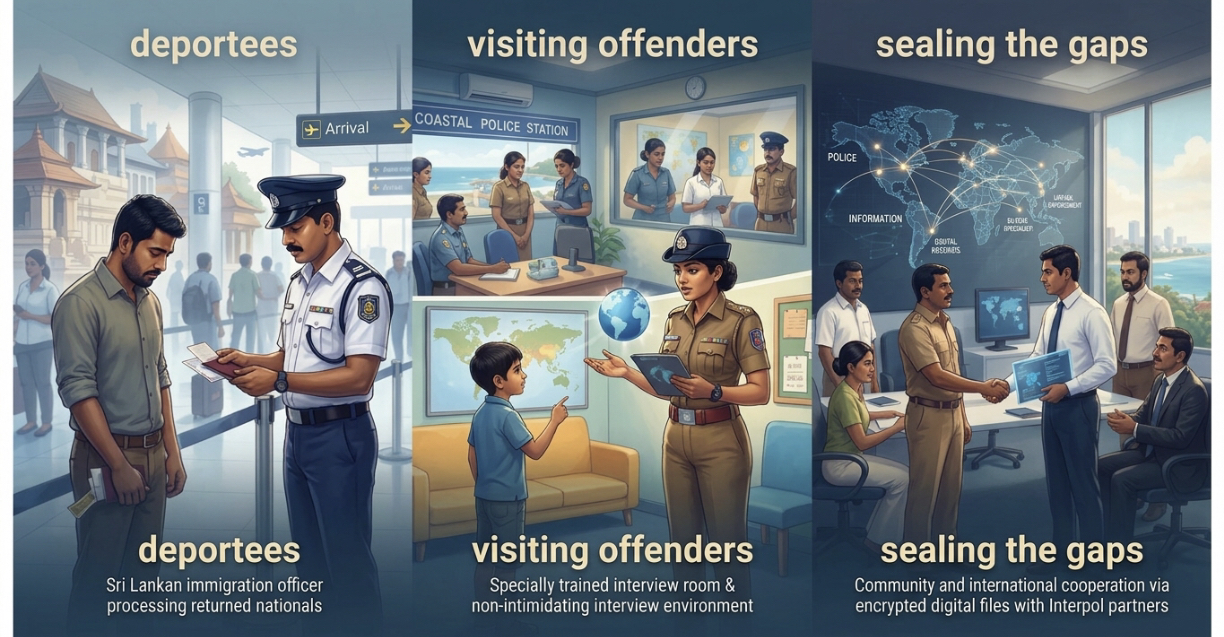
When a Sri Lankan national convicted of sexual abuse overseas finishes a prison sentence and is deported back to Colombo, domestic police frequently receive no formal record of the crime. Because foreign convictions do not automatically appear on local registers, a convicted offender can step back into neighbourhoods and workplaces with what looks like a clean slate. That vulnerability took centre stage in Parliament on Monday, November 23, 2026, when the Women Parliamentarians’ Caucus and its Subcommittee met under the chairmanship of Minister of Women and Child Affairs Saroja Savithri Paulraj to close this legal blind spot.
Addressing the joint committee alongside senior officials from the Ministry of Women and Child Affairs, the Attorney General’s Department, the National Child Protection Authority, the Government Analyst’s Department, the Sri Lanka Police, and the Ministry of Health and Mass Media, Paulraj warned that relevant domestic authorities are routinely left uninformed when deportees arrive following foreign sexual abuse convictions. Without official notification or statutory mechanisms to log those convictions, such individuals can reintegrate without scrutiny, creating an acute risk of repeat offences against women and children.
The legal problem runs deep into how territorial criminal jurisdiction operates in Sri Lanka. Under existing penal and evidentiary statutes, a conviction handed down by a foreign court does not automatically register on the Sri Lanka Police criminal record database or trigger domestic post-release supervision unless specific statutory recognition, mutual legal assistance, or treaty mechanisms apply. Even where deportation takes place on immigration grounds after a foreign sentence is completed, immigration removal is an administrative act by the sending state rather than a judicial transfer under the Extradition Law or the Mutual Assistance in Criminal Matters Act, meaning criminal dossiers often never cross between ministries. To close that gap, the Caucus explored recognizing and enforcing foreign court judgments in sexual offence cases, building an international coordination channel to obtain verified conviction data on Sri Lankan nationals abroad, and establishing legal and technical protocols to integrate those records directly into police databases.
Submit Your Press Release
Get your company news, announcements, launches, appointments and events in front of a wider audience.


Equally critical is workplace and institutional screening. The Caucus called for mandatory criminal background checks for anyone recruited to institutions working with children, alongside a legally authorized, risk-based monitoring system to deter recidivism. That push builds on broader child protection efforts initiated earlier in 2026, including moves by the National Child Protection Authority and the Ministry of Women and Child Affairs to enforce fingerprint-based vetting and child-offence clearance certificates across state-sector institutions. Yet without linking foreign conviction intelligence to domestic fingerprint and police clearance registries, a deported offender could still pass a local background check and secure employment in schools, tuition centres, orphanages, sports academies, or transport services.
Looking beyond returning Sri Lankan nationals, lawmakers and security agencies also face an equally pressing question: how to screen, bar, or monitor registered foreign sex offenders entering Sri Lanka as tourists, consultants, volunteers, or long-term residents. International experience offers concrete tools Sri Lanka can adopt through legislative amendment and border integration.
First, immigration and police authorities could establish direct, automated data-sharing protocols with foreign tracking hubs such as the United States Angel Watch Center under International Megan’s Law, which issues advance travel notifications and passport identifiers for convicted child sex offenders, alongside systematic use of INTERPOL Green Notices and the I-24/7 network at Bandaranaike International Airport and seaports to flag travelling offenders before boarding or upon arrival.
Second, Sri Lanka could amend the Immigrants and Emigrants Act to make prior foreign sexual offence convictions an explicit statutory ground for visa refusal, entry denial, or immediate deportation, backed by mandatory disclosure on electronic travel authorization forms where false declarations carry criminal penalties.
Third, for any foreign national permitted to enter or reside in the country despite a historical conviction, Parliament can introduce civil preventive orders modeled on the United Kingdom’s Sexual Harm Prevention Orders and foreign-conviction notification notices, empowering courts or senior police officers to compel in-person registration of addresses, passports, and financial accounts within days of arrival, bar contact with minors or entry near schools and child-care facilities, and criminalize any breach.
Regional precedents across Southeast Asia show how quickly tourism economies can become magnets for transnational predators when border screening lags behind visitor growth. In the Philippines, the Bureau of Immigration actively enforces its #ShieldKids campaign alongside advance passenger notices under International Megan’s Law, routinely intercepting and blacklisting convicted foreign sex offenders at airports before they can enter the country. Thailand has similarly tightened digital border controls and pre-arrival screening systems after decades of battling foreign exploitation networks in coastal and urban tourist hubs. Both countries learned the hard way that once a destination gains a reputation for weak border vetting or lax enforcement, organized exploitation networks and travelling offenders quickly follow.
For Sri Lanka, which is banking heavily on high-yield tourism to anchor its economic recovery, leaving these legal and border loopholes open carries severe social and economic risks. Coastal towns, wildlife circuits, and boutique hospitality hubs thrive on international arrivals, yet past child protection studies have repeatedly warned that unchecked tourism corridors can expose vulnerable children and young people to commercial sexual exploitation. When other regional destinations slam their doors shut on registered sex offenders through real-time intelligence sharing and strict visa bars, any neighbouring country without matching safeguards risks becoming the path of least resistance.
Beyond the immediate harm to victims, failing to seal these gaps threatens the very high-value tourism brand Sri Lanka is trying to build. High-spending family travellers, reputable international tour operators, and global hospitality investors increasingly scrutinize destination safety and child protection standards. Closing the border loophole for both deported nationals and visiting foreign offenders is therefore not just a matter of criminal justice, but an urgent safeguard for Sri Lanka’s communities and its economic credibility.
Ultimately, legislative amendments alone will only protect communities if diplomatic missions, border control, child protection authorities, and local police operate on a single shared intelligence loop. Whether an offender is a deported citizen returning home or a registered foreign national arriving at the border, public safety depends on ensuring that a conviction recorded across an ocean never disappears upon landing in Sri Lanka.



