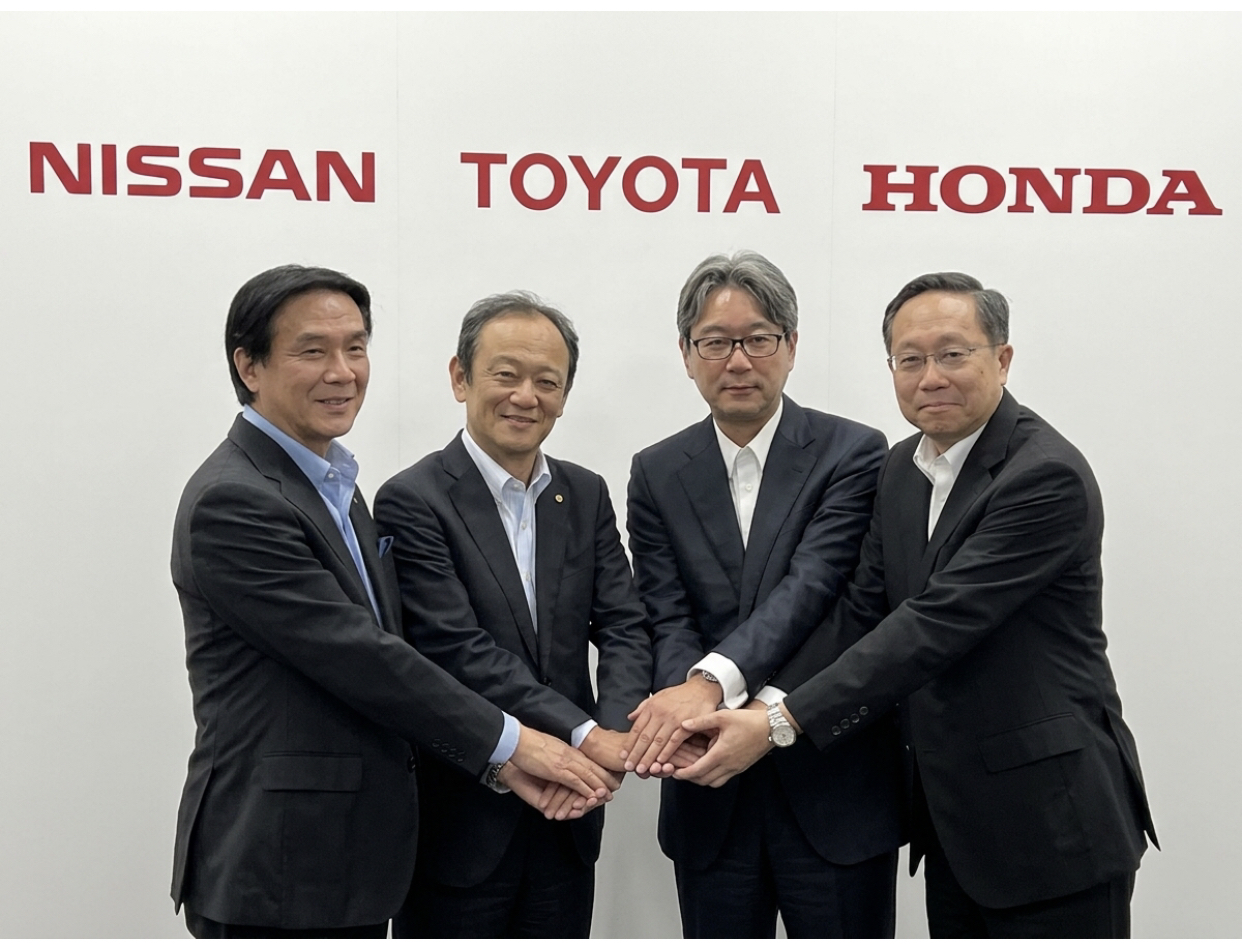
Japan’s automotive titans built global dominance on fierce domestic competition and bespoke engineering, guarding every bolt, alloy, and circuit specification as proprietary armour. That era effectively ended this week when 14 Japanese vehicle manufacturers, including Toyota, Honda, Nissan, Mazda, and Subaru, joined forces under the Japan Automobile Manufacturers Association (JAMA) and the Japan Auto Parts Industries Association to standardize core vehicle components and materials. Announced by JAMA Chairman and Toyota Vice Chairman Koji Sato, the pact targets steel grades, recycled plastics, and wiring harnesses in a bid to slash manufacturing costs, automate assembly lines, and free up capital against a relentless Chinese automotive offensive.
The numbers behind Japan’s urgency are stark. According to Sato, Japanese automakers currently rely on roughly 70,000 different specifications for wiring harnesses alone. Every minor variation forces parts suppliers to maintain separate molds, assembly boards, and manual instruction sheets, turning factory automation into an expensive nightmare. By consolidating low-volume steel grades, establishing unified protocols for recycled resins, and cutting wire-harness varieties while expanding aluminum wiring, Japan’s carmakers are trying to strip out self-inflicted complexity. Yet the deeper question hanging over Tokyo is unavoidable: why did an industry renowned for lean manufacturing wait until now to fix 70,000 duplicate wire specifications, and can cost-cutting on legacy hardware alone close a widening technological gap?
That gap has been carved open by China’s extraordinary global expansion. Data from the China Passenger Car Association shows China’s exports of new energy passenger vehicles surged 139.7% year over year to 4.472 million units in the first ten months of 2026 alone. Across the global market in the first half of 2026, three Chinese groups broke into the world’s top ten automakers by market share, with Geely Holding Group climbing to 4.6% from 1.5% a decade ago and Chery matching Ford at 4.1% after sitting at just 0.8% ten years earlier. Even more alarming for Tokyo, Chinese brands have already overtaken Japanese rivals in market share across 39 countries, eating directly into traditional Japanese strongholds across Southeast Asia, Latin America, and the Middle East. The supply chain tells an equally sobering story: Bain & Company analysis published this month reveals that US and Japanese auto parts suppliers have ceded 21 percentage points of global market share over the past two decades, representing more than €200 billion in lost revenue, while Chinese suppliers have climbed from near-obscurity to capture 13% of global top-100 supplier revenue.
Submit Your Press Release
Get your company news, announcements, launches, appointments and events in front of a wider audience.


China did not become a stronghold by accident; it monetized the very trends legacy automakers hesitated to embrace. While Japanese giants doubled down on hybrids and gradual incrementalism, Beijing poured state-backed industrial policy, subsidized credit, and vertical supply-chain integration into batteries, power electronics, and software-defined vehicles. By controlling the lion’s share of lithium refining, cathode manufacturing, and battery cell production, where giants like CATL command roughly 40% of China’s power battery market, Chinese automakers compressed vehicle development cycles from the traditional four or five years down to 18 to 24 months. Across the globe, electric vehicles reached 68% of China’s passenger car market share by October 2026, creating a hyper-competitive domestic testing ground that forced firms like BYD, Geely, and Chery to master scale, software integration, and aggressive pricing before exporting those efficiencies worldwide.
Western automakers in Europe and the United States are caught in the same vice, though they have responded differently. Rather than relying purely on pre-competitive parts standardization, Washington and Brussels erected tariff walls to buy time for domestic manufacturers such as Volkswagen, Stellantis, Ford, and General Motors. Even so, the International Energy Agency’s Global EV Outlook 2026 warns that over one in four electric cars sold in advanced economies will be made in China by 2035, up from 15% in 2025, with Chinese vehicles projected to capture more than two-thirds of European Union EV imports. In the United Kingdom, where Chinese brands are not blocked by punitive tariffs, they have already captured a record 14% market share.
Japan’s 14-brand alliance stops short of corporate mergers, preserving brand competition on the showroom floor while pooling scale behind the factory wall. Still, the move raises hard strategic questions for the global industry. If Western tariffs merely delay Chinese market entry while legacy giants struggle with high cost bases, and if Japan’s standardization drive only lowers the cost of steel, plastics, and copper wiring, who will match China’s speed in battery chemistry, autonomous software, and digital cockpits? Tokyo’s historic truce proves that no single Japanese automaker can survive the new era alone, yet standardizing the skeleton of a car will only matter if Japan and the West can also win the race for its electric and digital brain.