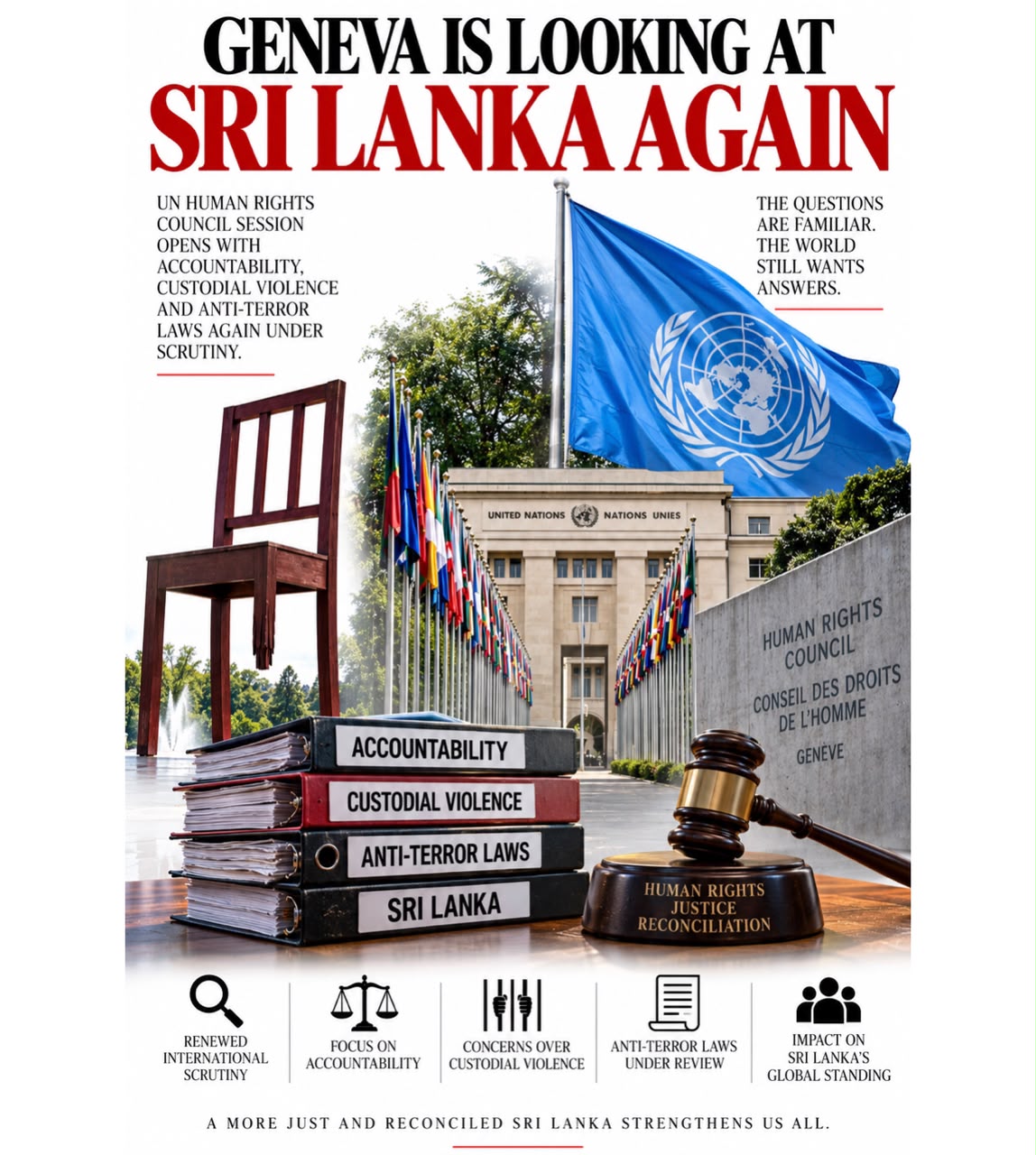
UN Human Rights Council session opens with accountability, custodial violence and anti-terror laws again under scrutiny
Sri Lanka returns to scrutiny in Geneva this week as the 63rd session of the United Nations Human Rights Council gets under way.
A report by the Office of the United Nations High Commissioner for Human Rights on Sri Lanka is scheduled to be considered during the session which opened on September 7.

The report warns that commitments relating to truth, justice and systemic reform risk losing momentum and raises concerns over custodial violence, continued use of the Prevention of Terrorism Act and legislation proposed to replace it.
Sri Lanka’s Permanent Representative in Geneva is expected to deliver the Government’s response.
There is nothing particularly new about Sri Lanka finding itself before the Human Rights Council.
Successive governments have spent years arguing that accountability and reconciliation are matters which Sri Lanka should principally address through its own institutions rather than through international mechanisms.
There is considerable force in the principle.
But its credibility ultimately depends upon the effectiveness of those domestic institutions.
A country which demonstrates that allegations are investigated, prosecutions proceed where evidence exists and institutions are capable of holding public officials accountable has a powerful answer to demands for international intervention.
A country which promises repeatedly to do those things but does not inevitably makes the international argument more difficult.
The real contest in Geneva, therefore, may not be between Sri Lanka and the Human Rights Council at all.
It is between the commitments Sri Lanka has made and what it can demonstrate it has actually done.