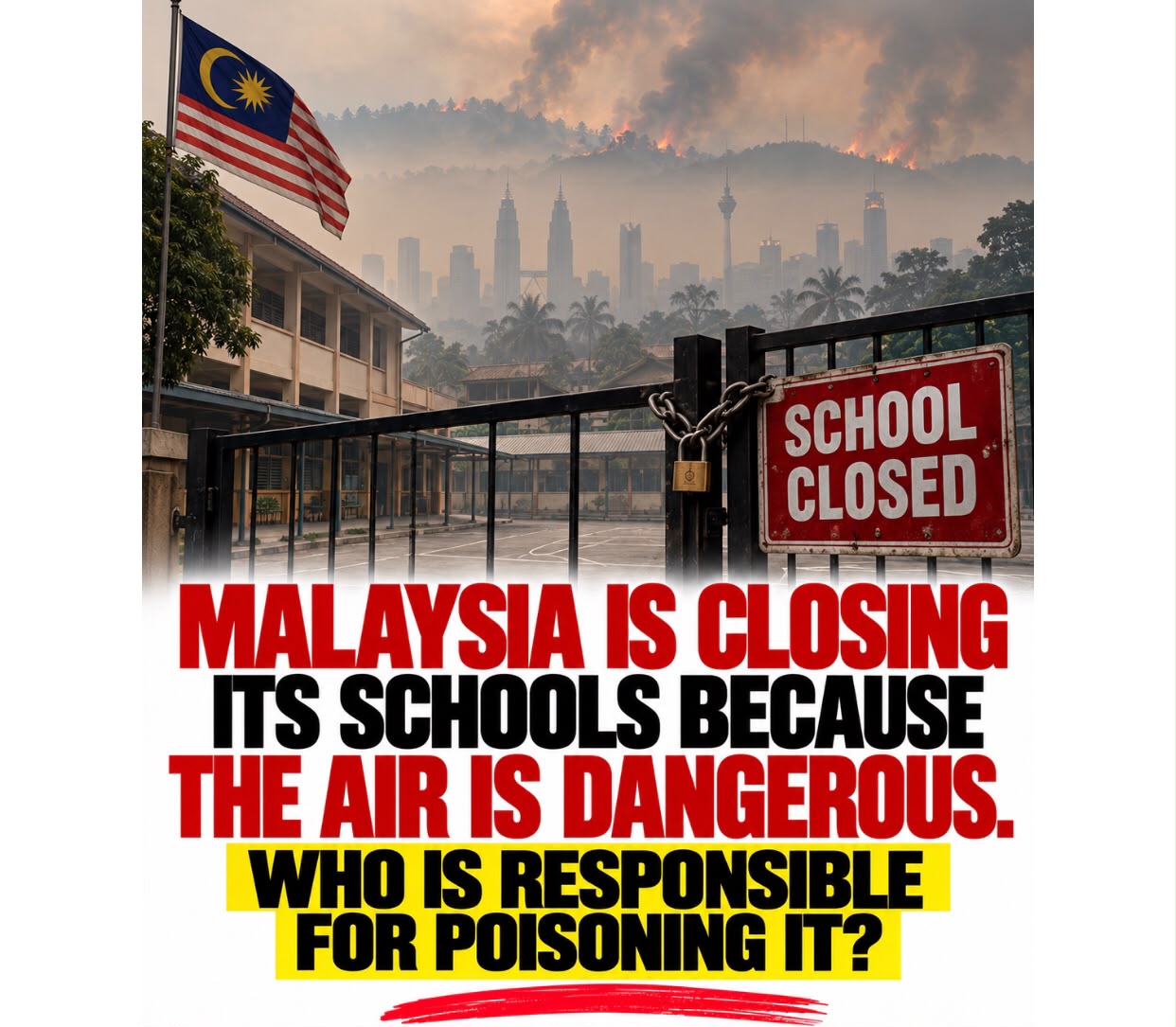
Malaysia has ordered further school closures for Wednesday, October 14, as toxic haze from Indonesian forest and peatland fires continues to spread across Southeast Asia. What began as an environmental emergency has become a test of regional diplomacy, corporate responsibility and the fundamental right of millions of people to breathe clean air.
Malaysia’s Education Minister Fadhlina Sidek has confirmed that schools in Johor, Melaka and Negeri Sembilan will remain closed on Wednesday, October 14. Closures also affect specified districts in Selangor, Pahang, Sabah and Sarawak. Johor has already extended its school closures until October 16, reflecting growing concern about the persistence of the pollution.
The decision is not an administrative inconvenience. It is an admission that the atmosphere has become sufficiently dangerous to interrupt the education of children. Across affected areas, families must reorganise their working lives, teachers must improvise lessons and children are being instructed to remain indoors because the air outside their homes and classrooms presents a health risk.
Submit Your Press Release
Get your company news, announcements, launches, appointments and events in front of a wider audience.


The principal source of the emergency lies across the border in Indonesia, where extensive forest and peatland fires have generated enormous volumes of smoke. Dry conditions associated with El Niño have intensified the disaster, while longstanding concerns about land clearing, plantation development and inadequate enforcement have returned to the centre of the debate.
Indonesia’s President Prabowo Subianto has now ordered additional resources to combat the fires amid mounting criticism from neighbouring countries. Malaysia and Singapore have offered assistance, but the broader question remains whether emergency firefighting can adequately address a problem that has been allowed to recur for decades.
There is an important distinction between a natural disaster and a preventable environmental catastrophe. Drought can create the conditions for fire, but human decisions about land use, agricultural burning, forest protection and regulatory enforcement can determine whether those conditions develop into a regional emergency.
For Malaysia, the immediate priority must be public health. Children, older people and those suffering from respiratory and cardiovascular conditions face particular risks from prolonged exposure to polluted air. Closing schools may reduce exposure, but it does not eliminate the danger faced by families who cannot afford air filtration, suitable protective equipment or the luxury of remaining indoors.
There is also an uncomfortable economic dimension. The industries associated with forest conversion and plantation development can generate substantial profits, while the costs of environmental destruction are distributed across millions of people who receive none of those profits. Hospitals absorb the patients, parents lose working hours, schools lose teaching days and governments spend public money managing consequences they did not necessarily create.
ASEAN foreign ministers are expected to discuss the transboundary haze crisis in November. That is welcome, although the smoke has demonstrated considerably greater efficiency in crossing national boundaries than the region’s diplomatic machinery has shown in preventing it.
Malaysia’s Prime Minister Anwar Ibrahim faces a difficult balancing act. Indonesia is an important neighbour and economic partner, and regional cooperation is essential. But diplomatic courtesy cannot become a substitute for demanding effective enforcement and accountability.
There must be a serious examination of who is responsible for the fires, whether commercial interests have benefited from destructive land-clearing practices and what mechanisms exist to ensure that those responsible bear the costs of the damage.
The same questions should interest Sri Lanka. Environmental destruction does not become acceptable merely because it contributes to economic activity. Nor does the promise of investment confer a licence to transfer private costs onto the public.
Malaysia has acted to protect children by closing schools. That is a necessary precaution. But the greater achievement would be to ensure that children can return to those schools without having to wonder whether the air they breathe is safe.
Be that as it may, Southeast Asia has spent years discussing the haze. The children are still being sent home, the fires are still burning and the people responsible for preventing this recurring disaster still have rather more explaining to do.