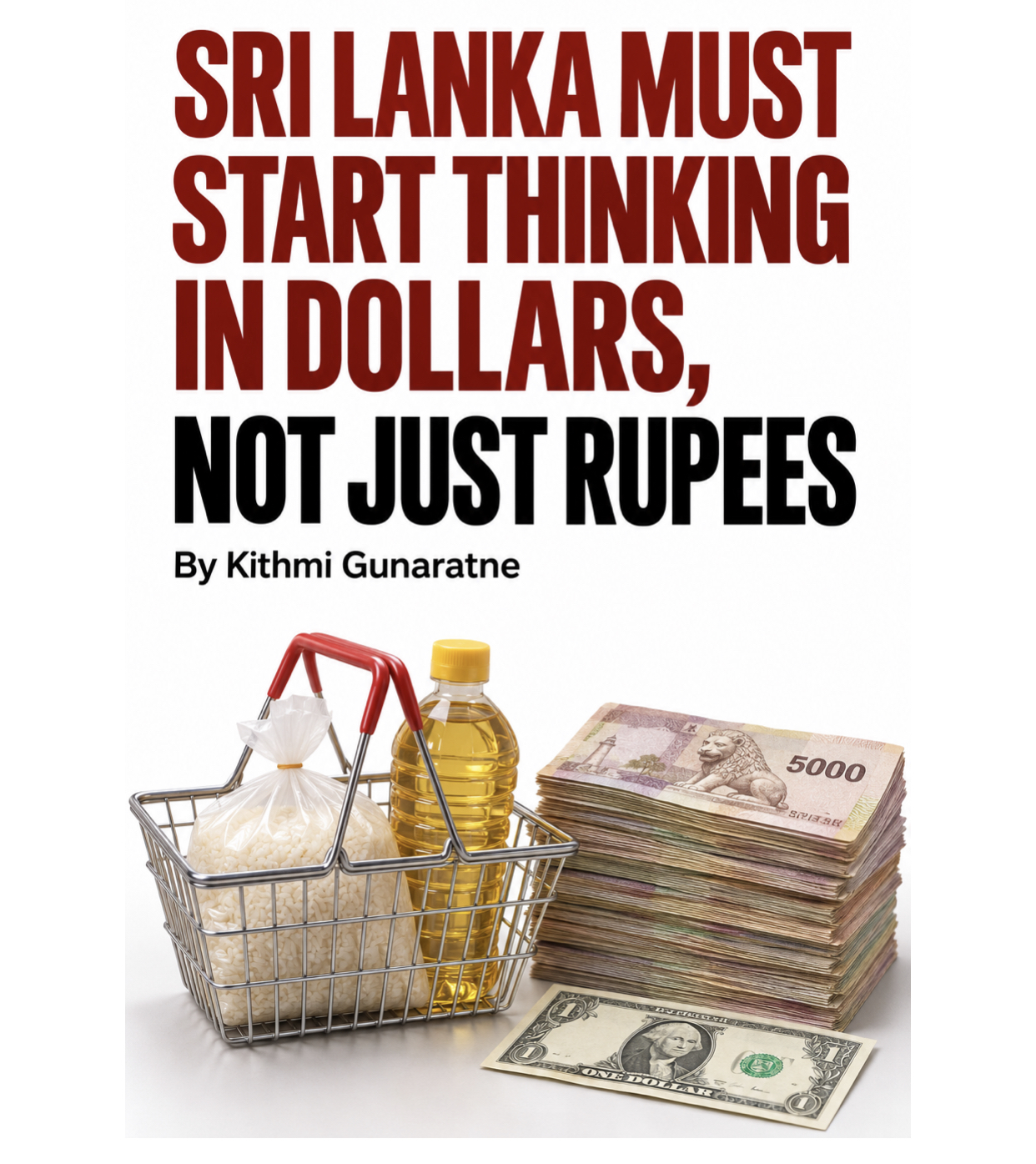
Sri Lanka celebrates rising revenues, corporate profits and economic recovery in rupees. But when inflation erodes household incomes and currency depreciation weakens international purchasing power, a harder question emerges: is the country genuinely becoming wealthier, or merely counting its progress in larger numbers?
By Kithmi Gunaratne
Sri Lanka has become remarkably comfortable with large numbers. Corporate revenues are celebrated in billions, government budgets announced in trillions, and economic recovery proclaimed through expanding domestic output. Yet beneath these figures lies an uncomfortable contradiction: a country can become nominally richer while its citizens afford less and its economy struggles to purchase what it cannot produce. For a nation dependent on imported fuel, pharmaceuticals, machinery and industrial raw materials, prosperity must be measured through two inseparable questions: what can citizens afford domestically after inflation, and what can the country afford internationally after currency depreciation?
Submit Your Press Release
Get your company news, announcements, launches, appointments and events in front of a wider audience.


The depreciation problem Sri Lanka cannot ignore
By October 2026, the rupee had depreciated 6.8% against the dollar since January, according to Central Bank data. During January–September, merchandise imports reached $18.67 billion against exports of $10.75 billion, leaving a trade deficit approaching $7.91 billion. Remittances and services earnings provide essential foreign exchange, but cannot eliminate the underlying vulnerability. The problem extends beyond imported consumer luxuries. Sri Lankan manufacturers require foreign currency to purchase machinery, chemicals, components and intermediate goods, hospitals require imported medicines and equipment, while agriculture depends partly on imported fertilisers and machinery. When the rupee weakens, these necessities become more expensive, potentially increasing production costs throughout the economy. Sri Lanka cannot depreciate its way towards industrial competitiveness when depreciation simultaneously raises the cost of industrialisation.
Hayleys: Growth beyond the currency
Hayleys illustrates the potential of internationally competitive businesses. During the six months ending September 2026, consolidated revenue from continuing operations increased 33% to Rs.358.01 billion, while pre-tax profit rose 49% to Rs.21.31 billion. The conglomerate surpassed $1 billion in first-half revenue. Its profit expansion substantially exceeded the rupee’s year-to-date depreciation, although the comparison alone cannot establish productivity gains. During the September quarter, operating profit increased approximately 55% to Rs.17 billion, while net finance costs approached Rs.5.60 billion and borrowings stood near Rs.334 billion. Hayleys demonstrates that businesses can achieve meaningful expansion despite currency instability. Nevertheless, substantial financing obligations reinforce why revenue growth must be examined alongside operating profitability, cash generation and foreign-currency exposure.
John Keells: When exchange rates change the profit story
John Keells Holdings reveals the opposite danger: currency movements can disguise underlying performance. During April–June 2026, the conglomerate recorded approximately Rs.1.89 billion in net exchange losses. In the September quarter, exchange movements instead contributed approximately Rs.340 million. Reported quarterly pre-tax profit increased 2% to Rs.7.95 billion, but excluding exchange movements, profit declined from Rs.8.04 billion to Rs.7.61 billion.
City of Dreams Sri Lanka offers a particularly revealing example. Quarterly EBITDA improved from negative Rs.64 million to positive Rs.340 million, demonstrating operational progress. Yet the development recorded a pre-tax loss of approximately Rs.1.19 billion despite an exchange gain of Rs.896 million. Depreciation, amortisation and interest expenses totalled approximately Rs.2.43 billion. The distinction matters because stronger operations do not necessarily guarantee profitability when financing costs and currency exposures remain substantial.
The real measure: What can citizens actually afford?
The contradiction becomes more troubling when examined through household incomes. Department of Census and Statistics survey findings indicate that average monthly household income rose from Rs.62,237 in 2016 to Rs.120,266 in early 2025. Yet after adjusting for inflation, average income increased by only approximately 6%. More revealingly, real median monthly household income fell from Rs.43,511 to Rs.41,623 in 2016 prices, a 4.3% decline. The typical household therefore possessed less purchasing power despite the impressive increase in nominal earnings.
Higher salaries mean little if food, electricity, transport, housing and healthcare absorb a greater share of household budgets. Inflation-adjusted income reveals whether citizens can purchase more domestically, but this represents only half the equation. A household may receive a nominal salary increase while its dollar-equivalent earnings deteriorate. Similarly, collecting more rupees in government revenue does not guarantee the capacity to import additional medicines, energy or industrial equipment.
The illusion of growth in a weakening currency
Consider a company whose revenue rises from Rs.100 billion to Rs.120 billion. It reports 20% nominal growth, but if its rupee-per-dollar exchange rate rises by 15%, dollar-equivalent revenue grows by only approximately 4.3%. Inflation may further weaken real domestic performance. Sri Lanka therefore needs two complementary measures of prosperity: inflation-adjusted purchasing power to establish whether citizens are better off, and foreign-exchange earning capacity to establish whether the economy can afford its international obligations.
Strategic dollarisation, not monetary surrender
What is monetary sovereignty worth if it cannot consistently deliver economic security? Sri Lanka does not need to abandon the rupee or surrender independent monetary policy. It needs strategic dollarisation: retaining the national currency while expanding regulated foreign-currency investment instruments, improving affordable currency hedging and requiring internationally comparable corporate reporting. Public investment and major infrastructure projects should be evaluated against both their rupee costs and foreign-exchange requirements, while safeguards prevent excessive dollar borrowing by households and businesses earning predominantly in rupees. The objective is not to replace monetary sovereignty but to make it economically meaningful.
Think in dollars. Build prosperity in rupees.
Sri Lanka must stop confusing rising monetary figures with rising economic strength. Greater domestic value addition, export diversification and internationally competitive production are essential because dollarisation cannot manufacture dollars; only productive economic activity can earn them. A successful economy must enable citizens to afford more at home while generating sufficient international earnings to finance essential imports, industrial production and future development. The real test of prosperity is not how many rupees Sri Lanka earns, but what those rupees can buy at home and what its economy can command abroad.