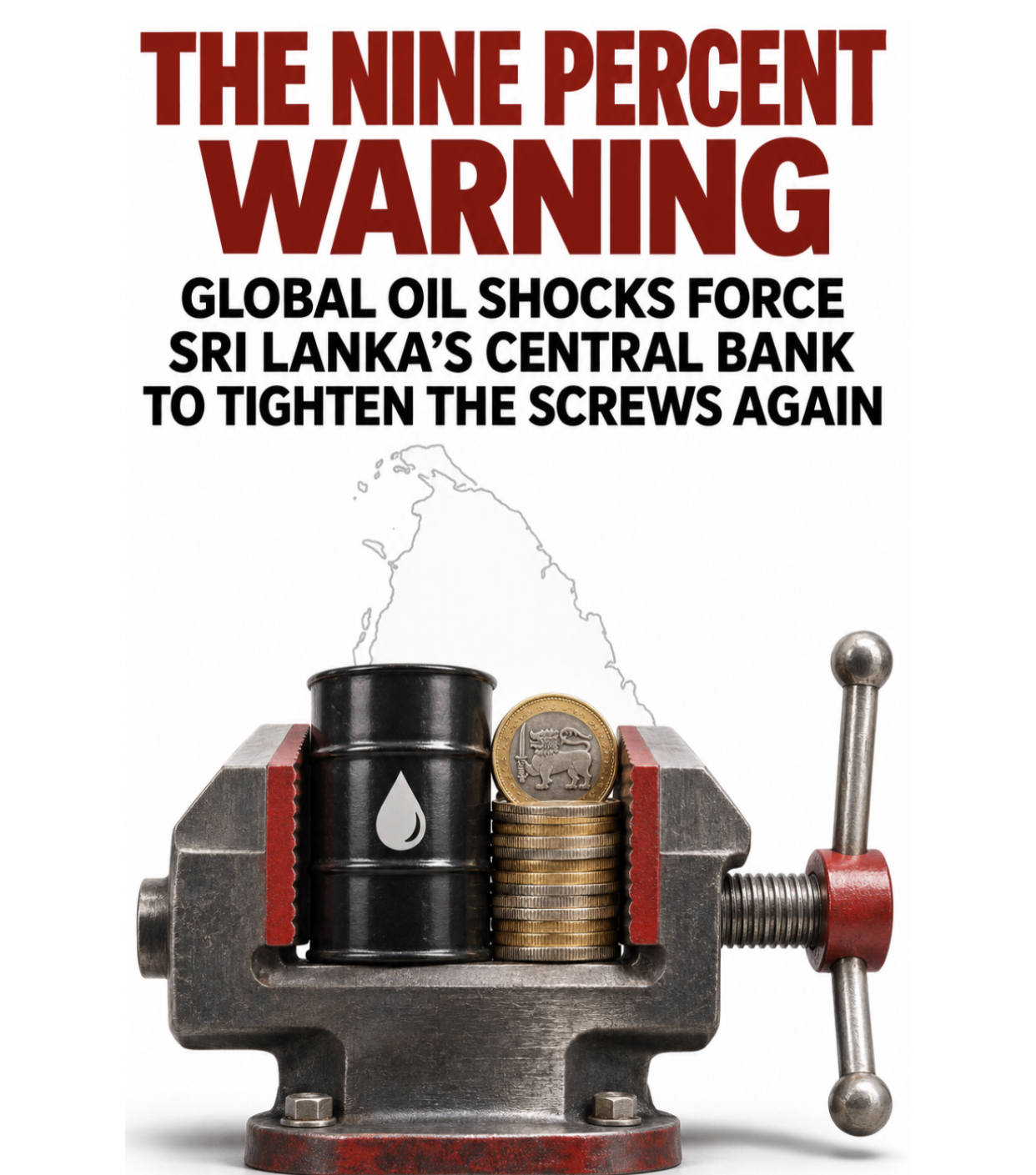
Central bankers rarely enjoy admitting that reality moved faster than their econometric models, yet candid course corrections are infinitely preferable to wishful thinking. Addressing the Monetary Policy Review media briefing in Colombo on Friday, November 20, Central Bank Governor Dr. Nandalal Weerasinghe delivered a sobering assessment of Sri Lanka’s near-term price trajectory, warning that headline inflation could climb to around nine percent or slightly higher by December 2026 after already reaching eight point three percent in October.
To put that warning into perspective, one only needs to look back six months to see how sharply external shocks have redrawn the economic map. When the Monetary Policy Board delivered an outsized one hundred basis point interest rate hike in May 2026, raising the Overnight Policy Rate from seven point seven five percent to eight point seven five percent, policymakers projected that inflation would peak neatly between seven and eight percent before tapering downward. Instead, headline inflation climbed steadily from five point four percent in May to six point eight percent in June, hit a three-year high of eight percent in August, and pushed past projections to eight point three percent last month. As Dr. Weerasinghe acknowledged on Friday, the Central Bank had assumed the conflict in the Middle East would prove short-lived and that international crude prices would stabilize swiftly. Instead, prolonged regional hostilities and shipping disruptions kept global energy costs stubbornly elevated, feeding directly into domestic transport, electricity, and food prices across an import-dependent island.
Rather than sitting on its hands while inflation expectations risk becoming unanchored, the Monetary Policy Board responded on Friday with a decisive double tightening. Policymakers raised the Overnight Policy Rate by twenty-five basis points to nine percent while simultaneously increasing the Statutory Reserve Requirement for commercial banks by one full percentage point to three percent, effective December 9. The logic behind pairing a rate hike with a reserve ratio increase reveals a fascinating balancing act inside Fort’s central banking tower. Over recent months, the Central Bank’s aggressive foreign exchange purchases from the domestic market successfully bolstered gross official reserves to roughly seven point one billion dollars by the end of October. Yet buying dollars injects substantial rupee liquidity into the domestic money market, fueling brisk private sector credit expansion that threatens to fan inflationary embers if left unchecked. Raising the Statutory Reserve Requirement mops up that excess rupee liquidity before it translates into excessive borrowing and import demand.
Submit Your Press Release
Get your company news, announcements, launches, appointments and events in front of a wider audience.


Compared to Sri Lanka’s harrowing hyperinflationary collapse of 2022, when consumer prices spiraled past seventy percent amid sovereign default and empty fuel queues, today’s nine percent projection sits in an entirely different universe. The rupee remains broadly stable, external buffers are healthy, and the Central Bank expects inflation to moderate gradually during the second half of 2027 toward its medium-term target of five percent. Still, for ordinary households whose real wages have barely recovered from years of fiscal austerity and tax hikes, an inflation rate nudging nine percent is hardly an abstract statistic. As Dr. Weerasinghe rightly underscored, allowing high inflation to linger erodes purchasing power and living standards. Yesterday’s twin policy moves show that Sri Lanka’s monetary authorities are determined not to let a foreign oil shock undo hard-won domestic stability.