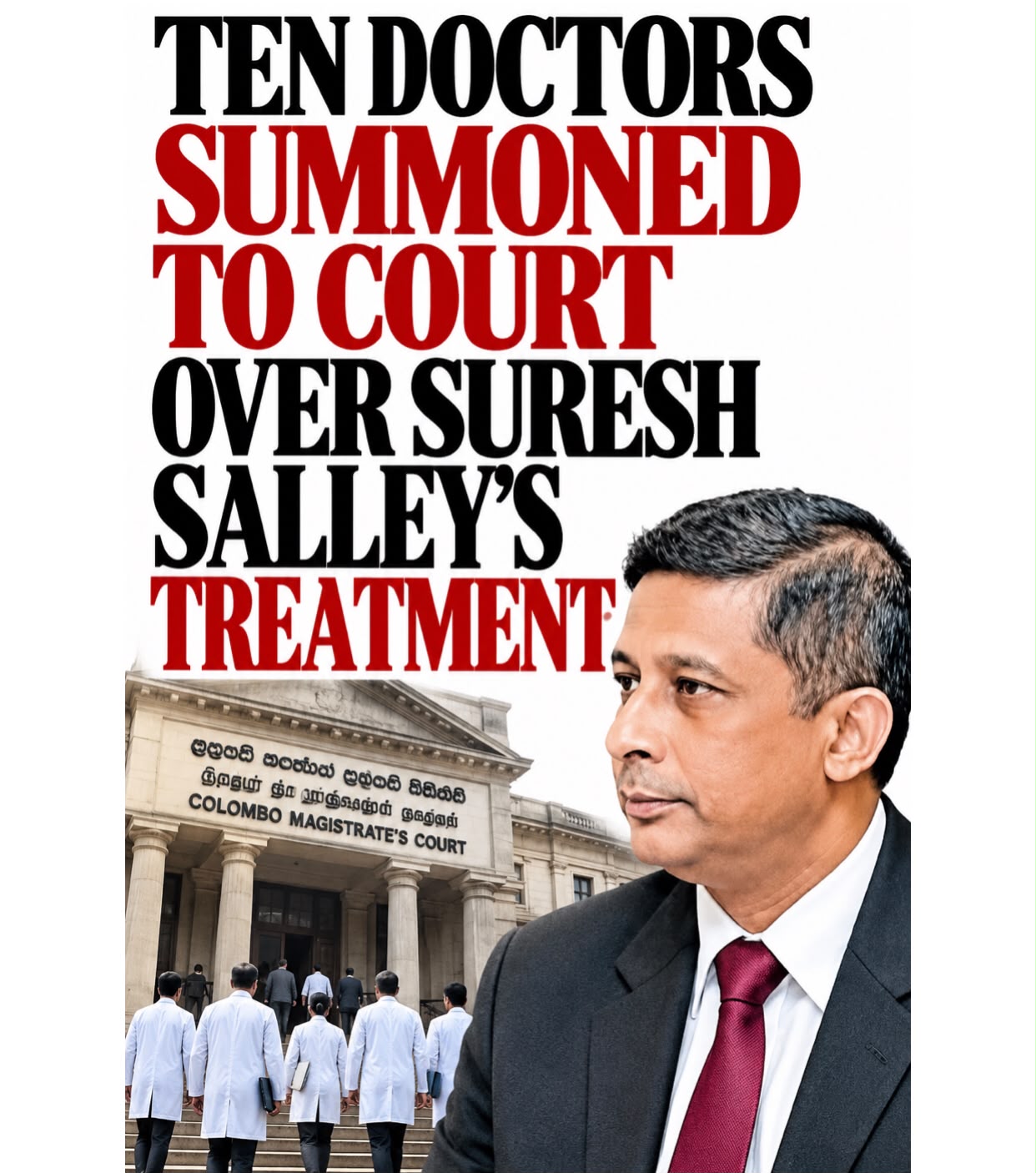
Ten doctors who served on the medical board overseeing former State Intelligence Service Director Suresh Salley’s treatment, together with the Director of the National Hospital, have been ordered to appear before the Colombo Magistrate’s Court on October 6. The order followed a motion by the CID. It deserves careful reporting because being summoned to explain a medical decision is not the same thing as being accused of wrongdoing.
The legal proceedings involving retired Major General Suresh Salley have acquired an unusual medical dimension.
Salley, the former Director of the State Intelligence Service, was arrested in connection with the continuing investigation into the Easter Sunday attacks and has been receiving treatment at the National Hospital in Colombo. A ten-member medical board had been overseeing his condition and recommended that he remain in hospital until September 28.
Submit Your Press Release
Get your company news, announcements, launches, appointments and events in front of a wider audience.


That period has now expired.
The Criminal Investigation Department returned to court through a motion, following which Colombo Chief Magistrate Pasan Amarasena issued notices requiring the ten doctors and the Director of the National Hospital to appear before court on October 6.
The immediate purpose is important.
The medical board and hospital authorities are being required to inform the court about the next course of action regarding Salley’s treatment now that the period previously recommended by the board has ended.
That is considerably different from saying that ten doctors are themselves under criminal investigation or have been accused of improperly keeping Salley in hospital. On the information presently available, that conclusion would go beyond what the court has actually done.
The distinction matters because medical treatment and judicial custody can intersect awkwardly.
A person who has been arrested does not cease to possess medical rights. If hospital treatment is genuinely required, the fact that the patient is a suspect or detainee does not make the illness disappear. Doctors must make clinical decisions according to the patient’s condition rather than public sentiment surrounding the case.
The court, however, has a different responsibility.
When a person whose liberty is controlled by judicial proceedings remains in hospital on medical advice, the court is entitled to know whether continued hospitalisation remains necessary. A previous medical recommendation cannot automatically become an indefinite arrangement simply because nobody has returned to explain what happened when the recommended period ended.
That appears to be where the present proceedings have reached.
The doctors who examined Salley possess the medical expertise. The court possesses the judicial authority. The CID is conducting the investigation. Each has a separate role and those roles should not be casually confused.
There is an additional reason for caution.
Suresh Salley is not an ordinary public figure. He previously headed Sri Lanka’s State Intelligence Service, and the investigation in which he has been arrested relates to the Easter Sunday attacks, one of the most politically and institutionally sensitive criminal investigations in the country’s recent history.
That inevitably creates enormous public interest.
It also creates fertile ground for speculation.
The correct question at this stage is therefore not whether the medical board did something wrong. There is presently insufficient basis for NewsLine to make such a claim.
The questions are narrower.
What medical assessment led the board to recommend hospitalisation until September 28? What is Salley’s present condition? Does the board now recommend further inpatient treatment, treatment under another arrangement or discharge? What information does the court require before deciding what happens next?
NewsLine would like to also ask: how many persons detained by the state for whatever reason – investigation, pending trial, convicted even – are hospitalised for dental care? After 108 days its time that the trial got on not for the state to be made into an unwilling partner in what appears to be delay tactics – a charade even – simply to buy more time before the inevitable.
Those answers should become clearer when the doctors and hospital director appear on October 6.
The independence of medical judgment matters. So does the authority of a court to satisfy itself that a person in judicial proceedings remains in hospital for legitimate medical reasons.
Neither principle has to defeat the other.
That is precisely why the doctors are being asked to explain.