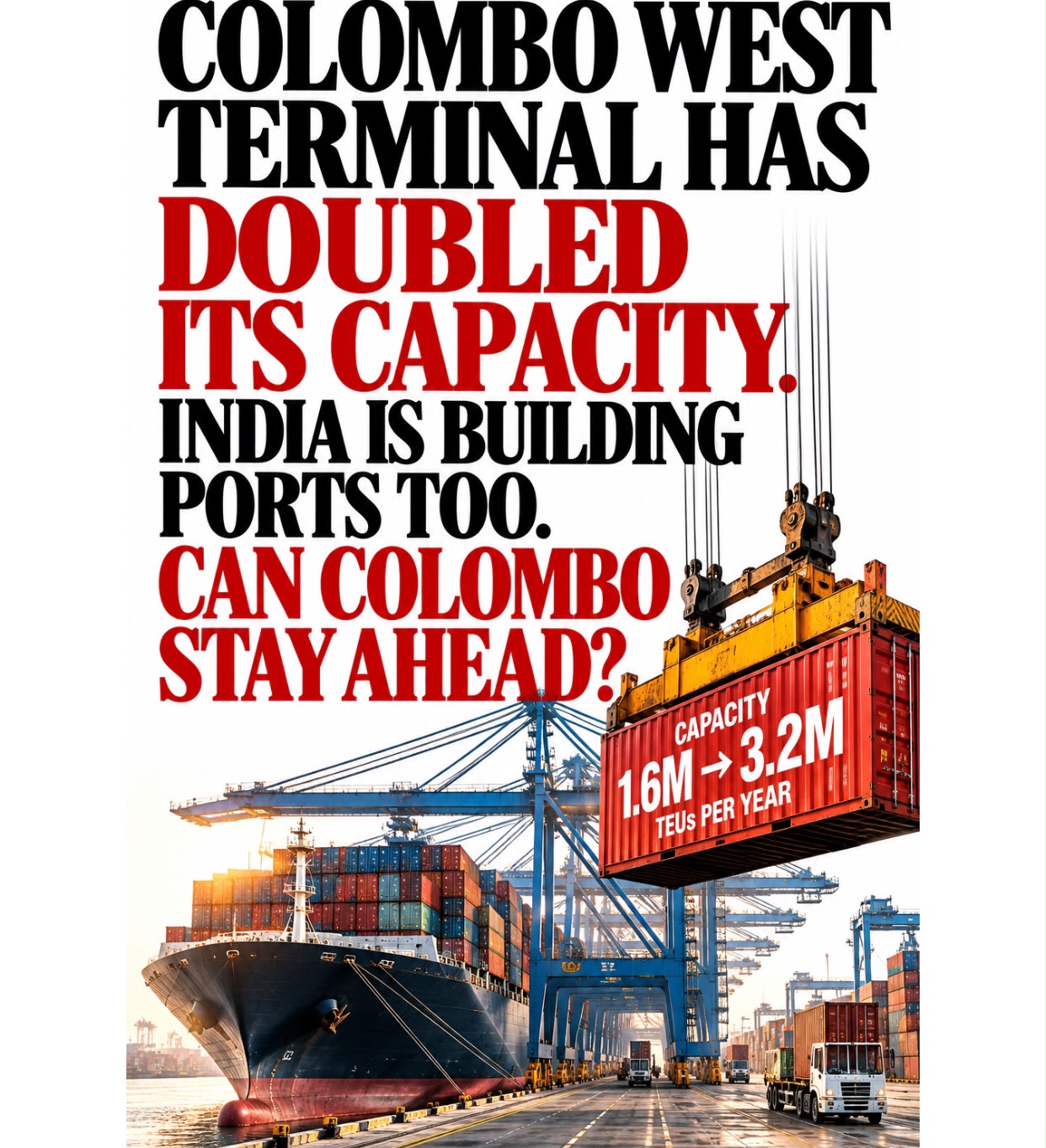
Colombo West International Terminal has doubled its annual capacity from 1.6 million to 3.2 million containers after handling more than 2 million TEUs in its first 18 months. It is an impressive beginning. The larger question is whether Colombo can convert its geographical advantage into something India’s rapidly expanding ports cannot economically replace.
There are some numbers that explain why ports matter to Sri Lanka considerably better than speeches about becoming a maritime hub. Colombo West International Terminal has handled more than 2 million twenty-foot equivalent units within its first 18 months of operation and has now commissioned the second phase of a US$750 million investment.
Its annual handling capacity has consequently doubled from 1.6 million to 3.2 million TEUs. The expanded deep-water terminal can accommodate three ultra-large container vessels simultaneously and operates as Sri Lanka’s first fully automated container terminal.
Submit Your Press Release
Get your company news, announcements, launches, appointments and events in front of a wider audience.


Those are serious numbers.
CWIT alone is ultimately intended to handle close to a quarter of the Port of Colombo’s targeted 13 million TEU annual capacity by 2028. The terminal is operated through a partnership involving India’s Adani Ports and Special Economic Zone, John Keells Holdings and the Sri Lanka Ports Authority under a 35-year build-operate-transfer arrangement.
But the most important cargo at Colombo is not necessarily coming to Sri Lanka.
Colombo’s great maritime advantage has always been transshipment. The island sits immediately beside one of the world’s busiest East-West shipping routes while much of neighbouring India’s container traffic has historically required transfer through larger regional hub ports.
A container originating at an Indian port can therefore travel to Colombo aboard a smaller feeder vessel, be transferred onto an enormous mainline vessel and continue towards Europe, America or another major destination.
That business has been extraordinarily valuable to Colombo.
It is also business India would understandably prefer to perform itself.
India has been investing heavily in port capacity and deep-water infrastructure, with Vizhinjam in Kerala emerging as an especially important competitor. The irony is difficult to miss. Vizhinjam is itself operated by Adani Ports, the principal investor in Colombo West.
Adani therefore has substantial interests on both sides of the competition.
That does not make the Colombo investment contradictory. Global port operators invest where cargo exists and where they believe cargo will grow. It does mean Sri Lanka should avoid assuming that an investor in Colombo has any reason to prevent an Indian terminal from competing vigorously with it.
Sri Lanka’s protection must come from economics.
Colombo has geography on its side. It sits close to the main East-West shipping lane and has decades of experience as a transshipment hub. It has established relationships with shipping lines, a significant network of feeder services and increasingly sophisticated terminal infrastructure.
But geography is an advantage, not a monopoly.
Shipping companies ultimately care about turnaround times, berth availability, productivity, cost, reliability and how far a vessel has to deviate from its main route. If another port can provide a competitive combination of those things, cargo can move.
That makes CWIT’s automation and deep-water capability particularly important. Modern container ships are enormous and become expensive whenever they are sitting still. A terminal capable of handling several ultra-large vessels quickly and predictably becomes valuable because time itself is part of the shipping company’s cost.
There is also a larger opportunity that Sri Lanka has discussed far more often than it has exploited.
A successful port should create economic activity beyond moving somebody else’s container from one ship to another. Logistics, warehousing, ship services, bunkering, repair, distribution, processing and value-added operations can capture substantially more of the money flowing through a maritime hub.
Sri Lanka has spent decades celebrating container throughput while often capturing only a fraction of the wider economic opportunity created by its location.
CWIT’s expansion therefore deserves attention, but not simply because another terminal can handle another 1.6 million TEUs.
The important test comes over the next several years.
Can Colombo retain Indian transshipment traffic while India’s own deep-water ports expand? Can it attract additional mainline services? Can faster terminals lower the cost of Sri Lankan exports and imports? Can the country build logistics businesses around the port rather than merely watching containers pass through it?
Two million containers in 18 months is an excellent beginning.
The next question is how much value Sri Lanka keeps after they leave.