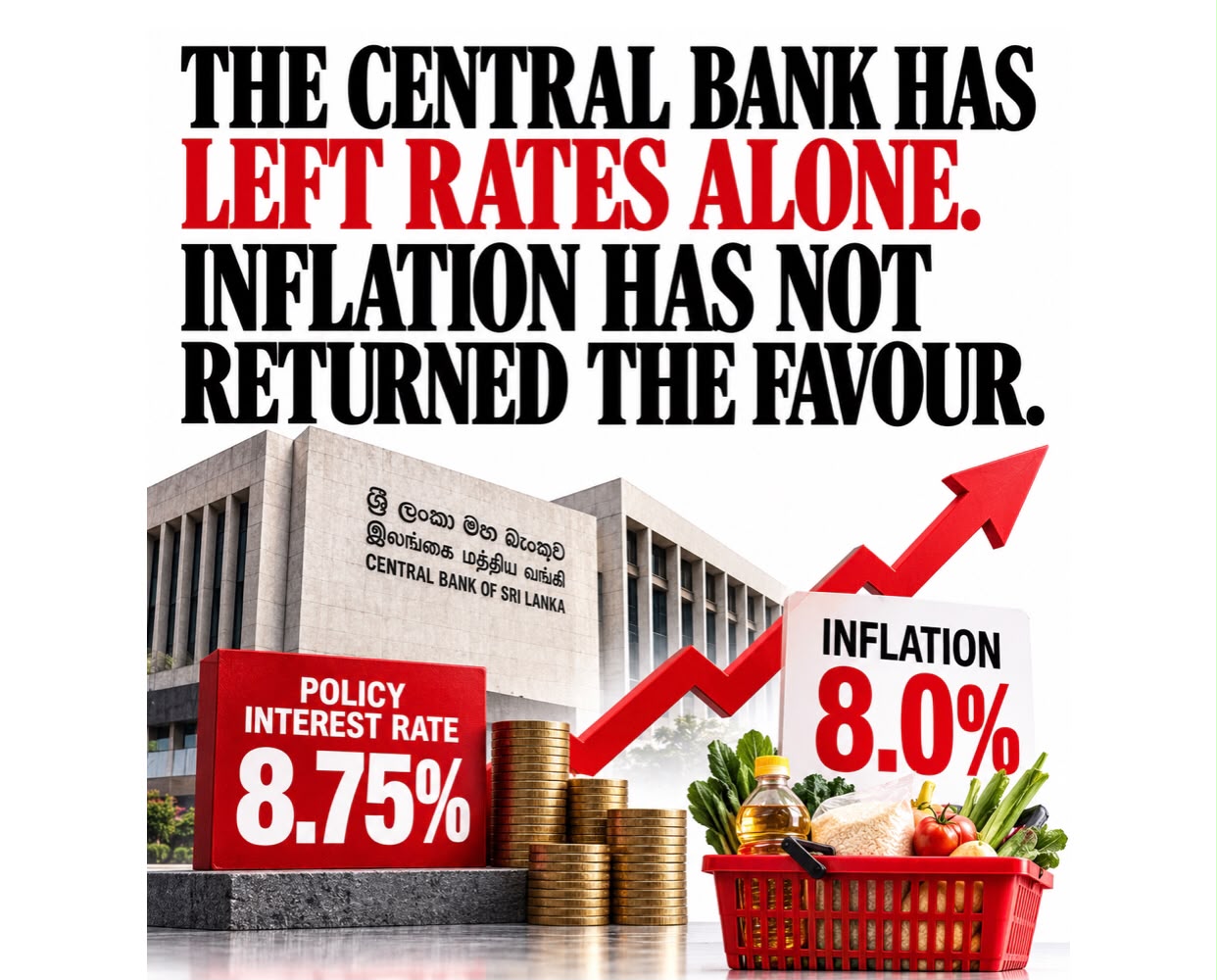
Sri Lanka’s policy interest rate remains at 8.75 percent while inflation has climbed to 8 percent. The Central Bank believes the tightening already undertaken should be given time to work. For households and businesses, however, the question is whether prices will be equally patient.
The Central Bank has decided against another immediate increase in interest rates, keeping the Overnight Policy Rate at 8.75 percent as it attempts to balance two competing dangers. Tighten too aggressively and the recovery could be damaged. Wait too long while inflation is accelerating and the country risks allowing price pressures to become considerably more difficult to contain.
Headline inflation reached 8 percent in August, up from 7.3 percent in July, while core inflation also increased to 5.1 percent. The distinction matters because headline inflation can be pushed around by food and energy prices, whereas core inflation attempts to identify the more persistent price pressures developing underneath them.
Submit Your Press Release
Get your company news, announcements, launches, appointments and events in front of a wider audience.


Sri Lanka’s present inflation problem has an important external component. The Middle East crisis pushed international petroleum prices sharply higher, and a country importing its fuel cannot insulate itself completely from what happens thousands of kilometres away. Higher petroleum costs eventually find their way into transport, electricity, manufacturing and food distribution, spreading the original shock much further through the economy.
The Central Bank’s difficulty is that increasing interest rates in Colombo cannot reduce the international oil price. Monetary policy can suppress domestic demand and credit, but it cannot reopen a shipping route, increase global petroleum production or reduce the insurance premium on a tanker travelling through a conflict zone. Increasing rates too aggressively in response to imported inflation could therefore punish domestic borrowers without addressing the original cause.
There is nevertheless a danger in assuming that imported inflation remains imported. Businesses confronted with higher energy and transport costs pass them onwards. Workers whose purchasing power is being eroded seek higher wages, suppliers increase prices and expectations begin adjusting. An external price shock can eventually become domestic inflation, which is precisely what the Central Bank must prevent.
The wider economy is in considerably better condition than it was during the crisis. Growth continued in the second quarter, official reserves reached approximately US$6.9 billion by the end of August and the financial system remains substantially stronger. Those are important achievements, but they do not alter what inflation means to the person standing at a supermarket checkout.
There is a particularly misunderstood feature of falling inflation. If something costing Rs 100 rises to Rs 108 and inflation subsequently falls from 8 percent to 5 percent, the price does not return to Rs 100. It continues rising, only more slowly. That distinction between falling inflation and falling prices explains why official declarations of improving inflation can sound rather different from the experience of a household paying its bills.
The Central Bank is therefore making a calculated judgment that its previous tightening should be allowed to work through the economy before further action is considered. Credit conditions are already responding, while additional government measures have attempted to contain some of the pressures created by higher energy prices.
That judgment may prove correct. Monetary policy works with a delay and repeatedly changing direction can create its own instability. The difficulty is that Sri Lanka has spent several painful years restoring price stability and has relatively little room for complacency if inflationary expectations begin moving upwards again.
The number to watch is consequently not merely the 8.75 percent policy rate. It is what happens to inflation, core inflation, private credit, the rupee and energy prices during the months ahead. If those begin moving in the wrong direction together, leaving interest rates unchanged becomes a considerably more difficult decision to defend.
For now the Central Bank has decided to wait. Inflation, unfortunately, has not.