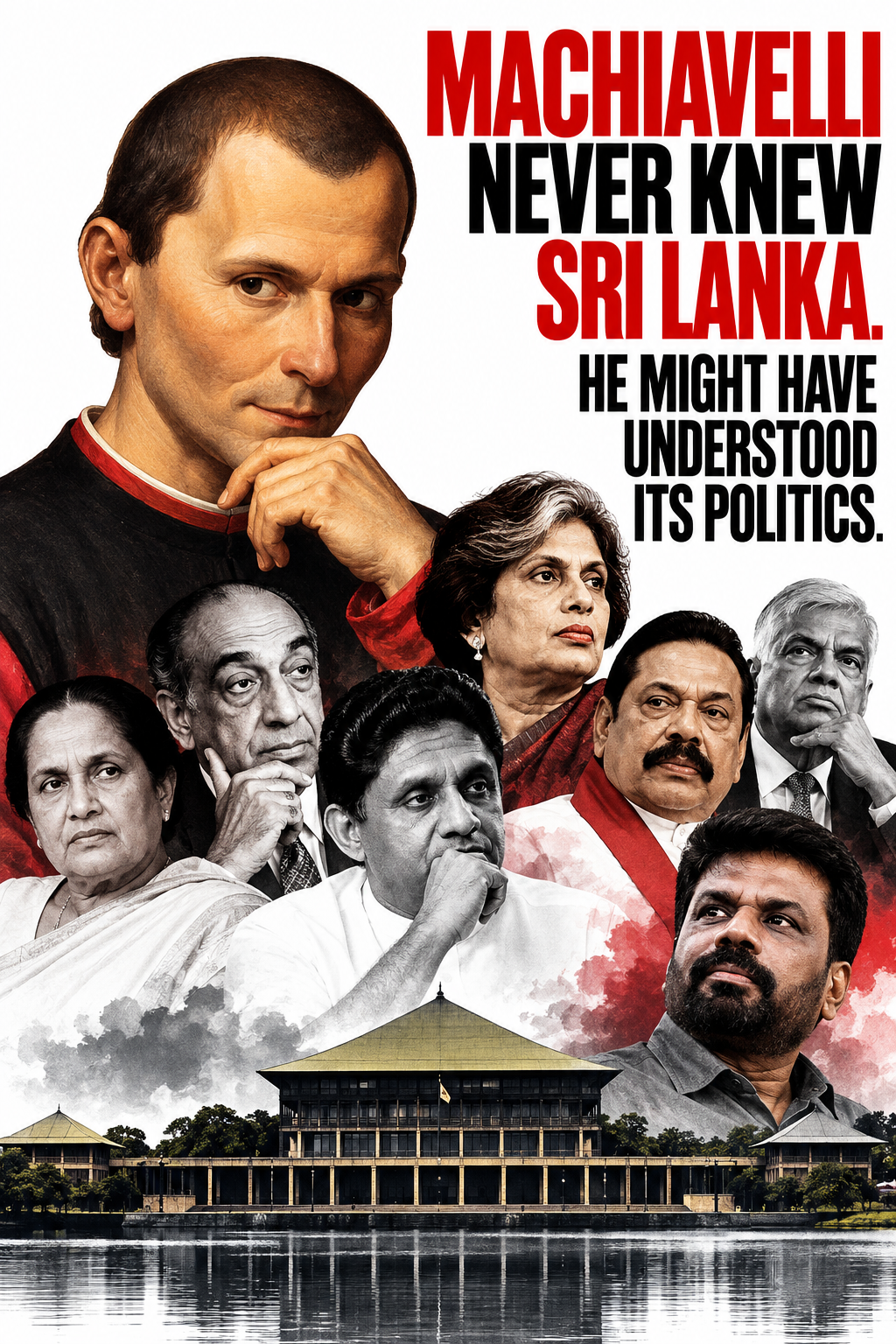
Five centuries ago, Niccolò Machiavelli wrote a little book about acquiring power, exercising it and, most importantly, keeping it. Sri Lanka’s leaders may not have governed with The Prince on their bedside tables. But from Sirimavo to JR, Premadasa to Chandrika, Mahinda to Ranil and now Anura Kumara Dissanayake, some of Machiavelli’s questions have an oddly familiar ring.
Niccolò Machiavelli died in 1527. He never heard of Sri Lanka, executive presidencies, constitutional amendments, preferential votes or two-thirds majorities.
Be that as it may, he might have recognised the politics.
Submit Your Press Release
Get your company news, announcements, launches, appointments and events in front of a wider audience.


The Prince, written in 1513, was not really a handbook teaching politicians to be wicked, although that is how it is frequently remembered. It was something considerably more uncomfortable: an examination of political power stripped of the comforting language politicians use to describe it.
Machiavelli wanted to know what a ruler actually had to do to acquire power, maintain authority and survive enemies, betrayal, popular anger and changing fortune. He distinguished between virtù – political skill, nerve, adaptability and decisiveness – and fortuna, the unpredictable events that can make or destroy a leader.
Sri Lanka’s post-independence history offers plenty of both.
Sirimavo Bandaranaike governed before the executive presidency existed, but she demonstrated one of Machiavelli’s fundamental propositions: institutions are shaped by those possessing sufficient political power to reshape them. Her United Front possessed the parliamentary strength to create the First Republican Constitution in 1972. Sri Lanka became a republic, the old constitutional order disappeared and effective political power remained centred on the Prime Minister and parliamentary majority. The constitution was different; the underlying question was timeless: who possesses sufficient power to write the rules under which power itself will operate?
Then came J.R. Jayewardene, perhaps the most obvious Sri Lankan figure through whom to read The Prince.
JR did not merely inherit power. He redesigned it.
The executive presidency he had advocated years earlier became reality in 1978. The new constitutional architecture placed enormous authority in a directly elected President. Then came another remarkable exercise in political power. Instead of holding the parliamentary election that would ordinarily have followed, the 1982 referendum asked voters to extend the life of the existing Parliament until 1989. The proposal passed with 3,141,223 votes against 2,605,983.
Machiavelli would surely have been interested. A successful prince does not merely occupy the political battlefield. Where circumstances permit, he alters the battlefield itself.
Ranasinghe Premadasa demonstrated another Machiavellian reality: obtaining the throne does not end the struggle for power. Sometimes it begins it.
Premadasa inherited JR’s extraordinarily powerful presidency but faced enemies within his own political establishment. In 1991 an impeachment attempt emerged with support extending into his own governing party. Contemporary reports said around 120 MPs had backed the move before the political counterattack began.
That episode illustrates one of the subtler lessons of The Prince. A ruler must worry not only about the opposition outside the gates but about powerful men standing inside them. Political survival therefore depends upon managing allies, rivals and institutions simultaneously.
Chandrika Bandaranaike Kumaratunga presents a different contradiction.
She came to power in 1994 amid demands for political change and constitutional reform. Yet she governed for eleven years within the executive presidential system created by JR. Whatever the intentions, constraints and failed reform efforts of that period, the institution survived her presidency. Parliament’s official record places Kumaratunga in the executive presidency from November 1994 until November 2005.
Here Machiavelli poses an awkward question extending far beyond Chandrika: what happens when politicians who criticise powerful institutions eventually inherit them?
The view from inside the palace can be remarkably different from the view outside its gates.
Mahinda Rajapaksa provides another fascinating case study.
He became President in 2005 and presided over the military defeat of the LTTE in 2009, dramatically altering the political environment in which he governed. Then, in 2010, the Eighteenth Amendment removed the constitutional two-term limit on the presidency. Parliament’s own documentation records precisely that consequence: a President who had been elected twice could again seek election.
Machiavelli wrote repeatedly about fortuna – the moment history presents – and virtù, the political capacity to exploit it.
Rajapaksa emerged from the war with immense political authority. The constitutional architecture was subsequently changed in a manner that removed a restriction on how long an incumbent could continue seeking the presidency.
Whether one regards that as democratic constitutional change or excessive concentration of power is a political judgement. The Machiavellian question is simpler: when political circumstances created an opportunity to consolidate authority, was that opportunity used?
Then consider Ranil Wickremesinghe.
His route to the presidency was almost the reverse of Mahinda’s.
He did not arrive on a great electoral wave. He arrived through institutional survival after the state itself appeared close to breakdown. Gotabaya Rajapaksa fled amid the 2022 economic crisis and mass protests and resigned. Parliament then elected Wickremesinghe under Article 40 to complete the presidential term.
That might have fascinated Machiavelli most of all.
Fortuna had produced extraordinary circumstances. A politician whose party had been electorally devastated suddenly occupied the most powerful office in the country because the constitutional machinery, parliamentary arithmetic and national crisis converged at precisely the right moment.
Power does not always belong to the politician commanding the largest crowd. Sometimes it belongs to the politician who remains standing when everybody else has fallen.
And now Anura Kumara Dissanayake.
Here the story becomes especially interesting because AKD came to office promising precisely the sort of systemic transformation demanded after the collapse of the old political establishment. He won the presidency in September 2024, dissolved Parliament almost immediately and sought a fresh legislative mandate.
He got one.
And therefore the politician who once challenged concentrated establishment power eventually found himself possessing something Sri Lankan leaders have historically valued enormously: the presidency backed by overwhelming parliamentary numbers.
Last week provided an extraordinary contemporary illustration. The Twenty-Second Amendment passed Parliament with 158 votes to 63 at its Second Reading and 158 votes at its Third Reading. The Supreme Court had determined that the measure could be enacted with the required special majority without a referendum.
Supporters argued the reform strengthened the administration of justice and addressed the structure and retirement of the superior judiciary. Opponents argued that it raised serious questions about judicial independence and executive influence. Those arguments should be judged on their merits, not by attaching Machiavelli’s name to either side.
But The Prince suggests another question.
What happens when a political movement created to challenge the concentration of power eventually acquires an overwhelming concentration of democratic power itself?
That may be the real lesson running from Sirimavo through JR, Premadasa, Chandrika, Mahinda and Ranil to AKD.
Sri Lanka keeps changing its rulers. It occasionally changes its Constitution. It repeatedly promises to change its political culture.
Yet power possesses its own gravitational force.
Machiavelli understood that rulers are changed by circumstances, enemies, opportunity and fear. More importantly, he understood that possessing power changes the calculations of those who possess it.
Five hundred years later, perhaps the most important question The Prince leaves Sri Lanka is therefore not whether our leaders are Machiavellian.
It is considerably more uncomfortable.
When politicians finally obtain the power they once criticised others for possessing, what persuades them to give any of it back?