There are people who build successful businesses, people who serve in government, people who excel in sport, and people who devote themselves to the arts. There are very few who manage to leave a meaningful mark across all four worlds. Thilan Wijesinghe belongs to that unusual category. His career has crossed investment banking, public policy, infrastructure, real estate, hospitality, education, cricket and music. More importantly, much of his professional life has been connected to one underlying objective: finding ways to mobilise private capital, talent and ideas to create something of lasting value in Sri Lanka.
His journey into the world of business began at a remarkably young age. Wijesinghe was among the founders of Asia Capital PLC and Asia Stock Brokers, established during a period when Sri Lanka’s capital market was undergoing major transformation. The company grew rapidly and became one of the country’s leading investment and stockbroking businesses. In an interview with Business Today, Wijesinghe recalled that Asia Capital grew from an initial investment of approximately US$25,000 to a market capitalisation of around US$55 million by 1994. Within a relatively short period, the company had become a significant force in the Colombo capital market and was involved in major corporate-finance transactions.
Among the transactions associated with Asia Capital was the privatisation of Trans Asia Hotel, then valued at approximately US$40 million and described by Wijesinghe as the largest transaction executed through the Colombo Stock Exchange at the time. Asia Capital also co-promoted the Regent Sri Lanka Fund, described as the first country fund dedicated to Sri Lankan equities. These achievements were significant not merely because of their financial size, but because they demonstrated that Sri Lankan companies could create sophisticated financial products and transactions at a time when the country’s capital markets were still developing.
Submit Your Press Release
Get your company news, announcements, launches, appointments and events in front of a wider audience.


Then came a decision that would change the direction of his career. In 1995, at the age of 35, Wijesinghe was invited to become Chairman and Director General of the Board of Investment of Sri Lanka. He was the youngest person to hold the position. Before taking up the appointment, he sold his interest in Asia Capital, citing the importance of avoiding conflicts of interest. The decision was significant because he was voluntarily walking away from ownership of a business he had helped build in order to take on a public-sector responsibility.
At the Board of Investment, his role extended far beyond attracting foreign investors. He became involved in developing the institutional structures, incentives and infrastructure required to make investment possible. One of his early priorities was the investment incentive framework. He worked with the investment community, BOI officials, Treasury officials and the Government to develop targeted incentives intended to make Sri Lanka more competitive as an investment destination. He also secured Treasury funding for the development of nine investment zones during his tenure, addressing one of the most practical problems facing investors: the availability of suitable infrastructure.
Perhaps the most enduring part of his BOI contribution was his work in public-private partnerships. In 1996, Wijesinghe established the Bureau of Infrastructure Investment within the BOI. The objective was to develop the institutional and technical capability required to structure private investment into infrastructure projects. According to his own account, the unit subsequently helped financially close and implement approximately US$800 million of infrastructure projects during his tenure. These included the South Asia Gateway Terminal, independent power projects, mini-hydro projects, telecommunications ventures and other infrastructure initiatives. In many respects, this was an early demonstration of a concept that has become increasingly important to Sri Lanka decades later: that the public sector and private capital can work together to deliver infrastructure and economic development.
His contribution to the development of Sri Lanka’s information-technology sector is another important but sometimes overlooked part of the story. During his time at the BOI, Wijesinghe identified the shortage of software programmers and the limited capacity of the country’s education system to produce technology graduates as a major constraint on future investment. He worked with university leaders and other stakeholders on the development of a dedicated technology institution. This ultimately contributed to the establishment of the Sri Lanka Institute of Information Technology, or SLIIT, together with Dr Lalith Gamage and Professor Sam Karunaratne. What began with BOI seed funding eventually developed into one of Sri Lanka’s major private higher-education institutions.
The results achieved during his BOI period have to be understood in the broader context of Sri Lanka’s economic development at the time. Wijesinghe has recalled that Sri Lanka recorded approximately US$206 million in foreign direct investment in 1999, while GDP growth reached 7.8 percent. The BOI also received international recognition for its investment-promotion work. None of these achievements can reasonably be attributed to one person alone. Wijesinghe himself has repeatedly emphasised the importance of the teams, government officials, investors, professionals and institutions with whom he worked. Nevertheless, his role in designing and pushing several of these initiatives places him among the significant figures in Sri Lanka’s investment-promotion history.
What makes his career particularly interesting is that his contribution did not end when he left the BOI. His professional journey continued through major businesses in property, hospitality, investment and technology. He became involved with companies and ventures including Asian Hotels and Properties, Overseas Realty, Ceylon Tea Trails and other entrepreneurial projects. Across these businesses, the common theme remained the creation of assets, businesses and institutions capable of attracting capital and creating economic activity in Sri Lanka.
Years later, Wijesinghe returned to the public-policy arena. In 2017, he became the founding Chairman of the National Agency for Public-Private Partnership under the Ministry of Finance. The appointment brought his career back to an area he had first pioneered more than two decades earlier at the BOI. The agency was intended to develop Sri Lanka’s capacity to identify, structure and implement PPP projects, and profiles of his work during this period refer to the development of a PPP project pipeline exceeding US$2 billion.
This continuity is perhaps one of the most interesting aspects of his career. Sri Lanka has gone through dramatic political and economic changes during the decades in which Wijesinghe has been active. Governments have changed, economic policies have changed, and the country has experienced periods of rapid growth, crisis, restructuring and recovery. Yet his involvement in investment, infrastructure, capital mobilisation and public-private partnerships has continued across these changes. Rather than being associated exclusively with one political administration, his professional work has repeatedly been connected to the broader economic question of how Sri Lanka can attract capital, build infrastructure and create productive businesses.
Today, that work continues through TWC, where Wijesinghe serves as Chairman and CEO. TWC describes itself as an investment and advisory group focused on mobilising diversified capital into priority sectors of Sri Lanka’s economy. Its activities include corporate advisory, private equity, mergers and acquisitions, real-estate advisory, policy advocacy and public-private partnership advisory. The company’s PPP work covers areas including policy and legislative frameworks, project structuring, procurement, capacity building and transaction management, with experience spanning ports, power and renewable energy, telecommunications, digitisation, software parks, housing, healthcare and higher education.
There is therefore a remarkable consistency in the journey. The young entrepreneur who helped build Asia Capital became the BOI chairman who established an infrastructure-investment capability. More than two decades later, he returned to public policy to work on public-private partnerships, and today he continues to advise businesses, investors and public-sector stakeholders through TWC. The titles have changed, the institutions have changed and the economic environment has changed, but the underlying objective has remained remarkably similar: finding ways to bring capital, expertise and institutions together to build economic capacity in Sri Lanka.
But to understand Thilan Wijesinghe only through business and economics would be to miss an important part of his personality. Before investment banking and public policy, there was cricket. At Ananda College, he was an exceptionally talented young cricketer. He played First XI cricket at only 13, represented several age groups, captained school teams and scored a century in the Ananda-Nalanda Big Match. He later represented Sri Lanka at Under-19 level and continued his cricketing career with Tamil Union Cricket and Athletic Club.
His cricketing ambitions eventually took him into the national development structure. In 1991 and 1992, he captained the Sri Lanka A team against England A and Pakistan A. He was therefore not simply someone who played cricket recreationally; he reached a level where professional cricket and business became genuine competing career paths. Ultimately, he chose business, but cricket remained an important influence throughout his life. Wijesinghe has spoken about cricket teaching him steadiness of mind and body and about the way the sport allowed him to build relationships with people from different communities and backgrounds.
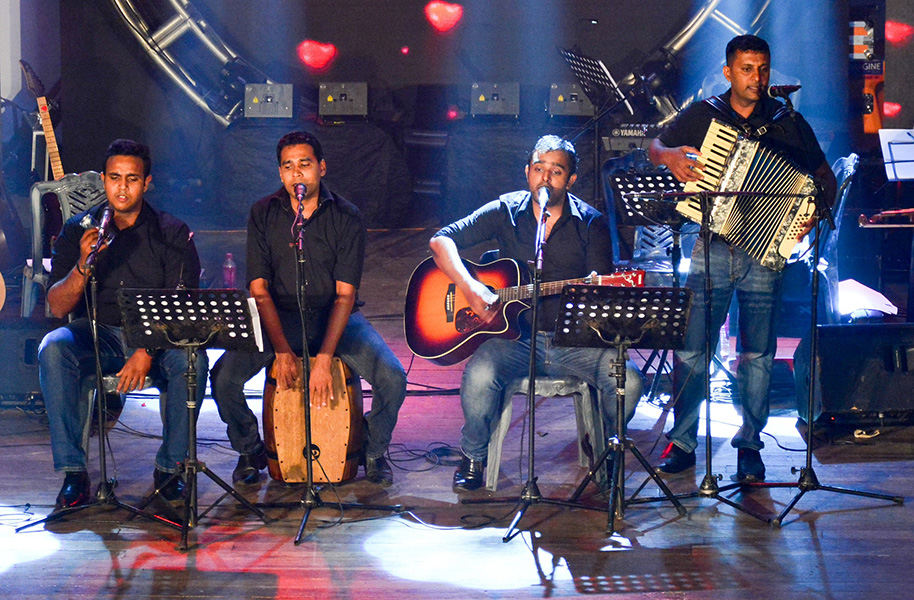
Then there is music, perhaps the most unexpected dimension of his story. Wijesinghe grew up in a musical family and learned instruments including piano, guitar and harmonica. At university, he began composing music. After returning to Sri Lanka, he auditioned for Nimal Mendis’s “The Thinking Show” and became involved in the country’s music scene. He developed friendships with musicians including Husni Suresh, D.K., Anthony Surendra and Jude Peiris. His musical involvement eventually went well beyond a hobby. He won the Golden Clef award for Folk Musician of the Year in Sri Lanka in 1991 and later became associated with Alien Accent. In 2001, he produced Rites of Passage, an album featuring his compositions.
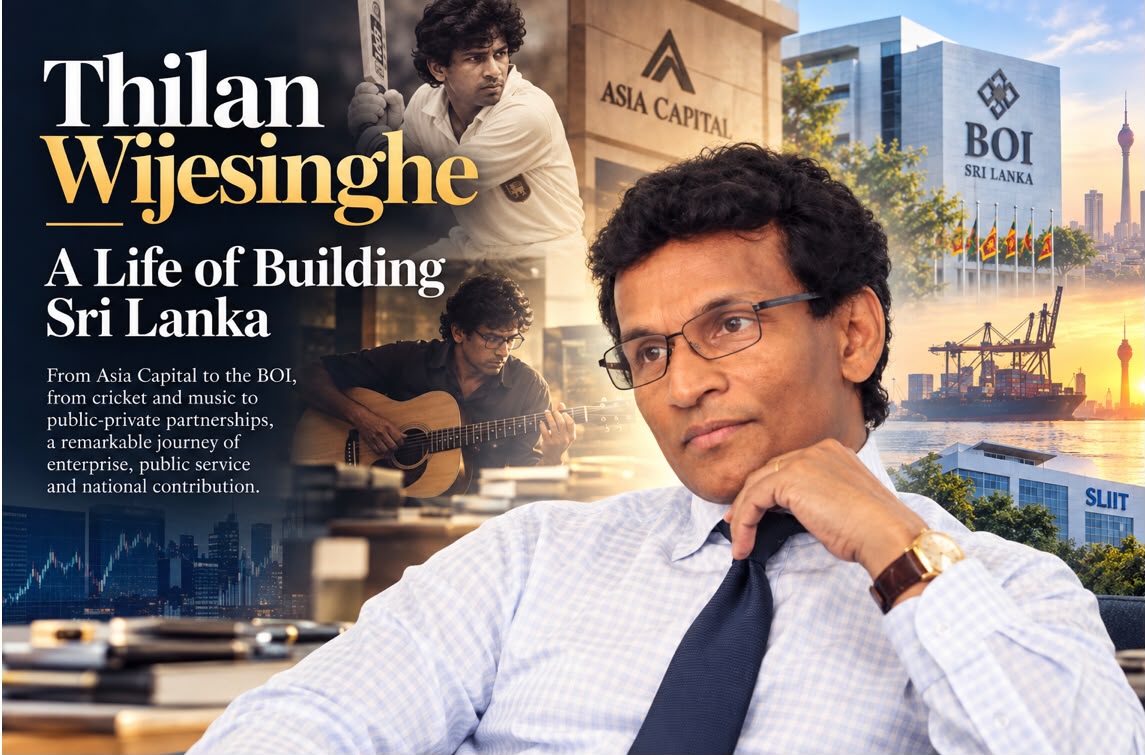
Those who remember his Asia Capital years also recall another, more personal side of the businessman. Amid the investment banking, financial analysis, corporate transactions and meetings, there was the guitar. He was known to pick up the guitar and play at his desk at the Asia Capital office. It is a small detail, but perhaps one of the most revealing images of the man: a young investment banker and entrepreneur surrounded by the intensity of Colombo’s financial world, yet still finding time to sit at his desk with a guitar.
That combination of interests is what makes his story particularly unusual. Cricket taught him discipline and competitiveness. Music gave him creativity and another form of expression. Business gave him the opportunity to build companies and mobilise capital. Public service gave him a platform to influence economic policy and infrastructure development. Instead of existing as separate parts of his life, these different experiences appear to have informed one another.
His career also provides an interesting perspective on what economic contribution really means. Economic contribution is not measured only by personal wealth or the size of a company. It can also be measured through institutions created, investment facilitated, infrastructure developed, businesses enabled, educational opportunities expanded and professionals trained. From the capital markets of the early 1990s to the BOI, from SLIIT to public-private partnerships and now TWC, Wijesinghe’s career has touched many of these areas.
It would be inaccurate to suggest that every achievement associated with these institutions belongs to one individual. Large economic projects are collective achievements involving governments, civil servants, investors, entrepreneurs, financiers, engineers, academics and countless professionals. Wijesinghe himself has acknowledged this repeatedly. But it is equally reasonable to recognise individuals who have repeatedly taken leadership roles in building such institutions and projects.
Sri Lanka has many talented people whose achievements can easily disappear into the background of political and economic events. The country often remembers politicians, sports stars and major corporate personalities, while overlooking individuals who have spent decades moving between the private sector and public institutions trying to solve practical economic problems. Wijesinghe’s career deserves attention precisely because it does not fit neatly into one category.
He was an entrepreneur before becoming a public official. He was a public-sector reformer who returned to business. He was an investment banker who helped structure major transactions, a BOI leader who worked on investment and infrastructure, an advocate of public-private partnerships, an education-sector builder, a cricketer who represented Sri Lanka at A level, and a musician who could put down the financial papers and pick up a guitar.
Perhaps the most admirable aspect is the persistence. Regardless of changes in governments, economic circumstances and political environments, the underlying engagement with Sri Lanka’s economic development has continued. Today, through TWC and his work in investment and public-private partnerships, that contribution continues in another form.
There is a broader lesson in that journey. Sri Lanka needs people who can move beyond political cycles and think in terms of institutions, infrastructure, investment, education and long-term economic capacity. It needs entrepreneurs who understand public policy, policymakers who understand business, and professionals who can bring different worlds together.
Thilan Wijesinghe’s career offers an example of that kind of versatility. His achievements do not need exaggeration to be impressive. They can be found in the companies he helped build, the investment he helped facilitate, the infrastructure initiatives he helped structure, the educational institutions he helped establish, the public-private partnership mechanisms he helped develop and the businesses he continues to build.
And perhaps the most memorable picture is not one of a chairman in a boardroom or a businessman signing a major transaction. It is the image of a young Thilan Wijesinghe at his Asia Capital desk, surrounded by the pressures of the financial world, picking up a guitar and playing.
That is the kind of talent Sri Lanka should learn to recognise and value: people who can build businesses, serve the country, create institutions, play cricket, make music and continue contributing long after the political headlines have changed.
Thilan Wijesinghe’s story is ultimately not simply about success. It is about continuing to build.