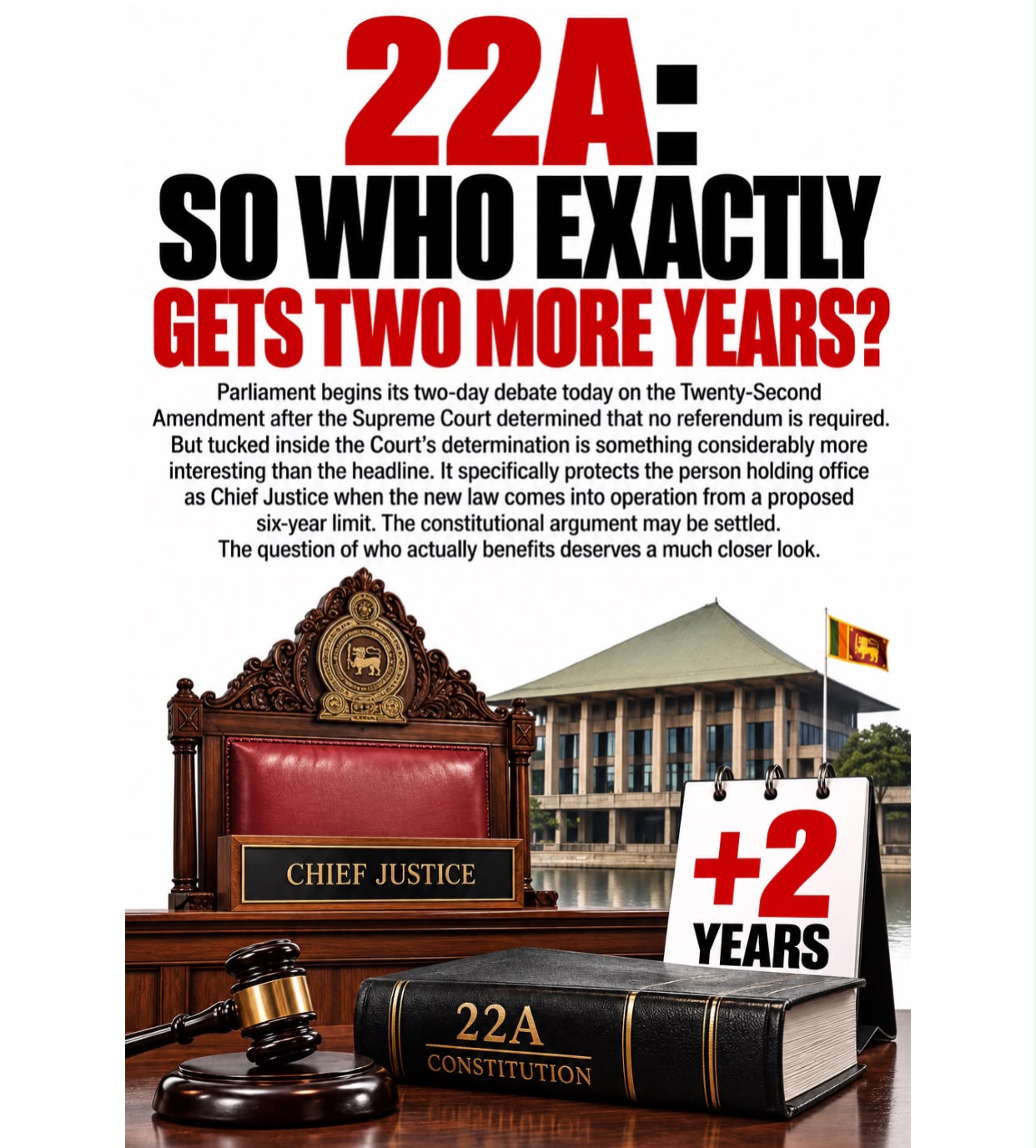
Parliament begins its two-day debate today on the Twenty-Second Amendment after the Supreme Court determined that no referendum is required. But tucked inside the Court’s determination is something considerably more interesting than the headline. It specifically protects the person holding office as Chief Justice when the new law comes into operation from a proposed six-year limit. The constitutional argument may be settled. The question of who actually benefits deserves a much closer look.
The Twenty-Second Amendment moves from the courtroom to Parliament today, and this time the argument is no longer about whether Sri Lanka must hold a referendum.
The Supreme Court has answered that question. It determined that neither the Bill as a whole nor any part of it requires approval by the people at a referendum under Article 83 of the Constitution. The Government can therefore proceed with the constitutional amendment if it secures the required two-thirds majority in Parliament.
Submit Your Press Release
Get your company news, announcements, launches, appointments and events in front of a wider audience.


That is important, but it is not the most interesting part of the determination.
The Supreme Court has required a specific addition to Clause 2 dealing with the Chief Justice. The Bill proposes increasing the retirement age of Supreme Court judges from 65 to 67, while also providing for a six-year limit applicable to the office of Chief Justice.
The Court has directed that a second proviso be inserted stating that this six-year limit will not apply to any person holding the office of Chief Justice on the date the Act comes into operation. It has also required a wording change so that the relevant retirement provision refers to completing the age of 67 rather than reaching that age.
That is not an insignificant drafting adjustment. It means Parliament is now being asked to enact a constitutional amendment whose application expressly distinguishes the incumbent Chief Justice from someone appointed to that office after the law comes into force.
The present Chief Justice is Preethi Padman Surasena. He also presided over the five-member Supreme Court bench which considered the 67 petitions challenging the Twenty-Second Amendment, together with Justices Achala Wengappuli, Arjuna Obeyesekere, Sampath Abeykoon and Gihan Kulatunga. The Court’s determination was unanimous.
That does not establish anything improper. It does, however, make transparency around the practical application of the amendment particularly important.
The proposed changes extend beyond the Chief Justice. Supreme Court judges would retire at 67 instead of 65, while Court of Appeal judges would move from 63 to 65. The linked Judicature Amendment Bill changes retirement arrangements in the lower judiciary and can, according to the Supreme Court determination, be enacted by a simple parliamentary majority.
The Government’s argument is that Sri Lanka needs judicial reform, greater capacity and the retention of experienced judges. During the Supreme Court proceedings, the Attorney General’s Department argued that extending retirement ages would not undermine judicial independence and pointed to considerably higher judicial retirement ages in countries including the United Kingdom.
Those arguments deserve to be heard on their merits. Sri Lanka’s court system faces serious delays, and losing experienced judges simply because they reach an age fixed decades ago is a legitimate matter for Parliament to reconsider.
But Parliament should also answer the other side of the question clearly. Does the two-year extension apply immediately to every serving Supreme
Court and Court of Appeal judge who would otherwise retire under the existing constitutional provisions? If so, which scheduled retirements will now be postponed? How does that affect the sequence of future appointments and promotions through the superior courts?
Those are not questions about personalities. They are questions about institutional design.
Judicial independence is protected partly by ensuring that judges know the conditions under which they take office and leave it. Altering those conditions while judges are already serving inevitably creates questions about retrospectivity, even where the purpose of the amendment may be entirely defensible.
The Supreme Court has now determined the constitutional route Parliament may follow. It has not ordered Parliament to enact the amendment. That decision belongs to the country’s elected representatives.
The Bar Association of Sri Lanka has called on MPs to consider their constitutional and representative responsibilities and to vote according to their conscience. The Opposition, meanwhile, is expected to continue campaigning against the amendment despite losing its argument that a referendum is constitutionally required.
The parliamentary arithmetic heavily favours the Government. The NPP entered Parliament with 159 seats, already above the two-thirds threshold in a 225-member House if its parliamentary strength remains intact. The debate begins today and continues tomorrow, with the vote expected on Friday.
That makes the debate more important, not less.
When a government possesses enough votes to amend the Constitution largely from its own parliamentary strength, scrutiny cannot stop at whether it has the numbers. Parliament must establish precisely what the amendment does, whom it affects immediately and what precedent it creates for future changes to judicial tenure.
The Supreme Court has settled one question. Sri Lanka does not constitutionally require a referendum to enact 22A in the form permitted by the Court.
Today Parliament begins answering another.
Who exactly gets the extra two years, and from when?