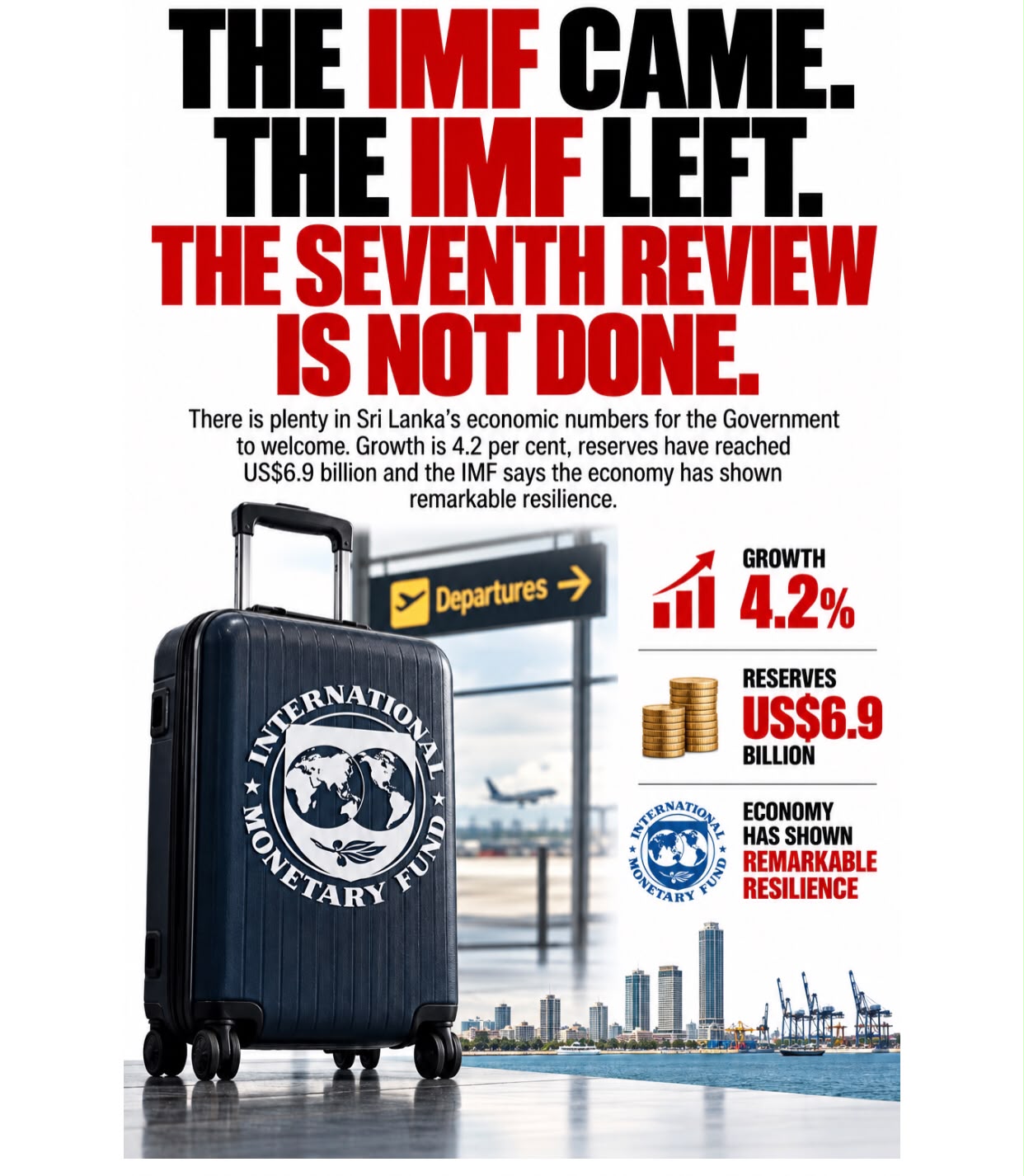
There is plenty in Sri Lanka’s economic numbers for the Government to welcome. Growth is 4.2 per cent, reserves have reached US$6.9 billion and the IMF says the economy has shown remarkable resilience. But after almost two weeks of talks in Colombo, there is still no staff-level agreement on the Seventh Review. More strikingly, the IMF has warned that parts of the Government’s proposed anti-corruption amendments could weaken transparency and accountability.
The International Monetary Fund ended its latest mission to Sri Lanka yesterday with plenty of praise for the country’s economic recovery, but without the one announcement Colombo might have preferred to hear.
There is no staff-level agreement yet on the Seventh Review of Sri Lanka’s Extended Fund Facility programme.
Submit Your Press Release
Get your company news, announcements, launches, appointments and events in front of a wider audience.


The IMF team, led by Mission Chief Evan Papageorgiou, was in Sri Lanka from September 10 to 23 for discussions on the Seventh Review and the 2026 Article IV Consultation. At the conclusion of the visit, the Fund said discussions would continue in the near term with the objective of reaching agreement on the policies and parameters required to complete the review.
That does not mean the review has failed, nor has the IMF announced a breakdown in negotiations. The language is considerably less dramatic than that. It does mean, however, that almost two weeks of discussions ended without the staff-level agreement that normally marks the next major step towards completion of a review.
The economic assessment accompanying that unfinished business is considerably more encouraging.
Sri Lanka’s economy grew by 4.2 per cent in the second quarter of 2026, marking eleven consecutive quarters of growth. Gross official reserves reached US$6.9 billion at the end of August, banks remain well capitalised and profitable, first-half fiscal performance was strong and debt restructuring is described by the IMF as largely complete.
Those are substantial achievements for a country that only four years ago defaulted on its sovereign debt and struggled to finance basic imports.
There is, however, another number in the IMF statement which deserves equal attention. Headline inflation reached 8 per cent year-on-year in August, driven by the global oil-price shock. The Fund says inflation expectations remain broadly anchored, but the return of price pressure will be considerably more tangible to households than the improvement in several macroeconomic indicators.
The IMF also sees significant risks ahead. It identifies uncertainty over the duration and intensity of the Middle East war, global trade policy and the possible effects of El Niño as threats to the recovery. Its prescription remains familiar: rebuild fiscal and external buffers, maintain price stability, strengthen social protection and continue reforms.
For taxpayers, that means the pressure is not disappearing. The IMF wants a medium-term revenue strategy, a broader tax base, fewer exemptions and incentives and stronger revenue administration. For electricity and fuel consumers, it continues to insist on cost-recovery energy pricing as a means of preventing State-owned enterprises from once again creating large fiscal liabilities.
The Fund is also calling for greater exchange-rate flexibility and recommends retaining the present 5 per cent inflation target and accountability band for now. It argues that Sri Lanka needs room to absorb food and energy-price volatility before considering movement towards a lower inflation target.
But perhaps the politically most significant sentence in yesterday’s IMF statement concerned neither debt nor inflation.
The Fund warned that preserving the integrity of Sri Lanka’s anti-corruption legislative framework is critical to maintaining public trust and said selected clauses in the amendments recently tabled by the Government could weaken transparency and accountability.
That deserves attention because anti-corruption reform is not some peripheral condition attached to Sri Lanka’s IMF programme. Governance reform became an important part of the country’s post-crisis programme precisely because corruption vulnerabilities, procurement weaknesses and institutional failures were recognised as economic problems as well as political ones.
It is also politically sensitive for the present administration. President Anura Kumara Dissanayake and the NPP came to office with corruption and accountability at the centre of their appeal to voters. An IMF warning that amendments proposed under that Government could weaken parts of the anti-corruption framework therefore deserves a detailed response from Colombo.
The Government may have legitimate reasons for changing the law. If it disagrees with the IMF’s interpretation, it should explain why. What would be difficult to reconcile with its own mandate is any change that demonstrably reduces transparency or weakens the independence and effectiveness of institutions created to investigate corruption.
The IMF’s wider message is that Sri Lanka now needs to move from stabilisation to transformation. It wants trade liberalisation, modernised business and labour regulation, wider access to finance, digitalisation and an environment capable of attracting investment and creating jobs. During the mission, its team also travelled to Jaffna and identified agriculture, fisheries, tourism, renewable energy and improved connectivity as potential sources of Northern economic growth.
Sri Lanka can therefore legitimately take considerable encouragement from this IMF visit. An economy growing for eleven consecutive quarters with US$6.9 billion in reserves is a profoundly different economy from the one that collapsed in 2022.
But yesterday’s statement also provides a useful antidote to premature celebration. The Seventh Review has not yet reached staff-level agreement, inflation has returned to 8 per cent, external risks remain substantial and the Fund is questioning parts of the Government’s anti-corruption amendments.
The recovery is real, but so are the conditions attached to preserving it. Sri Lanka has travelled a considerable distance from the queues, shortages and default of 2022, but the IMF’s departure yesterday makes one thing clear: the programme has not reached the point where either the Government or the country can declare the difficult part over.