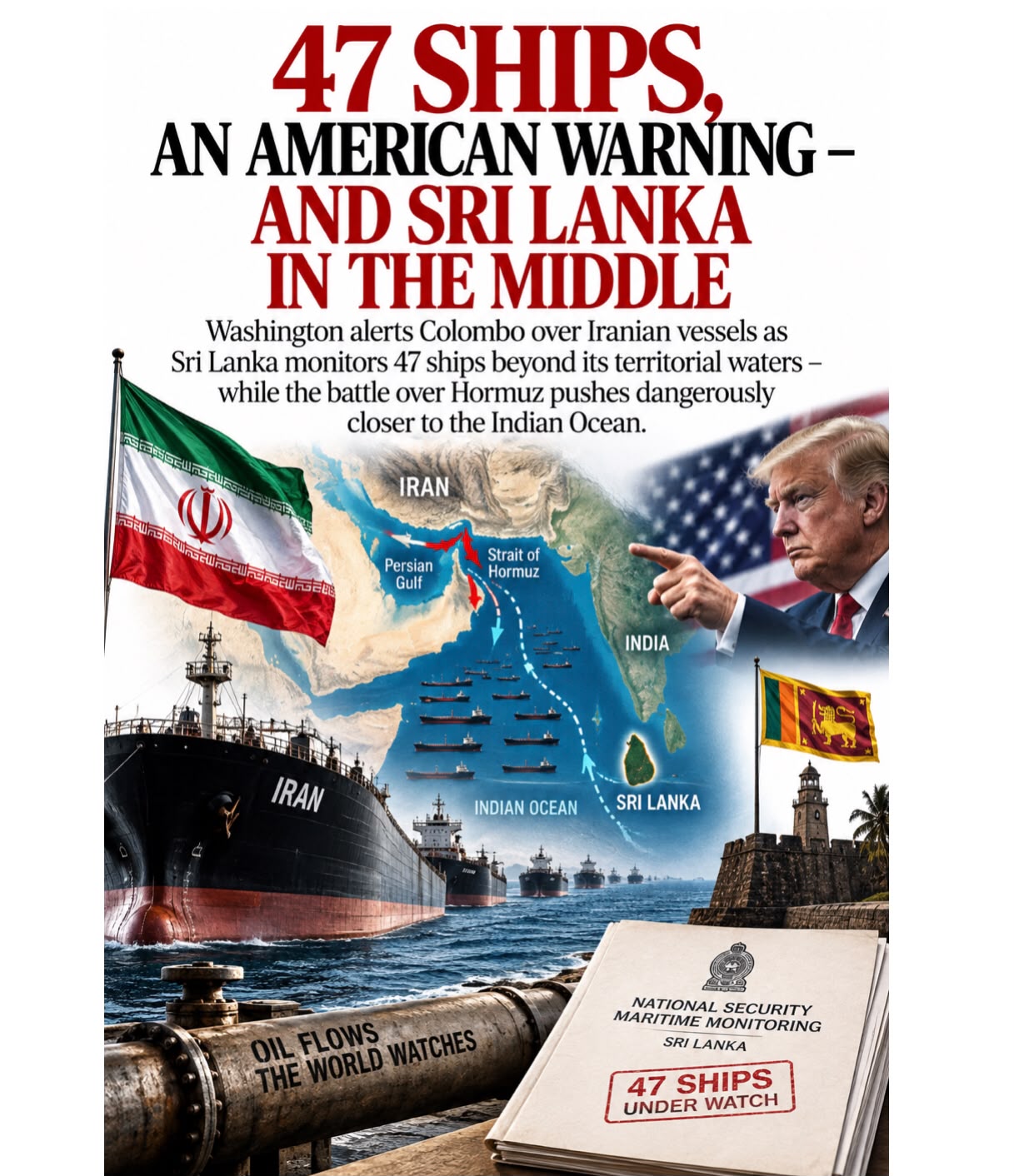
Washington alerts Colombo over Iranian vessels as Sri Lanka monitors 47 ships beyond its territorial waters – while the battle over Hormuz pushes dangerously closer to the Indian Ocean
Sri Lanka suddenly finds itself watching an increasingly uncomfortable gathering of ships just beyond its maritime doorstep.
Foreign Minister Vijitha Herath confirmed yesterday that approximately 47 vessels have been identified in international waters close to Sri Lanka’s maritime boundary, as the conflict involving the United States and Iran continues to disrupt shipping across the region.

More significantly, the United States Embassy in Colombo has contacted the Foreign Ministry about the presence of Iranian vessels and asked whether Sri Lankan authorities were aware of them and monitoring their movements.
Herath said the Defence Ministry and Ports Ministry were subsequently informed and that the Sri Lanka Navy is monitoring the vessels.
The Foreign Minister was careful, however, to draw an important legal distinction.
The vessels have not entered Sri Lankan territorial waters. According to Herath, they are positioned in international waters beyond Sri Lanka’s territorial jurisdiction. Reports yesterday placed the ships more than 24 nautical miles from Sri Lanka’s territorial sea boundary.
Nor are all 47 Iranian.
Herath said the vessels include ships associated with several countries, including Iran, Thailand and Malaysia. Sri Lanka has received no request from the vessels to enter its waters, he said.
But that does not make their presence insignificant.
Only last week the Government disclosed that it was monitoring 11 Iranian vessels south of Galle, operating beyond Sri Lanka’s 12-nautical-mile territorial limit.
The number now being watched is considerably larger, although the Government’s latest figure refers to vessels of several nationalities rather than 47 Iranian ships.
The development comes as the maritime confrontation surrounding Iran intensifies.
Traffic through the Strait of Hormuz, one of the world’s most important energy corridors, has slowed dramatically. According to Kpler data reported by Reuters, just seven commodity vessels passed through the Strait on Monday, following eight the previous day.
Iran has meanwhile threatened retaliation against Gulf energy infrastructure connected to American interests if further US attacks are launched. Tehran has also discussed establishing a new restricted shipping zone and corridor around Hormuz.
For Sri Lanka, these are no longer developments occurring safely on the other side of the Arabian Sea.
The island sits beside one of the world’s busiest east-west shipping routes. Any prolonged disruption to Gulf shipping can ultimately arrive here in the price of fuel, freight, insurance and imported goods.
There is also recent history.
In March, Sri Lanka found itself unexpectedly dealing with the human consequences of the conflict after Iranian sailors were rescued following the sinking of an Iranian naval vessel near Sri Lanka. Colombo insisted then that it would act according to international law and would not take sides.
The Government’s position today remains essentially the same.
The vessels presently being monitored are outside Sri Lankan territorial waters. They have not requested entry. Sri Lanka therefore has neither the legal authority nor, on the information presently available, a reason to interfere with them merely because they are there.
But Washington’s approach to Colombo changes the complexion of the story.
The question is no longer simply why Iranian vessels are congregating in the wider waters around Sri Lanka.
It is what the United States knows about them that prompted it to contact Colombo.
Were the Americans merely checking whether Sri Lanka was aware of the vessels? Was specific intelligence shared? Are particular ships among the 47 of interest to Washington? And has Sri Lanka been asked to do anything beyond monitoring them?
Those questions deserve answers.
Sri Lanka has neither the military interest nor the economic luxury to become a participant in somebody else’s war. Its obligation is to protect its territory, its shipping interests and its neutrality while complying with international law.
That balancing act could become considerably harder if the confrontation around Hormuz continues moving eastwards.
For the moment, 47 vessels remain outside Sri Lanka’s territorial waters.
The Sri Lanka Navy is watching them.
And, apparently, so is Washington.