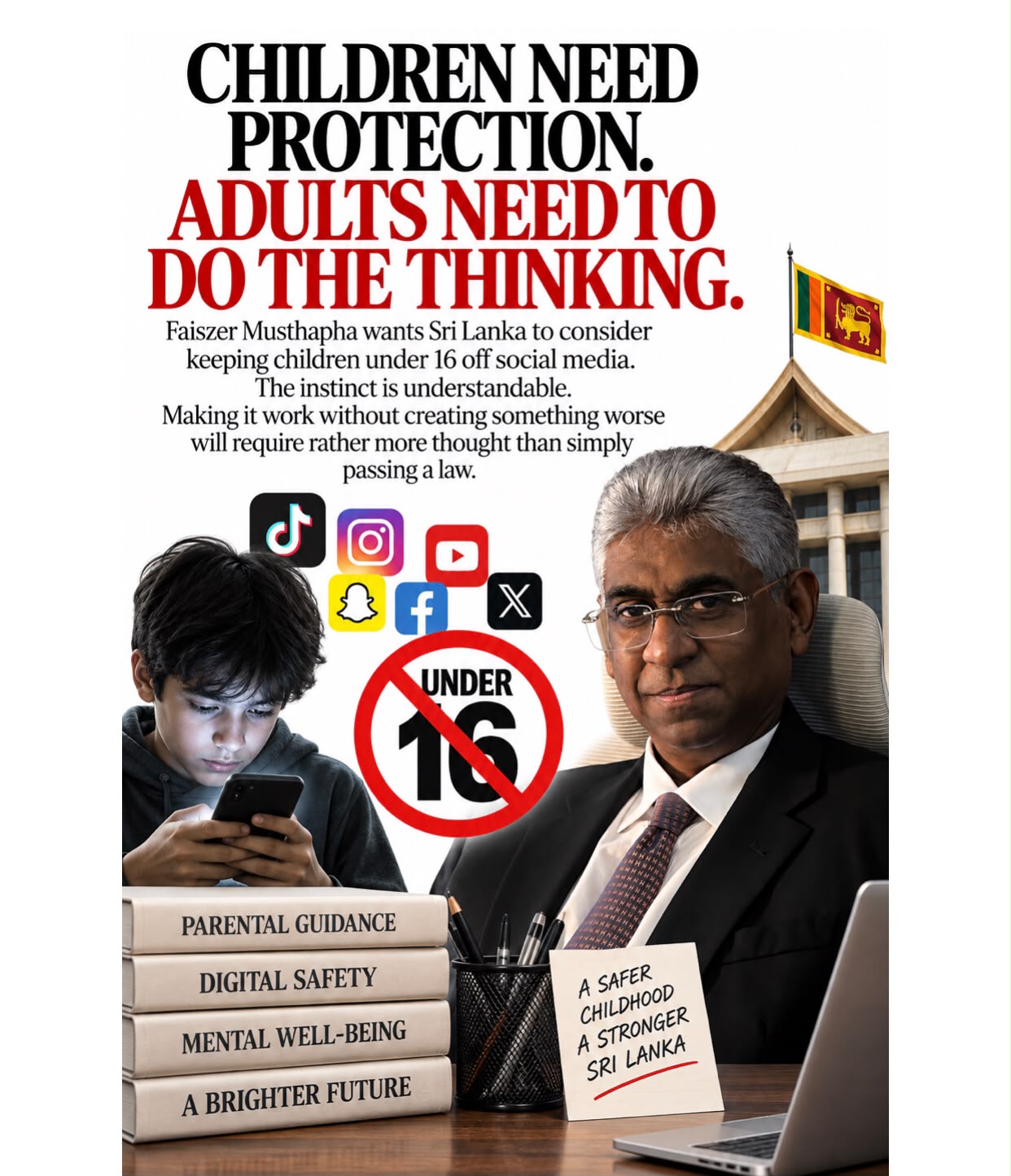
Faiszer Musthapha PC MP takes the battle over children’s online safety to Parliament, calling for urgent restrictions on social-media access for those under 16 while insisting the proposal is about protecting children, not opposing technology
MP Faiszer Musthapha PC has urged Parliament to move quickly towards restricting social-media access for children under 16, warning that unrestricted exposure is creating increasingly serious consequences for their safety, mental wellbeing, education and development.
Moving an adjournment motion in Parliament yesterday, Musthapha sought to push the issue beyond discussion and towards legislation, arguing that Sri Lanka should learn from countries already moving to impose minimum-age requirements on the world’s largest social-media platforms.

The intervention follows his earlier Private Member’s Bill seeking to establish 16 as the minimum age for social-media access in Sri Lanka. The proposed framework would place responsibility not merely on children and their parents but on the technology companies providing the platforms.
Musthapha pointed to international developments, including Australia’s move to impose a social-media minimum age of 16 and measures being considered elsewhere. His central argument was that Sri Lanka need not wait for the social consequences of unrestricted childhood access to become still more serious before acting.
The proposal would affect major social-media services used extensively by young people, including Facebook, Instagram, TikTok, Snapchat, YouTube and X, while distinguishing social-media platforms from essential communication services.
Musthapha was also at pains to reject the suggestion that such restrictions amount to an anti-technology position. The internet has become indispensable to education, communication and everyday life, particularly for a generation that has grown up with smartphones in their hands.
The concern is instead about platforms deliberately designed to maximise engagement and keep users watching, scrolling, clicking and returning. If adults themselves struggle to control the amount of time they spend on these platforms, expecting children to possess greater resistance is hardly realistic.
There are nevertheless difficult questions Parliament will have to answer before converting the principle into workable law. Establishing a minimum age is considerably easier than establishing how that age will be reliably verified.
Requiring identification documents, facial-age estimation or other verification mechanisms immediately raises questions about privacy and the collection and storage of personal information. A law designed to protect children must not inadvertently create a mechanism through which every Sri Lankan using social media is required to surrender unnecessary personal data.
There is also the practical reality that simply asking a child to enter a date of birth is unlikely to achieve very much. Any credible system will therefore have to place meaningful obligations on the platforms themselves rather than pretending that determined teenagers will police their own access.
That is where the debate becomes important. The question is no longer simply whether parents should supervise their children. It is whether enormously profitable global technology companies should carry a greater legal responsibility for protecting the children using products specifically engineered to hold their attention.
Sri Lanka must also ensure that legitimate child protection does not become an excuse for broader State control of the internet. Protecting children and protecting freedom of expression and privacy are not mutually exclusive objectives, but badly drafted legislation could easily place them in conflict.
Musthapha has nevertheless put an important issue squarely before Parliament. Cyberbullying, harmful content, online exploitation and compulsive social-media use are not problems that disappear because legislation is difficult.
The principle is relatively straightforward: children deserve protection in the digital world just as they do in the physical one. The real test for Parliament will be devising a system that actually provides that protection without creating another cumbersome regulatory machine or unnecessarily intruding into the privacy of everyone else.
Be that as it may, doing nothing is also a decision.
And with children spending an ever greater part of their lives online, it may increasingly be the least defensible one.