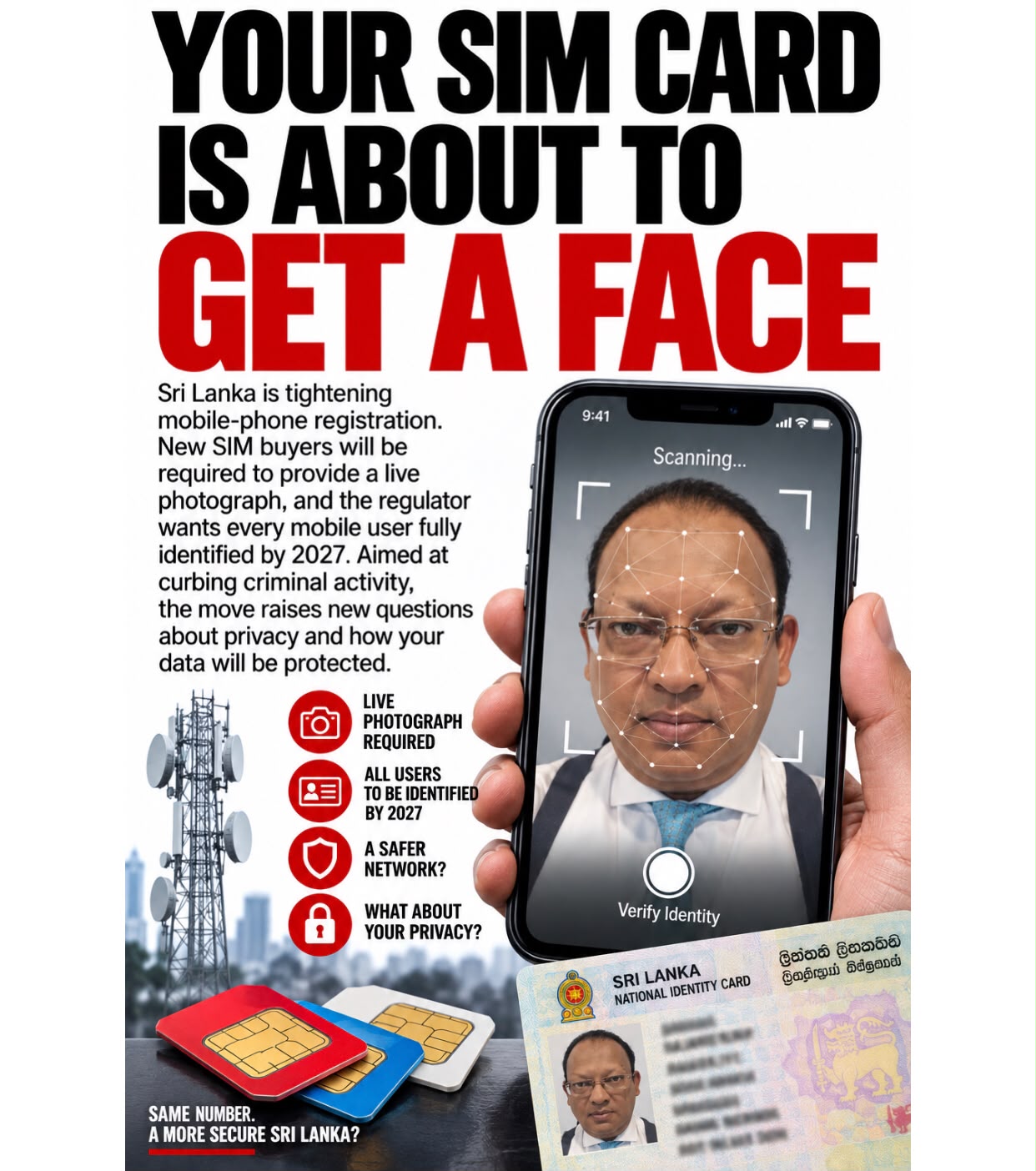
Sri Lanka is tightening mobile-phone registration. New SIM buyers are expected to provide a live photograph, while the regulator wants every mobile user fully identified by 2027. Fighting anonymous criminal communications is a legitimate objective. But with nearly 30 million active SIMs, NEWSLINE asks what information will be collected, who can see it and how it will be protected.
Buying a SIM card in Sri Lanka is about to become rather more personal.
The Telecommunications Regulatory Commission of Sri Lanka says new subscribers are expected to be required to provide a live photograph at the point of registration, probably from the end of this year. The regulator then intends to move towards 100 per cent identification of existing SIM and mobile-phone users during 2027.
Submit Your Press Release
Get your company news, announcements, launches, appointments and events in front of a wider audience.


There is a perfectly serious reason behind it. TRCSL Director General Air Vice Marshal (Retd.) Bandula Herath says Police and other law-enforcement authorities have raised concerns about an increase in criminal activity involving SIM cards obtained through irregular channels and connections whose actual users cannot readily be traced.
The scale is substantial. Sri Lanka has nearly 30 million active SIM connections. Under the present arrangements, one person can reportedly obtain as many as five SIMs from each mobile operator using the same National Identity Card potentially 15 connections across three operators.
The Government had already decided in February to overhaul the regulatory framework. Cabinet approved amendments covering, among other things, the re-registration of subscriber information for SIM cards obtained before August 2, 2019, where operators may not possess adequate subscriber information. The changes are also intended to address SIMs for 16- and 17-year-olds and foreign visitors.
There is little argument with the basic proposition that a mobile connection should be traceable to the person actually using it. Fraudsters, organised criminals and others should not be able to exploit weaknesses in registration procedures to disappear behind somebody else’s identity.
But identification and privacy are not mutually exclusive.
A live photograph is personal data. Add it to a National Identity Card number, address, telephone number and the other subscriber information already collected by operators and the result becomes a valuable identity record. The question therefore cannot end with whether the State has a good reason to collect it.
NEWSLINE wants to know how long the photographs will be retained, whether they will be held by the mobile operators or in a central system, who will have access to them, under what legal authority they may be disclosed and what happens if that database is compromised.
There is another interesting admission from the regulator. Herath says TRCSL currently depends largely upon information supplied by the telecom operators themselves when assessing network quality and does not yet possess an independent system capable of comprehensively verifying that information.
That deserves attention too.
If Sri Lanka is going to demand better identification of every person using its mobile networks, consumers are entitled to demand better accountability from the companies providing those networks and from the regulator supervising them.
There is some good news buried in the announcement. Work is continuing on mobile number portability, which would eventually allow customers to change operator without surrendering the telephone number around which much of their digital lives may have been built.
Security matters. So does privacy. And so does the quality of the service for which almost 30 million connections are paying.