
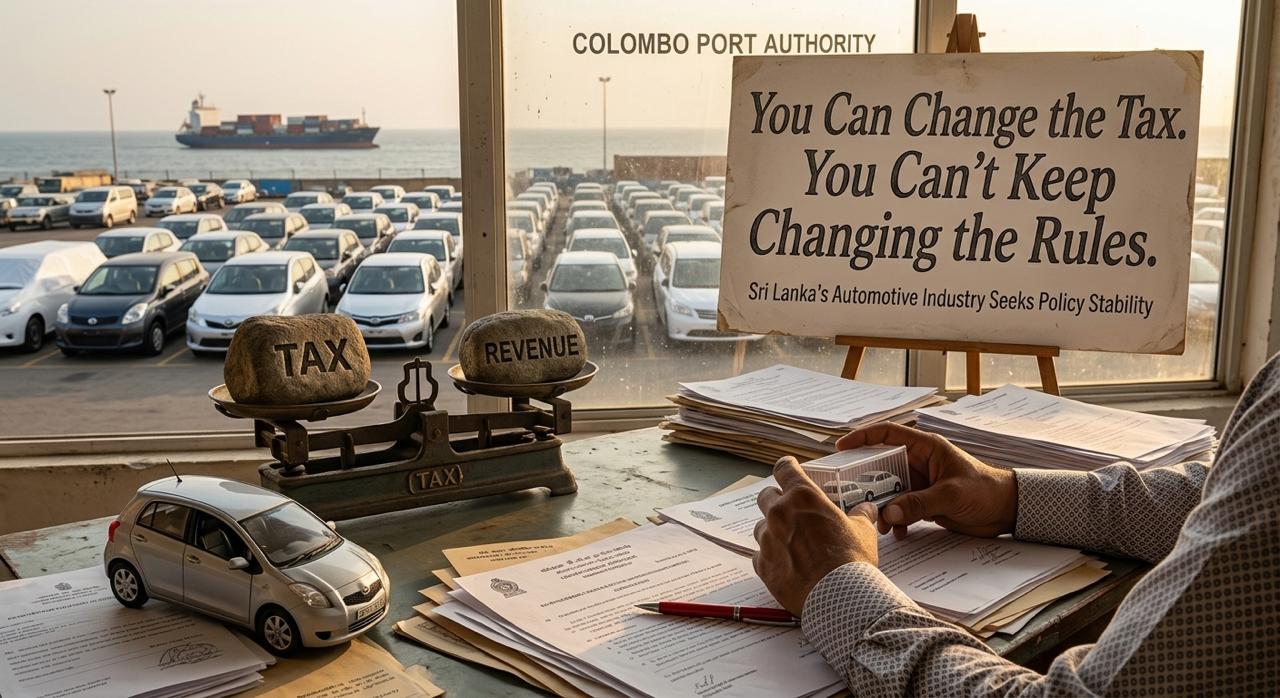
Sri Lanka reopened vehicle imports after a five-year restriction and collected billions in badly needed revenue. But the country’s automotive industry is warning that repeated policy changes, taxes and regulatory uncertainty are making international manufacturers think twice. The issue is no longer simply what a car costs it is whether investors can predict what Sri Lanka will do next.
Sri Lanka’s motor industry has become an extraordinarily useful cash machine for the Treasury.
Vehicle imports resumed in 2025 after almost five years of restrictions, unleashing pent-up demand and producing a substantial increase in customs revenue. During the first seven months of this year alone, vehicle imports reportedly cost approximately US$1.5 billion one reason Sri Lanka’s overall import bill has risen so sharply.
Submit Your Press Release
Get your company news, announcements, launches, appointments and events in front of a wider audience.


But there is another side to the reopening.
Associated Motorways has warned that what it describes as policy-driven distortions in the market are damaging Sri Lanka’s attractiveness to international automotive manufacturers and investors.
That deserves attention because the argument is considerably bigger than whether a Toyota, Nissan, Suzuki or any other vehicle costs too much.
A manufacturer or international distributor deciding whether to commit capital to Sri Lanka has to make decisions months sometimes years ahead. Vehicles must be ordered, production slots reserved, specifications agreed, financing arranged, dealerships developed, spare parts stocked and employees trained.
All of that assumes one rather basic thing: the rules under which the investment was made will remain reasonably predictable.
Sri Lanka has struggled with that concept.
Taxes can change. Import restrictions can appear. Valuation methodologies can be altered. Regulations can be introduced or interpreted differently, sometimes with little notice. A business that made a perfectly rational commercial decision under one policy environment can consequently discover that the economics have changed before its shipment even reaches Colombo.
Government has every right to tax vehicles. Indeed, after Sri Lanka’s fiscal collapse, vehicle taxation represents an important source of revenue and the State must also consider the foreign-exchange consequences of unrestricted imports.
But taxation and unpredictability are two different things.
A company can price a high tax into an investment decision. What it cannot easily price is uncertainty over what the tax, regulation or import condition will be when the product actually arrives.
That is why policy stability matters.
The same principle extends far beyond motor vehicles. A renewable-energy investor considering a twenty-year project, a manufacturer contemplating a factory or an international company deciding whether to establish its regional operation in Colombo all ask essentially the same question.
Can we trust the rules?
Sri Lanka competes for investment against countries capable of offering larger markets, cheaper energy, bigger labour forces and, in some cases, considerably more generous incentives. One advantage the country can provide almost free of charge is predictable government.
That does not mean freezing policy forever. Governments must respond to economic circumstances, close loopholes and change taxes when necessary. But major changes should be transparent, properly consulted upon and introduced with sufficient notice for legitimate businesses to adjust.
There is another reason this matters now. Sri Lanka is attempting to convince the world that the economic behaviour which preceded the sovereign default has changed. Investors will judge that claim not from investment conferences or glossy presentations but from what happens after they actually put money into the country.
If rules repeatedly change after commercial commitments have been made, the message travels remarkably quickly.
Be that as it may, Sri Lanka spent years asking international companies to come back. Now that they are looking again, the country should remember something rather elementary: investors can tolerate expensive rules. What they cannot tolerate indefinitely are rules they cannot predict.



