
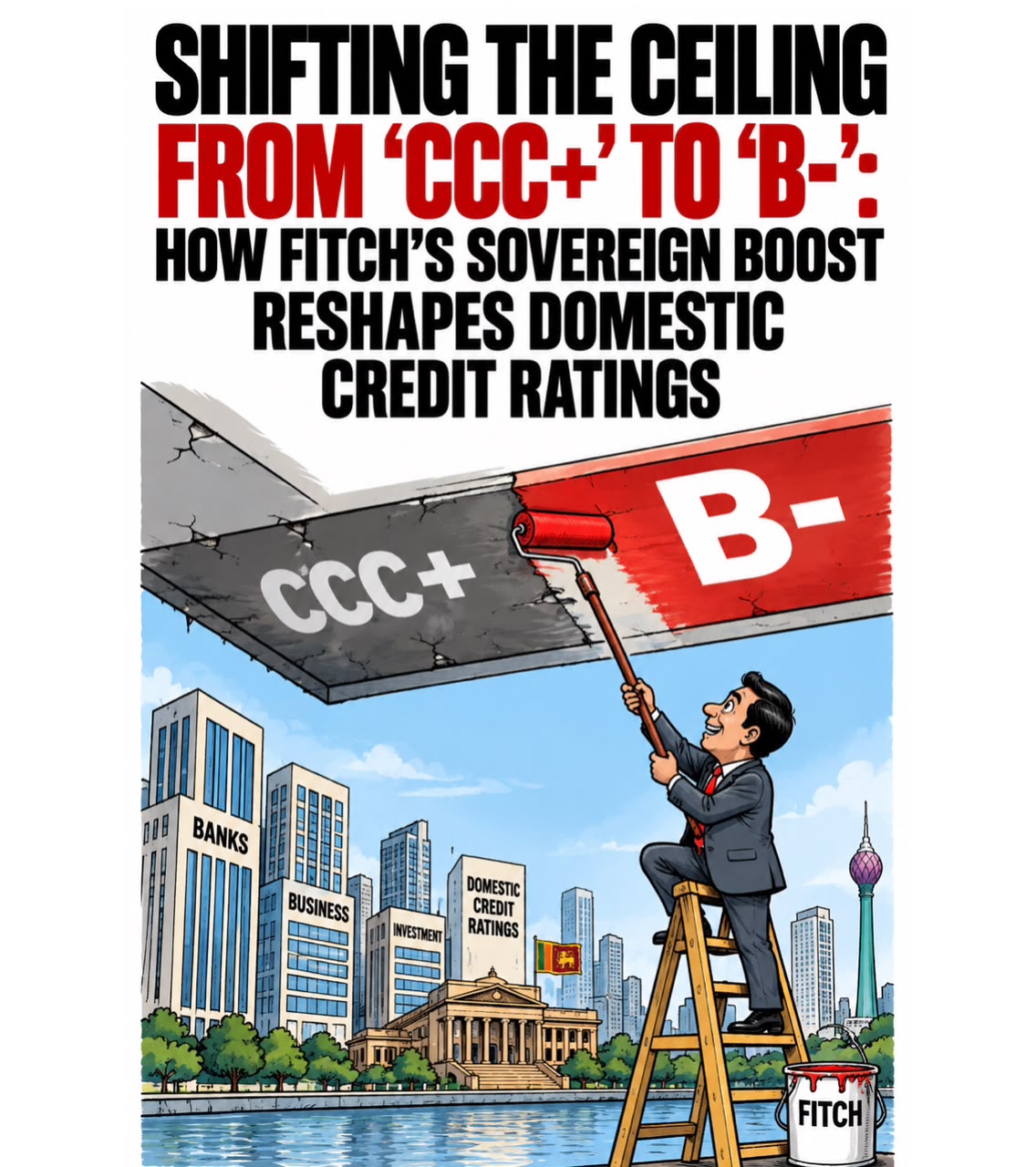
A sovereign credit upgrade inevitably sets off a chain reaction across a country’s financial system. Following its September 22 decision to elevate Sri Lanka’s sovereign Long-Term Local-Currency Issuer Default Rating to ‘B-’ with a Stable Outlook from ‘CCC+’, Fitch Ratings has officially recalibrated its Sri Lanka National Rating Scale. Far from a mere administrative routine, this recalibration represents a vital mechanical reset designed to re-anchor how every major domestic bank, finance company, and corporate borrower is ranked relative to the state.
National scale ratings, distinguished by the unique ‘(lka)’ identifier, perform a precise function within the island’s capital markets. Unlike international scales that evaluate sovereign borrowers on a global playing field, national scales isolate credit risk strictly within a single domestic market. They exist to provide local fund managers, institutional investors, and retail depositors with an accurate, localized risk ranking, helping market participants distinguish between varying levels of balance sheet strength under identical macro-economic conditions.
Because the sovereign rating serves as the effective structural ceiling for domestic credit, raising that baseline creates fresh headroom above existing ratings. Recalibrating the national scale simply resets the domestic measuring tape so that local institutions can be accurately reassessed under this elevated roof. As Fitch prepares to publish individual rating revisions in the coming days, several Sri Lankan issuers carrying national ratings will see their letter grades adjusted. Crucially, a rating revision triggered by a scale recalibration does not imply that an entity’s underlying financial health has suddenly transformed overnight. It indicates that the benchmark ruler itself has shifted, altering where each institution sits within the national risk hierarchy.
Submit Your Press Release
Get your company news, announcements, launches, appointments and events in front of a wider audience.


This recalibration arrives at a sensitive moment for Sri Lanka’s ongoing economic stabilization. While an elevated sovereign ceiling offers welcome breathing room for commercial banks and private issuers, it also demands rigorous clarity across corporate balance sheets. Domestic scale ratings cannot be compared directly to international rating scales or the national scales of other countries. As Fitch rolls out these specific entity revisions, local market participants will receive an updated, realistic view of which domestic institutions possess genuine fundamental strength, and which were simply floating on a lower sovereign baseline.



