When Sri Lanka opened its retail fuel market to foreign energy giants, the pitch was simple and persuasive. Introducing international competitors would share the financial burden, guarantee steady deliveries, and protect the country from global currency shocks. Yet, as world oil prices spike once again, that market experiment is showing its limits. Facing rising import costs, foreign distributors have quietly scaled back their operations, leaving the state-run Ceylon Petroleum Corporation (CPC) to pick up the slack.
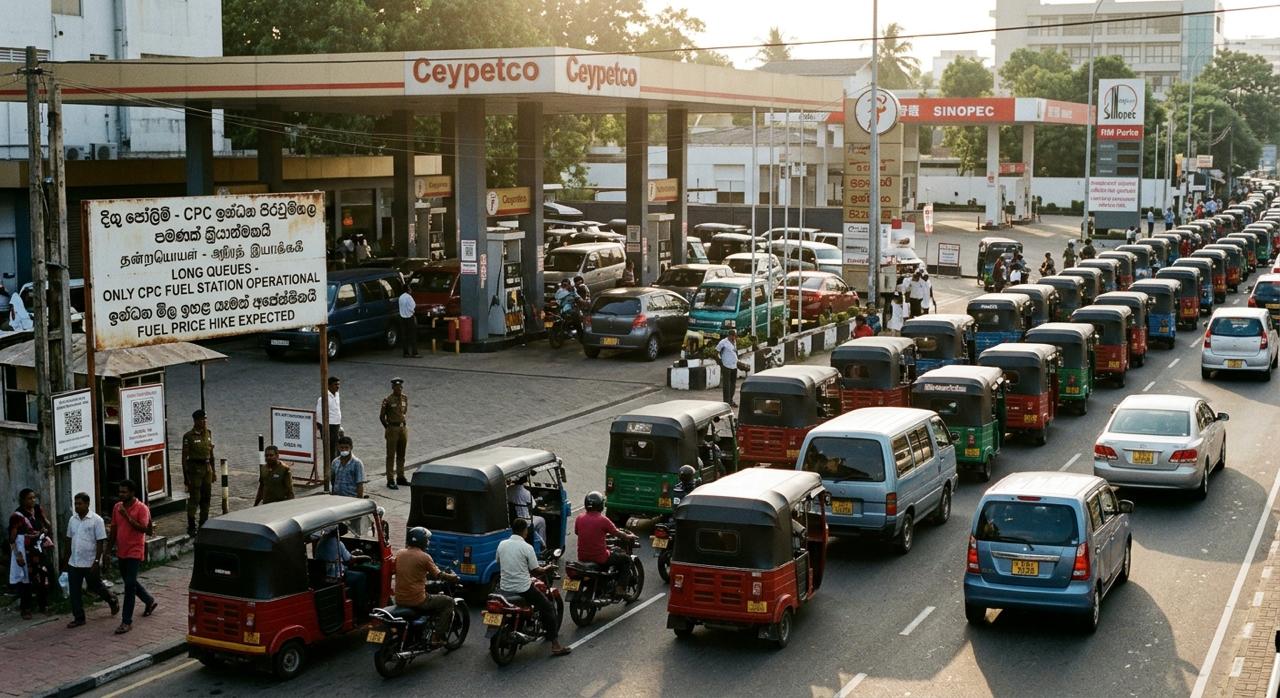
According to CPC Chairman D.J. Rajakaruna, the three private retail players, Lanka Indian Oil Company (LIOC), Sinopec, and RM Parks, collectively command 45% of the domestic market. But as global crude prices surged within days, pushing diesel to 174 dollars per barrel and petrol to 133 dollars, these companies restricted their distribution to protect their own bottom lines. The result is an immediate imbalance on the ground. The CPC has been forced to step in and absorb the difference, now pumping over 80% of the island’s diesel through its state-owned filling stations to prevent local distribution from collapsing entirely.
For everyday motorists, the operational fallout is fast becoming a financial headache. To cope with the mounting strain and curb rising domestic consumption, the CPC is considering another fuel price hike. While tightening the national QR-code ration system remains an option on paper, officials point out that expanding administrative oversight introduces heavy operational costs. Raising prices at the pump is once again being framed as the quickest way to balance the books.
Submit Your Press Release
Get your company news, announcements, launches, appointments and events in front of a wider audience.


This situation exposes a frustrating reality about partial deregulation. Foreign suppliers were brought in to cushion the local economy during global shocks, not just to collect profits when times are easy. If private firms can simply turn down the tap whenever global margins get tight, the public sector is left acting as an insurer of last resort. The state takes on all the risk while citizens face the familiar double blow of impending price hikes and lingering queues at the filling station.