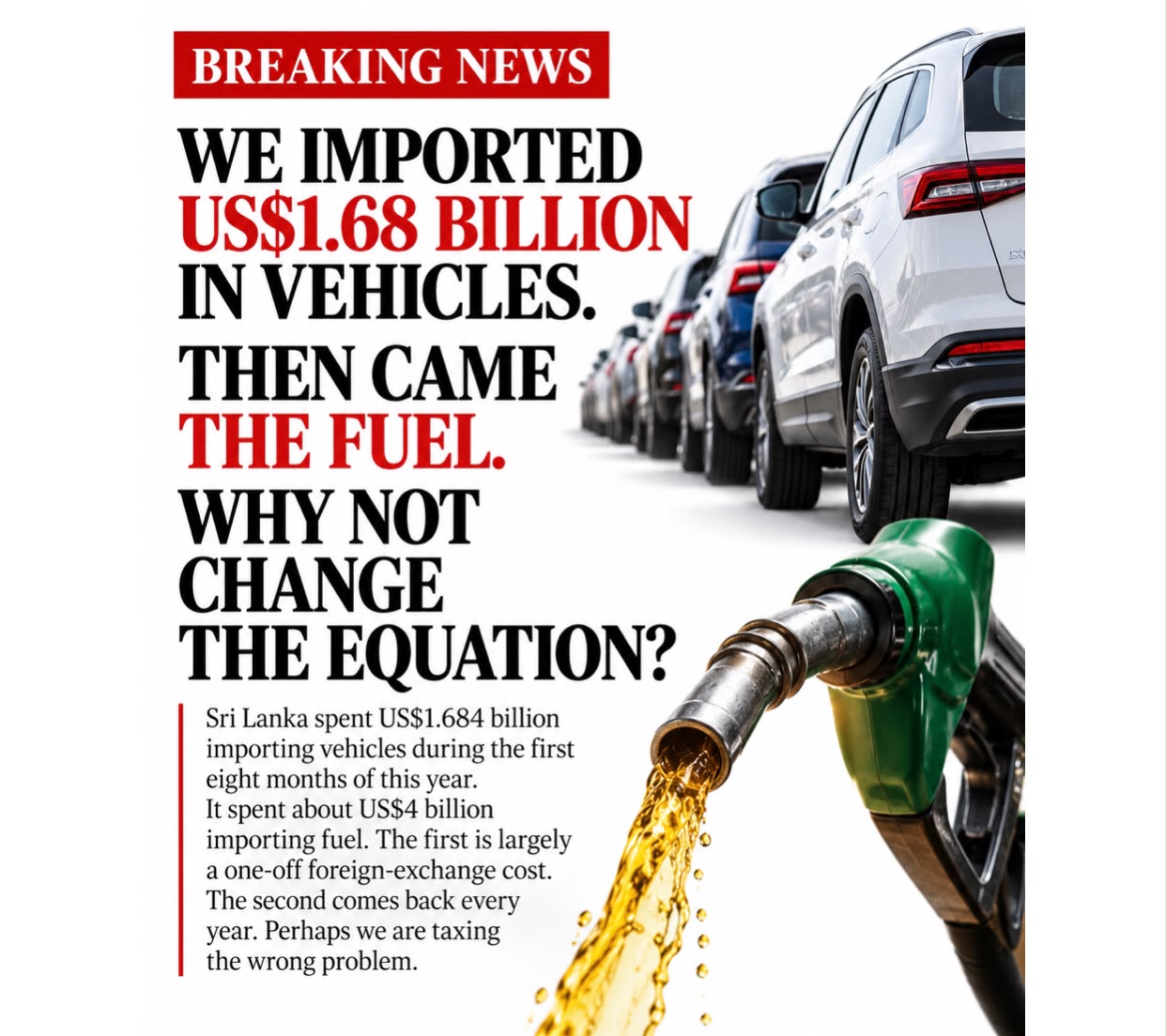
Sri Lanka spent US$1.684 billion importing vehicles during the first eight months of this year. It spent about US$4 billion importing fuel. The first is largely a one-off foreign-exchange cost. The second comes back every year. Perhaps we are taxing the wrong problem.
The fuel number is particularly revealing.
January to August fuel imports were 61.6 percent higher than a year earlier. Working backwards from the Central Bank figure puts the comparable 2025 bill at roughly US$2.48 billion. Sri Lanka therefore spent approximately US$1.52 billion more on fuel in just eight months this year.
Submit Your Press Release
Get your company news, announcements, launches, appointments and events in front of a wider audience.


That increase cannot simply be blamed on newly imported vehicles. It should not be. Higher petroleum prices and the Middle East crisis have played an enormous part.
But that is precisely where the argument becomes interesting.
Sri Lanka cannot decide what happens in the Middle East. It cannot determine the price of crude oil. It cannot guarantee that the Strait of Hormuz remains open.
It can decide whether the next generation of vehicles on Sri Lankan roads needs petrol.
What if we stopped treating electric vehicles as merely another source of Customs revenue and used taxation deliberately to change the country’s vehicle fleet?
Take a radical example.
Suppose a pure battery-electric vehicle, not a hybrid, attracted a flat 10 percent tax on CIF value. Suppose conventional petrol and diesel passenger cars were pushed in precisely the opposite direction, with the effective tax burden deliberately increased to perhaps 350 percent.
Buses, coaches and essential commercial vehicles would need separate treatment. Punishing public transport while encouraging private electric cars would be a rather peculiar environmental policy.
But look at what the proposed difference would do.
Take two cars each arriving in Colombo with a hypothetical CIF value of US$30,000. Under our 10 percent proposal the pure EV attracts US$3,000 in tax. Under a hypothetical 350 percent regime, the petrol vehicle attracts US$105,000.
Nobody would misunderstand the message.
The immediate objection is obvious. Government would surrender substantial tax revenue on EV imports. In a country still rebuilding its public finances, that cannot simply be waved away because electric cars are fashionable.
So calculate the other side.
A petrol vehicle does not stop costing Sri Lanka foreign exchange when it leaves the port. It begins doing so. Every tank of imported petrol it consumes during the next ten or fifteen years is another demand for dollars.
The EV is different. Sri Lanka imports the car and battery, but the energy moving it can increasingly be produced here. Hydro already does it. Solar does it. Wind does it. Even where electricity generation still depends upon imported fuel, the direction of travel can change as renewable generation expands.
And that is why the real calculation should not be Customs revenue on the day the car arrives.
It should be the foreign-exchange cost of that vehicle over its working life.
There are complications. Sri Lanka would need charging infrastructure, grid capacity, battery recycling, technical skills and sensible standards. A rush of cheap EV imports without those things would simply create another problem wearing an environmentally friendly badge.
Hybrids should also be treated honestly. They may consume less petrol, but they still consume petrol. If the national objective is eventually to break the link between mobility and imported petroleum, a hybrid is a transition technology, not the destination.
The Central Bank says Sri Lanka spent approximately US$4 billion on fuel in eight months. That is the number against which the lost tax revenue from cheaper EVs must eventually be measured.
Be that as it may, perhaps we should stop asking how much tax government can collect when a car enters Sri Lanka.
The more important question may be how many dollars that car will keep taking out of Sri Lanka after it gets here.