Sri Lanka wants foreign investment. Every government says so. There are investment forums, overseas delegations, tax incentives, industrial zones and glossy presentations explaining why this island is an irresistible place to put money. Then comes the less glossy bit: actually trying to do it.
The United States’ latest assessment of Sri Lanka’s investment climate presents a country recovering strongly from the economic crisis but still struggling with some remarkably familiar obstacles.
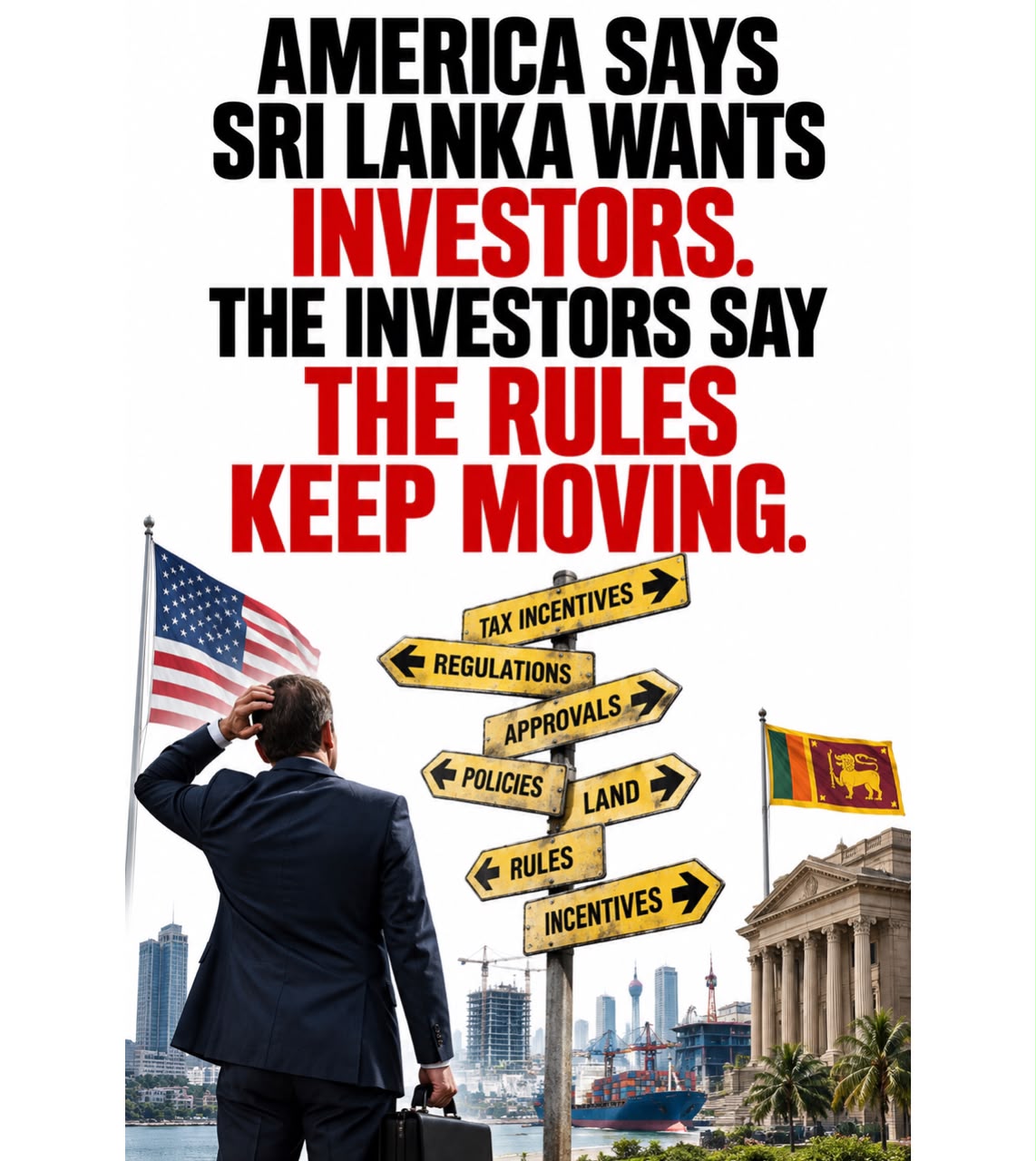
Regulatory unpredictability. Bureaucracy. Policy changes. Selective transparency. Slow approvals. Difficulties obtaining land. Complicated taxes. Weak contract enforcement.
Submit Your Press Release
Get your company news, announcements, launches, appointments and events in front of a wider audience.


It is a list Sri Lanka could probably have printed several governments ago.
Foreign direct investment reached approximately US$1.06 billion in 2025, according to the assessment, equivalent to roughly one percent of GDP. That remains well below the three to four percent often recorded by emerging economies.
That matters because Sri Lanka needs rather more than borrowed money.
Debt has to be repaid. Foreign direct investment brings capital into businesses, factories, hotels, ports, technology and other enterprises in return for ownership and future profits. Done properly, it creates employment, exports, taxes and productive capacity without simply adding another loan to the national balance sheet.
Sri Lanka has several genuine advantages.
It permits 100 percent foreign ownership across most sectors. It sits beside one of the world’s busiest shipping routes. It has a relatively educated workforce, established export industries, improving macroeconomic stability and access to important overseas markets.
The American assessment acknowledges the political stability following the 2024 elections and the reassurance provided by continued adherence to the IMF programme.
And yet investors remain cautious.
The Board of Investment is supposed to provide something approaching a one-stop shop. The problem is that many of the decisions an investor needs are not controlled by the BOI.
An investor may still encounter several ministries, regulators, local authorities and other government agencies before money becomes a functioning enterprise.
One stop can therefore become several stops remarkably quickly. There is also the question of predictability.
Businesses can live with taxes. They can price taxes.
What is considerably harder to price is a rule that changes halfway through an investment.
A factory costing US$100 million may take years to build and decades to recover its capital. Investors therefore care enormously about whether today’s tax regime, energy policy, import rules and investment conditions have some reasonable chance of surviving tomorrow’s political announcement.
There are positive developments. The BOI launched its Ready to Invest digital platform in May, and government has repeatedly promised digitisation, faster approvals and a more investment-friendly administration.
But foreign investors do not ultimately invest in promises. They invest in predictability.
Perhaps the most revealing comparison is not between Sri Lanka and Singapore or Dubai. Those comparisons are too easy.
Compare Sri Lanka with itself.
How many investors have expressed interest? How many received approval? How many actually transferred the money? How long did approval take? How many abandoned the project somewhere between the first meeting and the first brick?
Those numbers would tell us rather more than another investment summit.
Be that as it may, Sri Lanka does not need another government to tell investors that we are open for business.
It needs the investor who arrives on Monday to discover on Tuesday that we actually are.