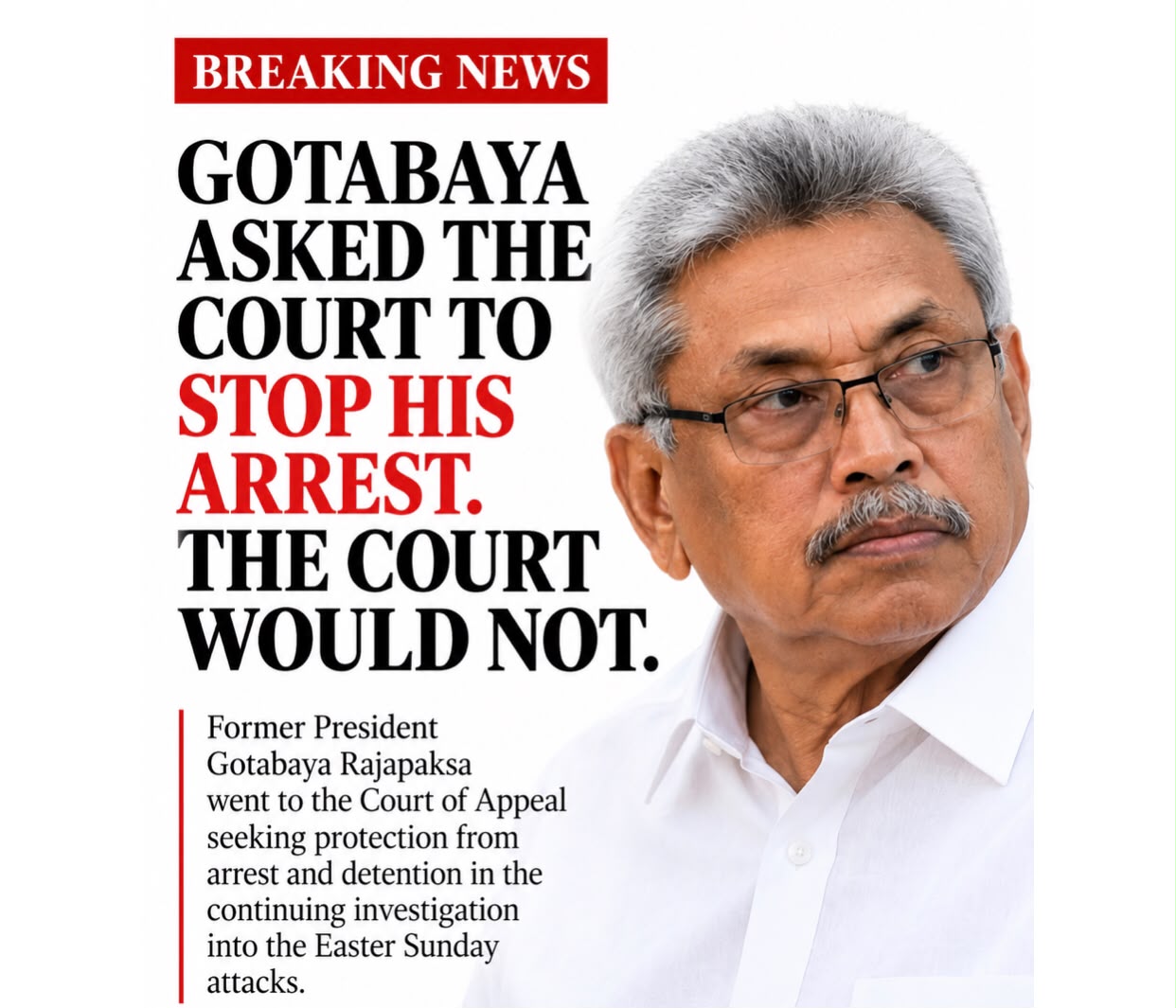
Former President Gotabaya Rajapaksa went to the Court of Appeal seeking protection from arrest and detention in the continuing investigation into the Easter Sunday attacks. Yesterday the Court declined even to issue notices on his application and dismissed it without proceeding to a full hearing. Seven and a half years after Easter Sunday, the investigation has reached another former President.
Rajapaksa had sought a writ preventing the Criminal Investigation Department from arresting and detaining him under the Prevention of Terrorism Act in connection with the investigation.
The application came before Court of Appeal President Justice Rohantha Abeysuriya and Justice Sarath Dissanayake. After considering submissions, the Court declined to exercise its writ jurisdiction and dismissed the petition at the threshold.
Submit Your Press Release
Get your company news, announcements, launches, appointments and events in front of a wider audience.


That distinction matters.
The Court has not convicted Gotabaya Rajapaksa of anything. It has not decided that he should be arrested. Nor has yesterday’s decision established his responsibility for any aspect of the Easter Sunday attacks.
It has declined his attempt to obtain an order preventing investigators from arresting him.
That leaves the investigative process to continue according to law.
Rajapaksa’s President’s Counsel Romesh de Silva subsequently sought permission to lodge a special appeal against the decision. The matter is due to return to court on October 9 for submissions on that request.
And so Sri Lanka returns once again to Easter Sunday.
On April 21, 2019, suicide bombers attacked churches and hotels while families were celebrating Easter and visitors were eating breakfast. More than seven years later, the country is still trying to establish the complete chain of responsibility surrounding one of the worst acts of terrorism in its history.
There have been commissions. There have been parliamentary proceedings. There have been investigations, prosecutions and judgments. There have been political accusations in almost every direction.
What the victims and their families have repeatedly wanted is considerably simpler.
The truth.
Gotabaya Rajapaksa occupies an unusual place in that history. He became President later in 2019, campaigning in an environment transformed by the attacks and promising national security.
His present legal position must nevertheless be treated with the same care afforded to anybody else.
An investigation is not a conviction. The possibility of arrest is not proof of guilt. A court declining to prevent an arrest does not establish that an arrest will happen.
Those distinctions become particularly important when the individual concerned is a former President and the crime being investigated remains one of the most politically charged events in modern Sri Lankan history.
The other side of the principle is equally important.
Former Presidents are citizens too.
Holding the highest office in the country cannot permanently place somebody outside the reach of an investigation any more than having once held office should make somebody automatically guilty of whatever investigators subsequently allege.
The law has to work in both directions.
That is why yesterday’s decision matters beyond Gotabaya Rajapaksa.
Sri Lanka has spent decades arguing about political interference in investigations, selective prosecution and the protection supposedly enjoyed by powerful people.
The answer cannot be to presume guilt when somebody powerful is investigated.
It is to permit a lawful investigation to proceed and then require investigators to prove whatever case they believe they have.
Be that as it may, seven and a half years after Easter Sunday, Sri Lanka is still asking who knew what, who did what and who failed to do what they should have done.
Yesterday the Court of Appeal decided that one former President could not use a writ to put himself beyond those questions.