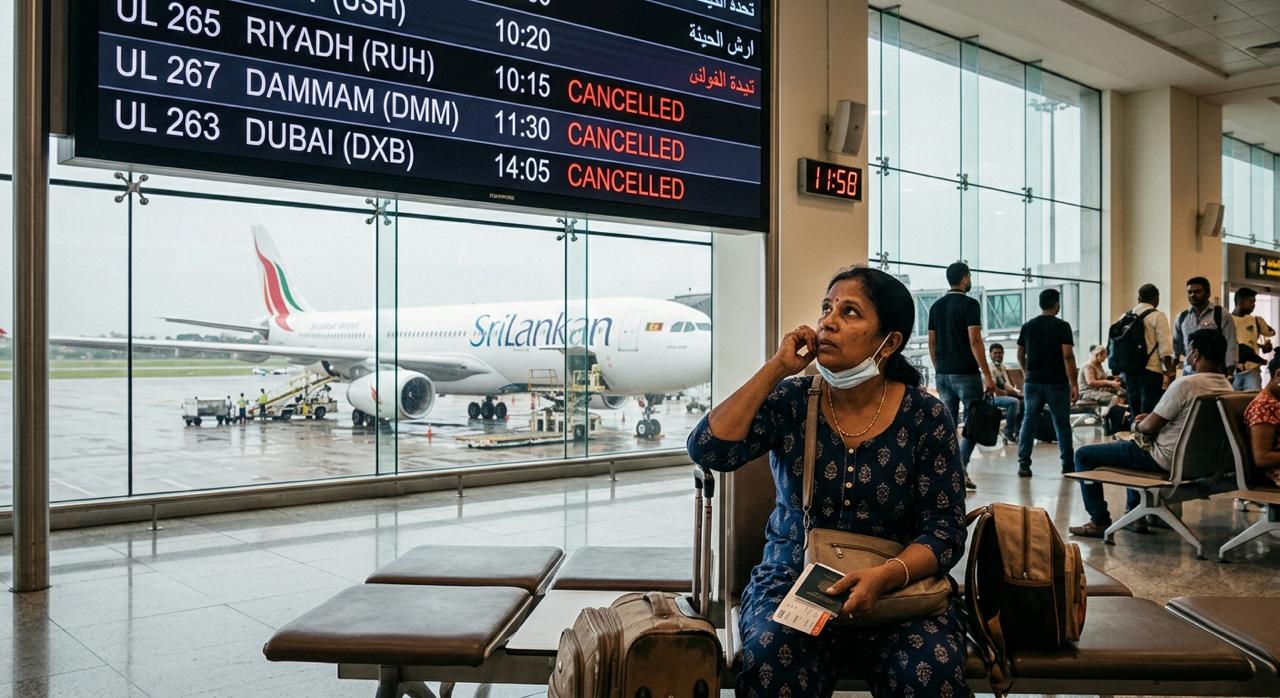
Sri Lankan Airlines has temporarily suspended flights from Riyadh and Dammam to Colombo until October 18, creating uncertainty for passengers travelling between Saudi Arabia and Sri Lanka. The disruption is particularly significant for migrant workers whose employment obligations, family commitments and limited financial resources may make unexpected travel changes considerably more difficult to manage.
SriLankan Airlines has announced the temporary suspension of its flights from Riyadh and Dammam to Colombo until October 18, citing prevailing conditions affecting commercial aviation operations. The national carrier has emphasised that the safety and security of passengers and crew remain its highest priority, an obligation that must take precedence over commercial considerations. The decision affects two important routes connecting Saudi Arabia with Sri Lanka, where a substantial number of Sri Lankan nationals live and work. While operational disruptions may sometimes be unavoidable, the consequences for affected passengers require careful attention.
For travellers whose journeys are associated with overseas employment, unexpected flight cancellations can create difficulties extending far beyond inconvenience. Migrant workers may have arranged leave for specific periods, obtained permission from employers or made commitments to return to work by particular dates. Families in Sri Lanka may also have organised important events, medical appointments or other arrangements around their expected arrival. A cancelled flight can disrupt all of these plans while imposing additional financial burdens upon people who may have limited resources available to meet unexpected expenses.
Submit Your Press Release
Get your company news, announcements, launches, appointments and events in front of a wider audience.


The immediate responsibility of the airline is to provide accurate and timely information concerning the flights affected and the arrangements available to passengers. Those arrangements should include clear explanations of rebooking options, refunds and any assistance available under the applicable conditions of carriage and passenger-protection requirements. Passengers should not be required to navigate conflicting information from booking agents, airline offices and online announcements. Effective communication is particularly important where travellers may have limited access to reliable information or may be unfamiliar with the procedures for obtaining assistance.
SriLankan Airlines operates under a national identity and provides an important connection between the country and its overseas workforce. Remittances from Sri Lankans employed abroad remain a significant source of foreign exchange and household income, supporting families and contributing to the wider economy. The workers generating those remittances deserve practical assistance when transport disruptions affect their ability to travel. Their circumstances should not be treated as incidental to the airline’s operational decisions.
The Government also has responsibilities through its diplomatic missions and the agencies concerned with overseas employment. Where large numbers of Sri Lankan nationals may be affected by disruptions, accurate information and appropriate coordination can help prevent unnecessary hardship. Diplomatic missions should be prepared to assist vulnerable passengers who encounter serious difficulties, particularly where employment arrangements or personal circumstances create urgent needs. Such assistance need not involve assuming responsibility for every commercial dispute, but it should ensure that citizens are not left without access to reliable guidance.
The wider issue concerns the resilience of Sri Lanka’s international transport connections in a region where geopolitical developments and operational uncertainties can affect aviation services. An island economy dependent upon tourism, overseas employment and international trade cannot eliminate every risk associated with international travel. It can, however, develop effective procedures for responding when disruptions occur. Those procedures require coordination between airlines, airport authorities, diplomatic missions and the agencies responsible for protecting the interests of overseas workers.
The immediate priority must remain the safety of passengers and crew, and no airline should be expected to operate services where conditions make doing so unsafe. Nevertheless, safety considerations do not remove the obligation to communicate clearly or to provide assistance in accordance with applicable rules and contractual commitments. The distinction is important because passengers have paid for a service and are entitled to know what happens when that service cannot be provided as scheduled. For SriLankan Airlines, already confronting substantial commercial and financial challenges, the treatment of affected passengers is an important measure of its commitment to public service.
An airline’s reputation is shaped not only by its performance when flights operate normally, but also by the way it responds when circumstances go wrong. Passengers may understand that cancellations are sometimes unavoidable, particularly where safety is concerned. They are considerably less likely to accept unnecessary confusion, inadequate information or unreasonable delays in resolving their difficulties. SriLankan Airlines should therefore ensure that affected passengers receive clear instructions and timely assistance while the suspension remains in effect.