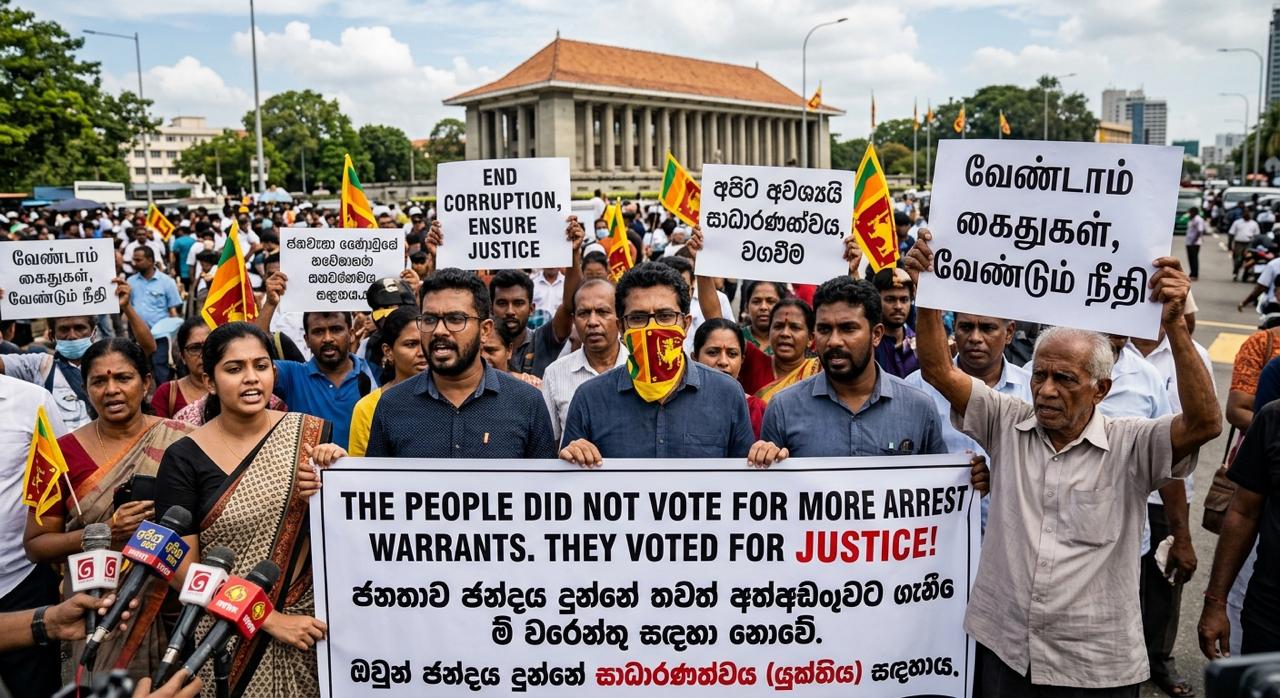
Sri Lanka has no shortage of investigations, arrests, court appearances and allegations of corruption. What remains in desperately short supply is the public confidence that wrongdoing will be investigated competently, prosecuted fairly and determined within a reasonable time. The Government promised accountability, but the country must now distinguish between the machinery of justice being set in motion and justice actually being delivered.
Sri Lanka’s political landscape has become crowded with investigations, arrest warrants, remand orders and court proceedings involving individuals who once occupied positions of considerable authority. Former ministers, parliamentarians and senior public officials are increasingly required to answer questions concerning the use of public money, the exercise of official powers and decisions taken while they held office. For a country that has spent decades watching allegations of corruption disappear into administrative obscurity, these developments represent an opportunity to strengthen accountability. But an opportunity is not an achievement, and the distinction matters enormously to the people who voted for change.
The present Government came to office with an overwhelming parliamentary majority and a powerful mandate to confront corruption, political privilege and the misuse of public resources. That mandate was not simply an invitation to investigate the previous administration or to demonstrate that powerful individuals could be arrested. It was a demand for a fundamentally different relationship between the State and its citizens, one in which public authority would be exercised lawfully and public money would be treated as belonging to the people. The Government must therefore be judged not by the volume of allegations directed against its political opponents, but by the quality, consistency and fairness of the institutions responsible for examining them.
Submit Your Press Release
Get your company news, announcements, launches, appointments and events in front of a wider audience.


The distinction between investigation and conviction is essential to any functioning democracy. An arrest warrant does not establish guilt, a remand order is not a sentence and the completion of a police investigation does not mean that a criminal offence has been proved. Those protections are not privileges reserved for political leaders, nor are they inconveniences that can be discarded when the accused happens to be unpopular. They are safeguards intended to protect every citizen from the arbitrary exercise of State power, including those who have never held political office and possess neither wealth nor influential friends.
Yet the opposite danger is equally serious. Investigations cannot be permitted to continue indefinitely while the individuals concerned remain under suspicion and the public remains without answers. Proceedings concerning events that occurred more than a decade ago inevitably raise questions about the efficiency of investigative institutions and the willingness of successive administrations to confront politically sensitive allegations. Delays can weaken evidence, complicate prosecutions and undermine confidence in the eventual outcome. A justice system that moves only when the political climate changes is not demonstrating independence, however impressive its announcements may sound.
The proceedings involving former Health Minister Keheliya Rambukwella and other former senior health-sector officials illustrate another dimension of accountability. Where courts impose financial obligations upon public officials, the enforceability of those orders becomes as important as the judgments themselves. A court cannot restore confidence in public administration merely by declaring that particular conduct was unlawful if the remedies it orders are subsequently ignored. Equally, allegations of non-compliance must be examined fairly, with the respondents receiving the full protections available under the law.
The consequences of weak accountability are particularly severe in essential public services. When money allocated to healthcare is mismanaged, the result may be a shortage of medicines or equipment rather than merely an unfavourable entry in a government account. When public resources intended for agriculture, education or transport are improperly diverted, the costs are ultimately borne by people who have little influence over the decisions being made. Corruption is not simply a contest between politicians and investigators. It is a transfer of public opportunity away from citizens who are entitled to expect that the State will act in their interests.
The Government must also recognise that the credibility of its anti-corruption programme depends upon the standards applied to its own members and supporters. It is relatively easy to demand accountability from political opponents, particularly when public opinion is already hostile towards them. The more difficult test arises when allegations concern individuals who are politically useful, personally familiar or associated with the governing movement. An administration that promises equality before the law cannot maintain one standard for its opponents and another for its friends without undermining the very principle upon which it sought office.
There is a temptation in politics to confuse public anger with evidence and political popularity with legal authority. Both temptations are dangerous because they invite the Government to treat criminal justice as an extension of electoral competition. Investigators must be free to follow evidence wherever it leads, prosecutors must be able to make decisions without political interference and judges must determine cases without regard to the popularity of the parties appearing before them. The public should expect no less, even when the outcome of a particular case is disappointing or politically inconvenient.
Sri Lanka’s experience also demonstrates why accountability cannot depend exclusively upon criminal prosecutions. Public institutions require transparent procurement systems, effective internal controls, independent auditing and meaningful parliamentary oversight capable of identifying problems before they become national scandals. Waiting until enormous sums have been lost and then announcing an investigation is a remarkably expensive method of public administration. Prevention may attract fewer headlines than an arrest, but it offers considerably greater protection to taxpayers.
Nearly two years into the present administration, the Government has had sufficient time to understand that the public expects more than a succession of dramatic developments in the courts. Citizens want to know whether investigations are progressing competently, whether prosecutions are being prepared properly and whether the institutions responsible for enforcing the law are themselves accountable. They also want to see public services improve, because the purpose of confronting corruption is not simply to punish wrongdoing after it occurs. It is to ensure that public resources are available for the purposes for which they were collected.
Be that as it may, the Government should resist the temptation to treat every arrest as a political victory and every accusation as proof that its promises are being fulfilled. The public did not elect a new administration merely to watch a different group of politicians describe the alleged misconduct of their predecessors. It elected a Government that promised to establish a system in which misconduct would be less likely to occur, more likely to be detected and capable of being dealt with fairly and efficiently. That is a considerably more demanding undertaking than producing another arrest warrant.
The country has already endured the financial and social consequences of weak institutions, political interference and the misuse of public authority. Its people have paid through higher taxes, diminished public services, reduced economic opportunity and a prolonged loss of confidence in those entrusted with governing them. They are entitled to expect that the sacrifices imposed upon them will produce lasting institutional improvements rather than another cycle of political accusations. The measure of this Government will not be how many former ministers appear before magistrates, but whether ordinary citizens can finally trust that the law applies equally to everyone.
The people voted for justice, not a permanent investigation.