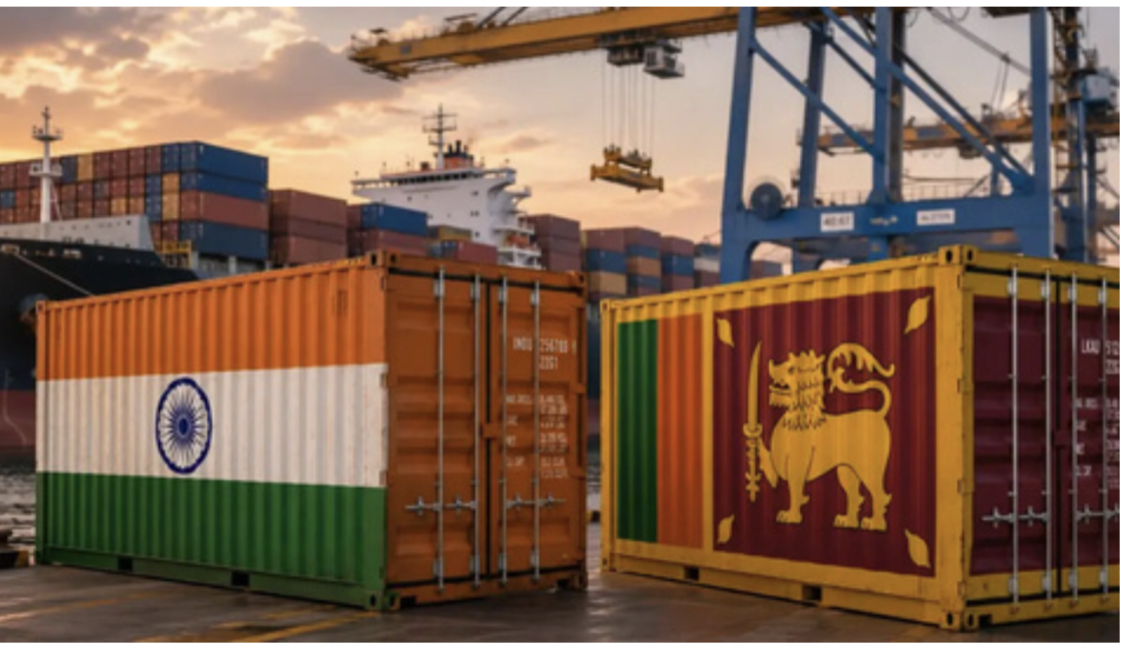
Sri Lanka’s export map has been anchored in the West for decades, built on garment containers bound for New York and London. That commercial geography is shifting in real time. Fresh data released by the Sri Lanka Export Development Board shows that India has firmly cemented its place as Sri Lanka’s second-largest export destination ahead of the United Kingdom, purchasing US$ 989.66 million worth of Sri Lankan merchandise in the first ten months of 2026.
The trajectory tells a clear story of divergence across Sri Lanka’s top three markets. Between January and October 2026, overall export earnings across goods and services climbed 6.03% year-on-year to US$ 15.28 billion, comprising US$ 12.01 billion in merchandise and US$ 3.27 billion in services. Within that basket, shipments to India jumped 14.16% from roughly US$ 867 million in the same period of 2025, accelerating sharply in October 2026 with a 34% surge to US$ 99.82 million. By contrast, exports to the United States, still Sri Lanka’s single largest buyer, edged up just 0.81% to US$ 2.52 billion, while exports to the United Kingdom fell 8.67% to US$ 723.40 million, including a 1.88% dip in October to US$ 69.04 million.
The shift becomes even sharper when looking at the multi-year timeline. Full-year Sri Lankan exports to India stood at US$ 830 million in 2023, rose to US$ 883.7 million in 2024, and crossed the billion-dollar mark at US$ 1,035.72 million in 2025. With US$ 989.66 million already banked by the end of October 2026, Colombo is on course to shatter last year’s record with two months still to spare.
Submit Your Press Release
Get your company news, announcements, launches, appointments and events in front of a wider audience.


What is driving the surge across the Palk Strait?
Unlike Western markets, where sluggish consumer demand weighed on Sri Lankan apparel exports, down 3.82% over the ten-month period, Indian buyers are snapping up agricultural commodities, processed foods, and industrial inputs. In October alone, pepper exports to India soared 371.58%, non-alcoholic beverages climbed 122.27%, desiccated coconut rose 92.41%, and animal feed grew 27.08%, alongside strong bilateral trade in refined petroleum products and spices.
That momentum reflects how deeply economic diplomacy now shapes Sri Lanka’s trade fortunes. Commercial ties with New Delhi are underpinned by the India-Sri Lanka Free Trade Agreement and strengthened by India’s pivotal financial backing during Sri Lanka’s 2022 economic crisis, alongside ongoing discussions over the Economic and Technology Cooperation Agreement, grid connectivity, and port logistics. Yet the relationship remains lopsided: while Sri Lanka exported US$ 1.04 billion to India in 2025, it imported US$ 4.33 billion in Indian fuel, fabrics, pharmaceuticals, and foodstuffs, leaving a US$ 3.29 billion trade deficit that exporters hope tariff-rate quota expansions and smoother non-tariff clearances will gradually narrow.
Meanwhile, relations with Washington and London carry their own economic weight. The United States remains indispensable to Sri Lanka’s apparel factories and diplomatic recovery under the IMF program, even as tariff uncertainty and softer retail orders flatten growth. Britain, tied to Sri Lanka through historical links, diaspora networks, and the Developing Countries Trading Scheme, continues to face cost-of-living headwinds that have dampened traditional clothing and tea orders.
For Sri Lankan policymakers, it appears that the lesson in the ten-month numbers is that Western markets still pay the biggest bills, but regional integration with a fast-growing neighbour is increasingly what keeps export growth moving forward.