
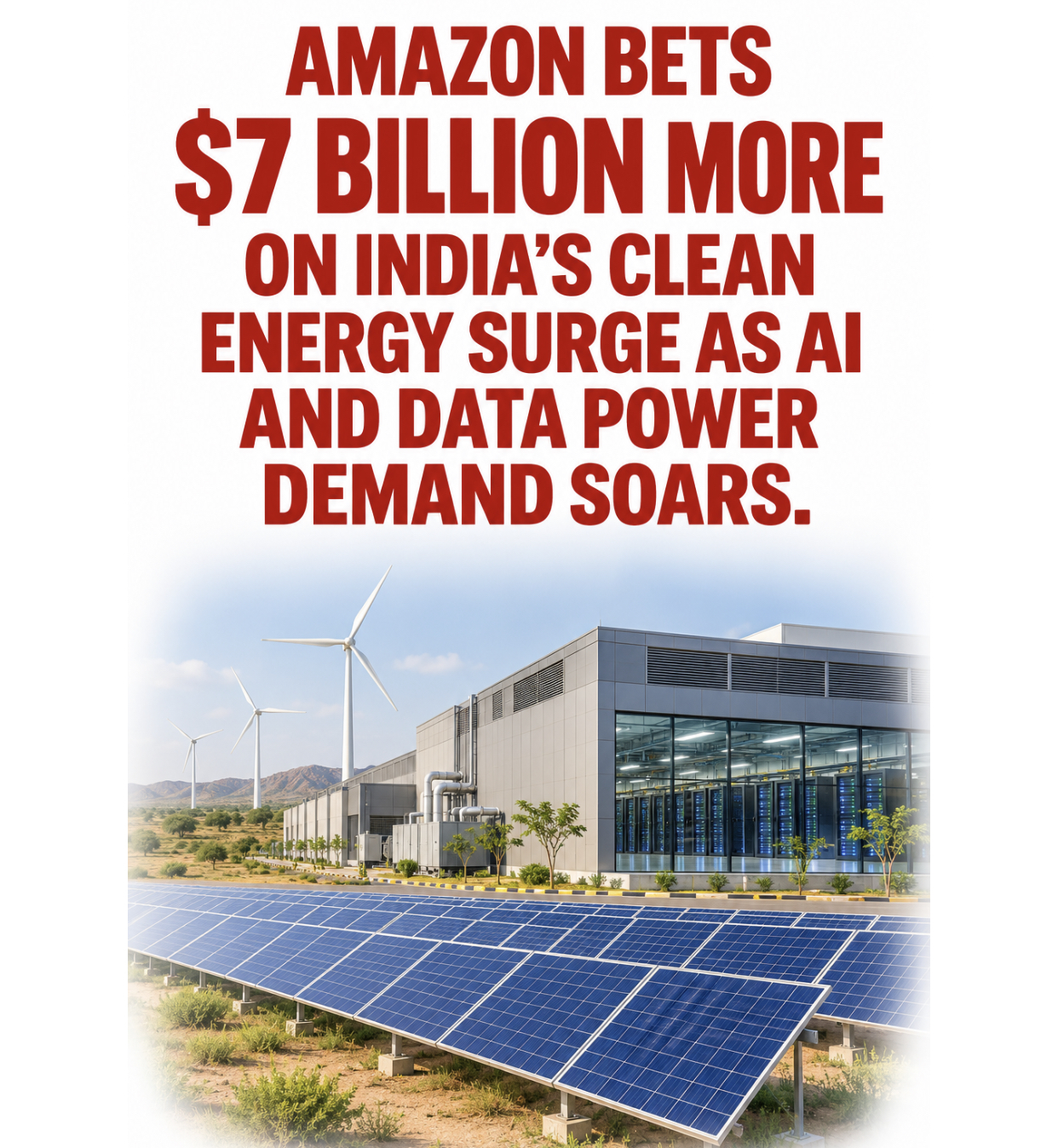
Corporate climate pledges often sound impressive in glossy sustainability reports, yet real conviction shows up on the balance sheet. On Tuesday, November 17, global technology and e-commerce giant Amazon put serious capital behind its green ambitions, announcing plans to invest an additional $7 billion in renewable energy projects across India by 2030. Layered on top of $4 billion already contracted in the country, the commitment lifts Amazon’s total clean energy pipeline in India to $11 billion, underscoring how central South Asia’s largest economy has become to powering the next generation of digital infrastructure.
Alongside the headline capital pledge, Amazon unveiled 4 new utility-scale power purchase agreements adding 934 megawatts of wind and solar capacity across 3 Indian states. In Karnataka, the company is backing a 234-megawatt wind farm, its largest contracted wind project in Asia to date, alongside a 200-megawatt hybrid wind and solar installation. Central and western India round out the expansion with a 300-megawatt solar plant in Madhya Pradesh and a 200-megawatt solar project in Rajasthan. Once these 4 projects come online, Amazon’s active Indian portfolio of 57 projects, comprising 14 large-scale wind and solar farms and 43 on-site facility installations, will exceed 2 gigawatts. That is enough clean electricity to power more than 3.5 million Indian households every year.
Why is an e-commerce and cloud computing powerhouse pouring billions into Indian wind turbines and solar panels right now? Follow the electricity demand. Rapid expansion in cloud services, logistics networks, and energy-hungry artificial intelligence data centers requires vast, reliable supplies of low-carbon power. That reality explains why Amazon simultaneously announced a new global target to cut the carbon intensity of electricity powering its operations by 65% by 2030 compared with 2019 levels, keeping it on track toward its broader pledge of net-zero carbon emissions by 2040. Chief Sustainability Officer Kara Hurst noted that scaling clean power in India not only supports Amazon’s operational needs but directly advances India’s national goal of reaching net-zero emissions by 2070.
Submit Your Press Release
Get your company news, announcements, launches, appointments and events in front of a wider audience.


For New Delhi, the timing could scarcely be better. India is racing toward an ambitious target of 500 gigawatts of non-fossil fuel electricity capacity by 2030, a transition requiring massive private and foreign capital. Welcoming the announcement, Union Minister for New and Renewable Energy Pralhad Joshi said sustained corporate investments of this scale reinforce India’s energy security while demonstrating growing international confidence in the domestic clean energy ecosystem.
Still, announcing a $7 billion pipeline is only the starting gun. Turning contracted megawatts into grid-connected power across multiple states will test land acquisition, transmission infrastructure, and regulatory execution over the next 4 years. Yet as global tech giants increasingly discover, winning the future of cloud computing and artificial intelligence starts with securing clean electrons on the ground, and Amazon has clearly decided that India’s sun and wind are essential to that race.



