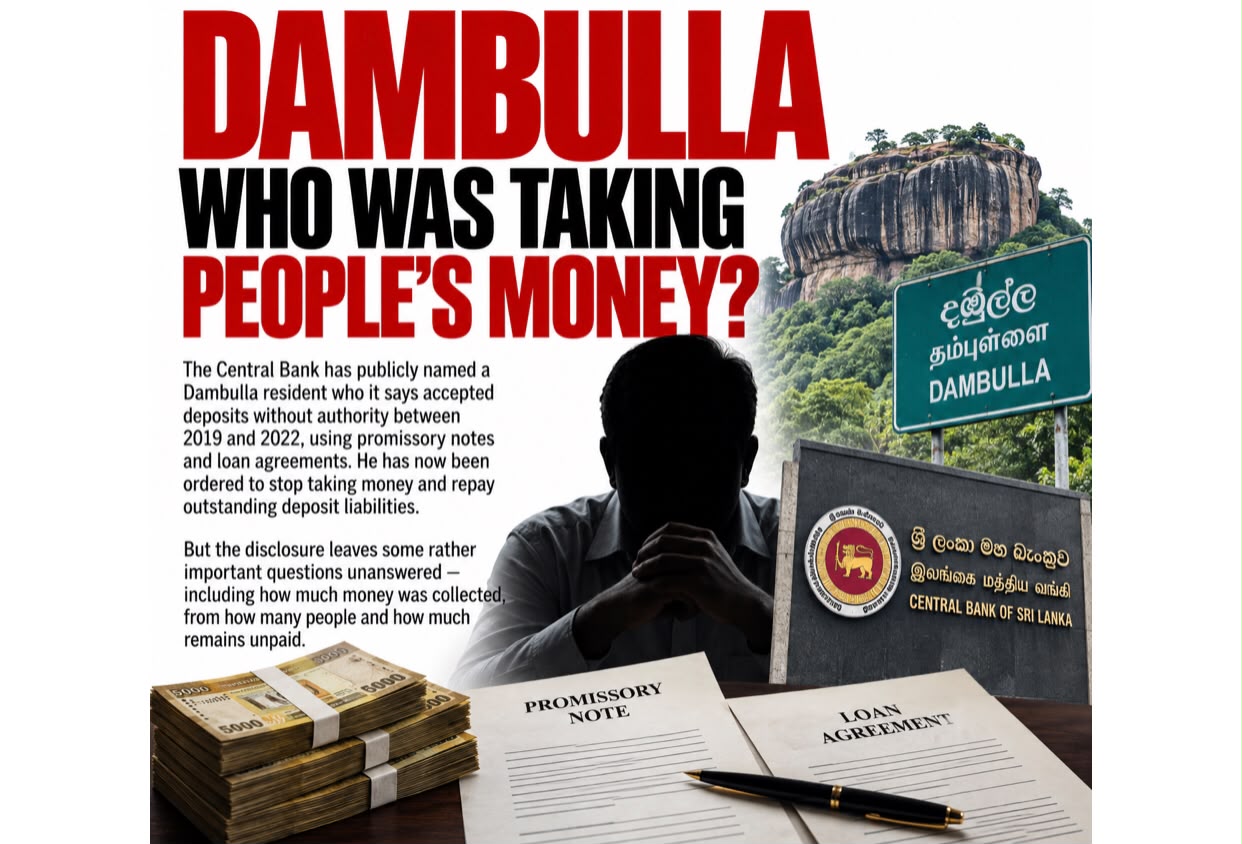
The Central Bank has publicly named a Dambulla resident who it says accepted deposits without authority between 2019 and 2022, using promissory notes and loan agreements. He has now been ordered to stop taking money and repay outstanding deposit liabilities. But the disclosure leaves some rather important questions unanswered including how much money was collected, from how many people and how much remains unpaid.
The Central Bank has taken the unusual step of publicly naming a Dambulla resident after determining that he had accepted deposits from members of the public in contravention of the Finance Business Act. The notice, published on September 16, identifies the individual as Pemadasage Indika Premakumara and says the activities occurred over a period stretching from 2019 to 2022.
According to the Central Bank, the money was accepted through the issuing of promissory notes and the entering into of loan agreements. Following an investigation under Section 42 of the Finance Business Act No. 42 of 2011, the Bank says it determined on July 15 this year that the deposits had been accepted in contravention of the law.
Submit Your Press Release
Get your company news, announcements, launches, appointments and events in front of a wider audience.


Two directions have now been issued. Premakumara has been ordered not to accept further deposits from the public through loan agreements, promissory notes or any other method, and he has also been directed to repay all remaining deposit liabilities.
So far, that sounds like a regulator doing precisely what a regulator is supposed to do. The difficulty begins with what the public notice does not tell us.
There is no figure for the total amount of money accepted. There is no number for how many people placed their money with the individual. There is no indication of the value of the liabilities still outstanding, nor does the notice explain when those outstanding sums must be repaid.
Those are not insignificant details. If the purpose of publishing the notice is to protect the public, the scale of what occurred is surely part of the public interest, particularly for anyone who may have handed over money and is now wondering what happens next.
There is also the question of time. The Central Bank says the deposits were accepted between 2019 and 2022. Its determination was made on July 15, 2026, and the public notice followed on September 16. That does not by itself establish that the regulator knew about the activity throughout the intervening years, but it does make the chronology important. When did the Central Bank first become aware of the deposit-taking, when did its investigation begin, and what triggered it?
The distinction between an ordinary private loan and the business of accepting deposits from the public matters enormously. Sri Lanka regulates deposit-taking because the moment members of the public are invited to hand over their savings with an expectation that the money will be returned, the potential consequences of failure extend far beyond an ordinary commercial disagreement.
A licensed bank or finance company operates inside a regulatory structure involving capital requirements, supervision and other safeguards. Somebody accepting money outside that framework does not suddenly acquire those protections merely because the transaction is described as a loan agreement or accompanied by a promissory note.
Sri Lanka hardly needs reminding what can happen when people entrust their savings to schemes they believe are safe. The attraction is often perfectly understandable: an apparently better return, a persuasive recommendation or confidence in the person collecting the money. The danger becomes apparent only when somebody asks for the capital back and discovers that a piece of paper is not the same thing as cash in the bank.
That is why the Central Bank’s action in this case is important. But enforcement after unauthorised deposit-taking has occurred is only one part of regulation. The more difficult objective is detecting it early enough to prevent members of the public becoming exposed in the first place.
The Central Bank has now told the individual to repay what remains outstanding. The next stage deserves watching rather carefully.
How much must be repaid? How many people are waiting for their money? And, most importantly, will they actually get it back?
Be that as it may.