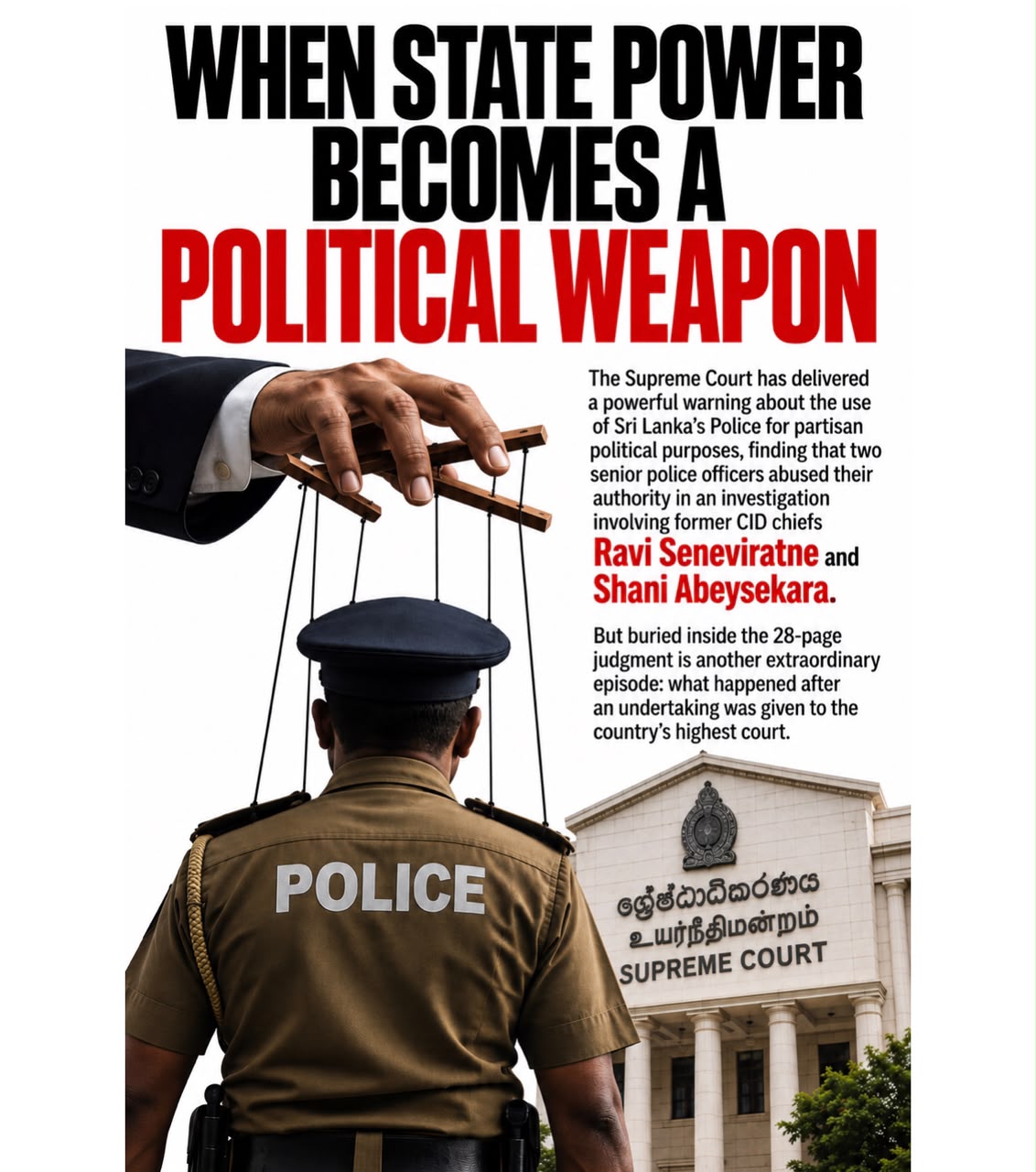
The Supreme Court has delivered a powerful warning about the use of Sri Lanka’s Police for partisan political purposes, finding that two senior police officers abused their authority in an investigation involving former CID chiefs Ravi Seneviratne and Shani Abeysekara. But buried inside the 28-page judgment is another extraordinary episode: what happened after an undertaking was given to the country’s highest court.
There are judgments which decide disputes. And then there are judgments which say something much larger about how a country is governed.
The Supreme Court’s decision delivered on September 15 in SC/FR Application 241/2024 belongs firmly in the second category. At its heart was an investigation launched following a complaint concerning the conduct of two former senior CID officers, Ravi Seneviratne and Shani Abeysekara, in relation to matters surrounding the Easter Sunday attacks.
Submit Your Press Release
Get your company news, announcements, launches, appointments and events in front of a wider audience.


But what emerged from the judgment was a much bigger constitutional question: what happens when the enormous investigative power of the State is turned towards political ends?
The answer from the Supreme Court could hardly have been clearer.
The Court found, on a balance of probabilities, that Chief Inspector D. K. Induka De Silva and then Inspector General of Police Deshabandu Thennakoon abused their police powers in order to counter and neutralise the political campaign of the two petitioners and thereby advance the interests of the political establishment then in power.
Those are serious findings in any democracy.
The petitioners had become involved with the Retired Police Collective supporting the National People’s Power during the run-up to the 2024 Presidential Election. A complaint was subsequently made against them by retired police officer Palitha Roshan Siriwardena concerning alleged failures connected with investigations preceding the Easter attacks.
The Supreme Court examined not merely the existence of that complaint but its timing, the circumstances surrounding it and the remarkable speed with which the police machinery responded.
The Court found that Siriwardena had acted mala fide in lodging the complaint with a political motive. It noted that then IGP Thennakoon acted with “great haste” in forwarding it to the CID and traced how statements were recorded and reports subsequently placed before the Magistrate’s Court.
The Court went considerably further.
It found sufficient evidence to conclude that Induka De Silva and Thennakoon had acted maliciously to assist Siriwardena and advance his political objectives. Their conduct, the Court held, amounted to an abuse of lawful authority for political purposes.
The judgment consequently found violations of the petitioners’ fundamental rights guaranteed under Articles 12(1) and 13(1) of the Constitution equality and equal protection of the law, and protection against arrest except according to procedure established by law. The Court found that the danger of the petitioners being arrested and detained for political reasons in the run-up to the election had been real and well-founded.
But the significance of this judgment extends far beyond two retired police officers.
The Supreme Court articulated a principle that should resonate through every police station, ministry and government department in Sri Lanka: public power does not belong to the political party temporarily occupying office.
“The abuse of executive power for partisan political ends strikes at the very foundation of constitutional government that is premised on the rule of law,” the judgment says.
Public power, the Court continued, exists for lawful public purposes and never as an instrument for advancing the electoral or political interests of those who temporarily possess political power.
There is another part of this judgment which deserves equal attention.
During the proceedings, an Additional Solicitor General appearing for the Attorney General informed the Supreme Court that proceedings arising from the relevant complaint before the Fort Magistrate’s Court would be brought to an end.
What followed plainly troubled the Court.
The judgment records that subsequent letters from the Attorney General’s Department appeared inconsistent with the undertaking. Earlier in the judgment, Justice K. M. G. H. Kulatunga described what followed as a “subtle attempt” to keep the investigation alive under another Attorney General’s file despite what had been represented to Court.
The language became stronger still.
The judge recorded a “profound sense of sadness” that an officer of the Attorney General had either failed to keep an undertaking made to the Court or had deliberately made an intimation which was not intended to be honoured. The Court stressed that undertakings are extremely serious and observed that intentionally disregarding one could amount to contempt. It nevertheless decided to put the episode to rest without further consequence.
That ought not make the episode insignificant.
The Attorney General’s Department occupies a unique position within Sri Lanka’s justice system. Its officers regularly make representations upon which courts, accused persons, investigators and the State itself rely. If an undertaking to the Supreme Court means precisely what it says as surely it must the Court’s observations deserve attention well beyond this particular case.
Ultimately, the Supreme Court held that Induka De Silva, Deshabandu Thennakoon and Palitha Roshan Siriwardena had infringed the fundamental rights of Seneviratne and Abeysekara under Articles 12(1) and 13(1). The Court found that Siriwardena had instigated the two police respondents to use executive power for an ulterior political purpose and had acted in connivance with them.
The Court ordered De Silva to pay Rs 10,000 personally to each petitioner and Siriwardena Rs 50,000 to each. More significantly, it ordered that no further investigation be conducted into the June 24, 2024 complaint, which the Court found to have been mala fide, malicious and politically motivated. The Attorney General was directed to advise the IGP accordingly.
Chief Justice P. Padman Surasena and Justice Achala Wengappuli agreed with Justice Kulatunga’s judgment.
Governments change. Police chiefs change. Attorneys General change. Political opponents become governments and governments become political opponents.
That is precisely why the principle established here matters.
A police investigation carries enormous coercive power. It can summon a citizen, search property, seize documents, restrict liberty and ultimately place somebody before a criminal court. Those powers cannot become another weapon in the political armoury of whichever government happens to hold office.
The Supreme Court has now said so in unusually uncompromising terms.
Sri Lanka has spent decades arguing about the politicisation of its institutions. This judgment is therefore about considerably more than Seneviratne, Abeysekara, Thennakoon or one investigation arising from the Easter attacks.
It is about the line separating the State from the government of the day.
When that line disappears, equal protection under the law begins to disappear with it.
Be that as it may.