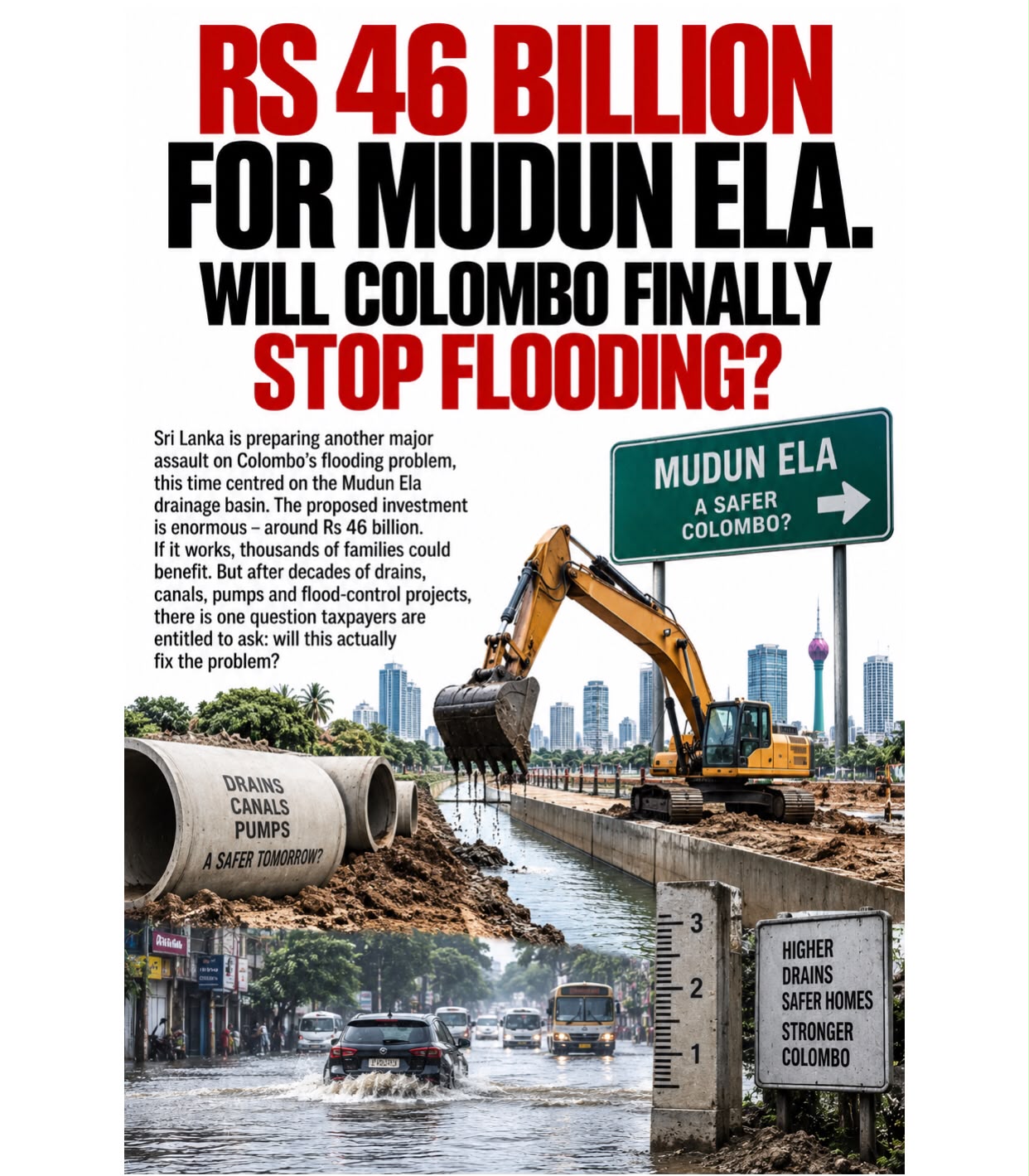
Sri Lanka is preparing another major assault on Colombo’s flooding problem, this time centred on the Mudun Ela drainage basin. The proposed investment is enormous around Rs 46 billion. If it works, thousands of families could benefit. But after decades of drains, canals, pumps and flood-control projects, there is one question taxpayers are entitled to ask: will this actually fix the problem?
Colombo does not need another study to establish that it floods. A few hours of sufficiently heavy rain can turn roads into rivers, trap commuters, inundate homes and expose the extraordinary vulnerability of parts of the country’s commercial capital and its surrounding suburbs. The problem is old, enormously expensive and, despite years of investment, stubbornly persistent.
The latest answer is the proposed Mudun Ela development, an undertaking carrying a price tag of around Rs 46 billion and intended to improve the management of storm water and reduce flooding across areas affected by the drainage basin. At that scale, this is no longer simply another drainage improvement. It is a major public investment whose success or failure will eventually be measured in homes protected, roads kept open and communities spared repeated flooding.
Submit Your Press Release
Get your company news, announcements, launches, appointments and events in front of a wider audience.


Mudun Ela is important because Colombo’s flooding cannot be understood simply by looking at the drains beside its roads. Water has to move through an interconnected system of canals, retention areas, wetlands and waterways before eventually
being discharged, and restrictions at one point can have consequences kilometres away. Rapid urbanisation has meanwhile covered enormous areas of naturally absorbent ground with concrete, buildings and roads, leaving storm water with fewer places to go.
That is why merely widening a drain or cleaning a canal may provide temporary relief without solving the underlying problem. Flood protection has to consider the entire catchment, including water retention, pumping capacity, encroachments, construction, solid-waste disposal and the preservation of wetlands that perform an enormous drainage function without sending the Government an invoice.
The Rs 46 billion figure therefore deserves attention not because flood mitigation is unnecessary but because it is so necessary. If Sri Lanka is going to commit that amount of public money to the Mudun Ela basin, taxpayers should be able to see precisely what is being built, how the expenditure has been calculated, what geographical areas will benefit and what measurable reduction in flooding the project is expected to deliver.
There should also be a clear answer to what happens after construction is completed. Sri Lanka has never suffered from a shortage of infrastructure projects; maintenance is another matter. A sophisticated drainage system clogged by garbage, obstructed by illegal construction or allowed to deteriorate can eventually become an extremely expensive version of the system it replaced.
Climate adds another complication. Infrastructure designed around yesterday’s rainfall patterns may not be sufficient for tomorrow’s extreme weather. A Rs 46 billion flood-control programme must therefore be designed not merely to deal with the floods Colombo already knows but with the increasingly intense rainfall events it may have to confront in the decades ahead.
There is an economic argument for getting this right. Flooding destroys household possessions, damages businesses, interrupts transport, reduces productivity and forces government agencies repeatedly to spend money responding to emergencies that better infrastructure might have prevented. Properly designed flood mitigation can therefore save considerably more than it costs.
But that calculation works only if the project actually delivers the promised protection. Sri Lanka’s recent economic history has taught the country a painful lesson about large public investments: the size of a project is not evidence of its value.
The Mudun Ela development should consequently be welcomed as an opportunity to tackle a serious and longstanding problem, but accompanied from the beginning by unusually rigorous transparency. The public should know the engineering objectives, procurement arrangements, implementation timetable, environmental safeguards and the benchmarks against which success will eventually be judged.
Rs 46 billion can buy an enormous amount of concrete.
What Colombo needs it to buy is considerably more valuable: dry homes, passable roads and a city that does not surrender every time the heavens open.
Be that as it may.