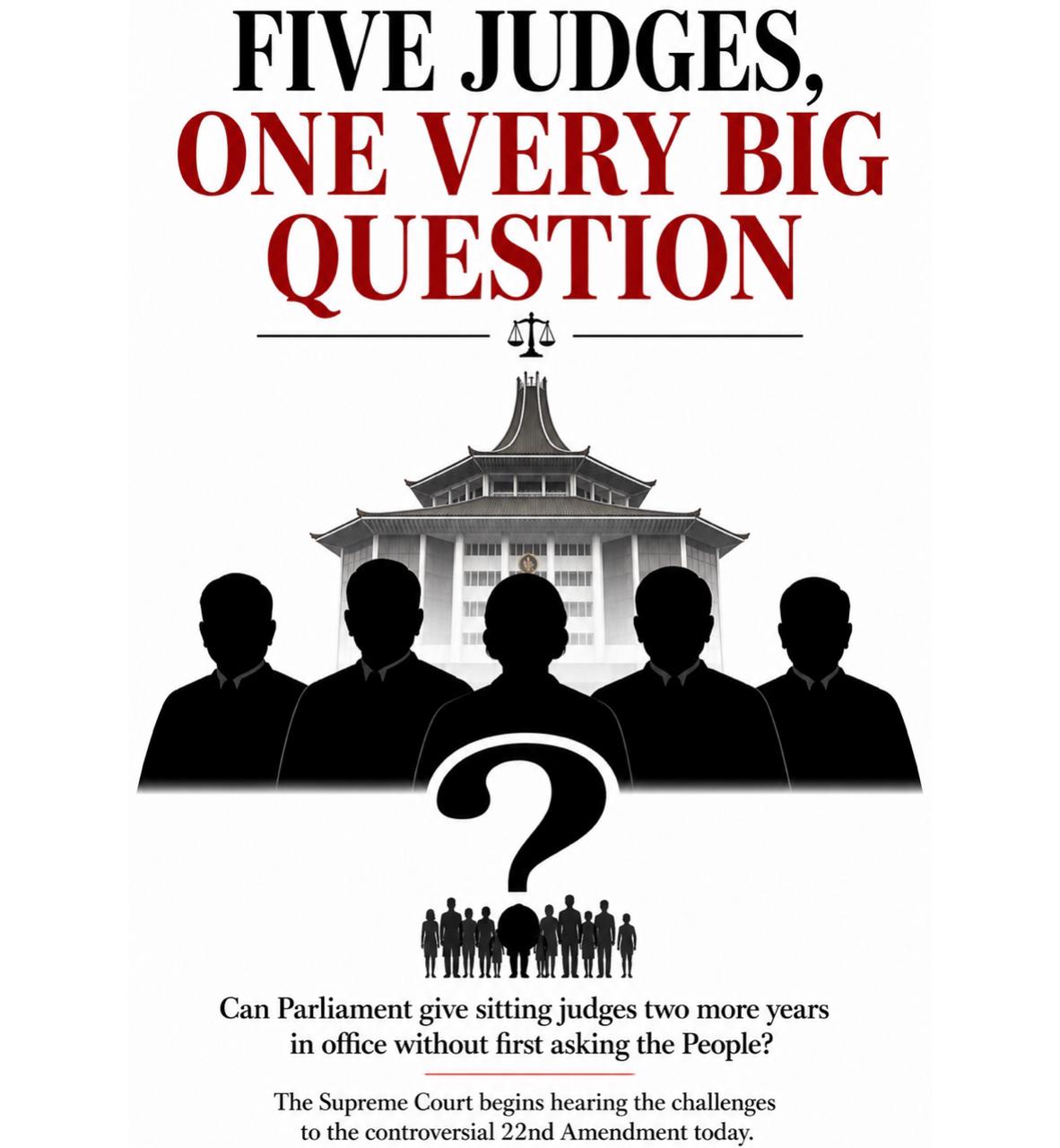
Can Parliament give sitting judges two more years in office without first asking the People? The Supreme Court begins hearing the challenges to the controversial 22nd Amendment today.
Sri Lanka’s Supreme Court takes centre stage today as five judges begin hearing one of the most consequential constitutional disputes to come before the country’s highest court in recent years.
Chief Justice Preethi Padman Surasena will preside over the five-member bench together with Justices Achala Wengappuli, Arjuna Obeyesekere, Sampath Abeykoon and Gihan Kulatunga.

Before them are 30 petitions concerning the proposed 22nd Amendment to the Constitution. Twenty-seven oppose the amendment while three have been filed in support.
On paper, the proposal appears remarkably straightforward. Supreme Court judges, who presently retire at 65, would retire at 67. Court of Appeal judges would move from 63 to 65. The proposed amendment also provides that a Chief Justice would retire upon reaching 67 or completing six years as Chief Justice, whichever occurs first.
But this has ceased to be an argument simply about whether judges should work for another two years. The much larger question is whether those additional years can constitutionally be given to judges who are already holding office.
That distinction could determine everything.
There is little argument about Parliament’s ability, with the required constitutional majority, to legislate for the future. Parliament could determine that judges appointed after a specified date should retire at a different age. Those judges would accept appointment knowing precisely the tenure attaching to their office.
The controversy becomes considerably more complicated if the change applies to judges already sitting on the Supreme Court and Court of Appeal.
The reason is simple enough for the non-lawyer to understand. An incumbent judge appointed on the basis that his or her tenure ends at a particular age would suddenly receive another two years in office through legislation enacted by the political branches of government.
That is where questions of judicial independence and the sovereignty of the People enter the argument.
The Bar Association of Sri Lanka and several petitioners contend that altering the tenure of incumbent judges affects judicial independence sufficiently to engage Article 3 of the Constitution, which declares that sovereignty is in the People and is inalienable.
If the Supreme Court accepts that argument, a two-thirds majority in Parliament may not by itself be enough. Approval by the People at a referendum could also become necessary.
The Government’s position is substantially different. It argues that longer judicial tenure is part of a legitimate attempt to address the enormous backlog within Sri Lanka’s justice system and retain experienced judges for longer. A petition supporting the amendment also argues that the Bill does not violate judicial independence or Article 3 and therefore does not require a referendum.
There is, however, another unusual feature to this constitutional battle. The judges being asked to determine the constitutionality of the amendment belong to the very institution whose members could potentially benefit from it.
That difficulty has already been raised before the Court.
The BASL sought consideration of the challenge by the full Supreme Court, pointing to the unusual circumstances surrounding legislation affecting the tenure of sitting judges. Instead, a five-member bench has been constituted.
The principle behind the concern is ancient and uncomplicated: no person should ordinarily be the judge of his own cause. Yet somebody must decide whether the legislation complies with the Constitution, and under Sri Lanka’s constitutional architecture that responsibility belongs to the Supreme Court.
The Court therefore finds itself in an extraordinary position. It must determine a constitutional question concerning judicial tenure while simultaneously demonstrating that the determination itself is entirely independent of any benefit which might eventually flow to members of the judiciary.
Opposition to the amendment has meanwhile spread considerably beyond Hulftsdorp.
Forty professional organisations and trade unions joined the BASL yesterday in calling upon the Government to withdraw the proposed amendment. They include organisations representing university academics, doctors, nurses, railway employees and other professionals and public servants.
Their joint position is that if the Government insists on proceeding with the amendment, the question should ultimately be placed before the People at a referendum.
That brings the controversy back to the deceptively simple question now confronting the five judges.
The issue is not whether a 67-year-old judge is capable of delivering justice. Judges elsewhere remain on the bench considerably longer. Nor should this debate become an argument about the competence or integrity of individual judges presently serving on Sri Lanka’s courts.
The constitutional question is about the rules governing their tenure and, crucially, when those rules may be changed.
There is an important difference between telling tomorrow’s judge, before appointment, that retirement will come at 67 and telling today’s judge, appointed to retire at 65, that Parliament has decided to give another two years.
One changes the rules for the future. The other changes them while the game is being played.
Sri Lanka has been here before in different forms. Governments of different political colours have discovered the attraction of constitutional amendments when existing constitutional arrangements become inconvenient. Some strengthened institutions. Others concentrated power. Several produced consequences their architects probably never anticipated.
That history is precisely why constitutional safeguards matter most when a government possesses the parliamentary numbers to change the Constitution.
A two-thirds majority provides enormous legislative power. It does not necessarily provide unlimited constitutional power. Certain elements of Sri Lanka’s constitutional order remain protected by the sovereignty of the People themselves.
The Supreme Court must now decide whether the proposed extension of judicial tenure crosses that boundary.
Its determination will matter far beyond whether a handful of judges retire at 65 or 67. It could establish an important principle about whether the tenure of judges already in office may be altered by Parliament and, consequently, about the distance that must always remain between political power and judicial office.
The Government says the reform will strengthen the administration of justice. Its opponents say applying it to incumbent judges could weaken judicial independence. Both arguments will now be tested where constitutional arguments ultimately must be tested: before the Supreme Court.
Five judges begin hearing those arguments today.
Be that as it may, the real question before them is larger than two additional years. It is who ultimately owns those years: Parliament, the judges – or the People.
The underlying facts are current as of tonight: the five-member bench and tomorrow’s hearing are confirmed, as are the 30 petitions – 27 opposing and three supporting – and the joint opposition announced today by 40 professional organisations and trade unions.