
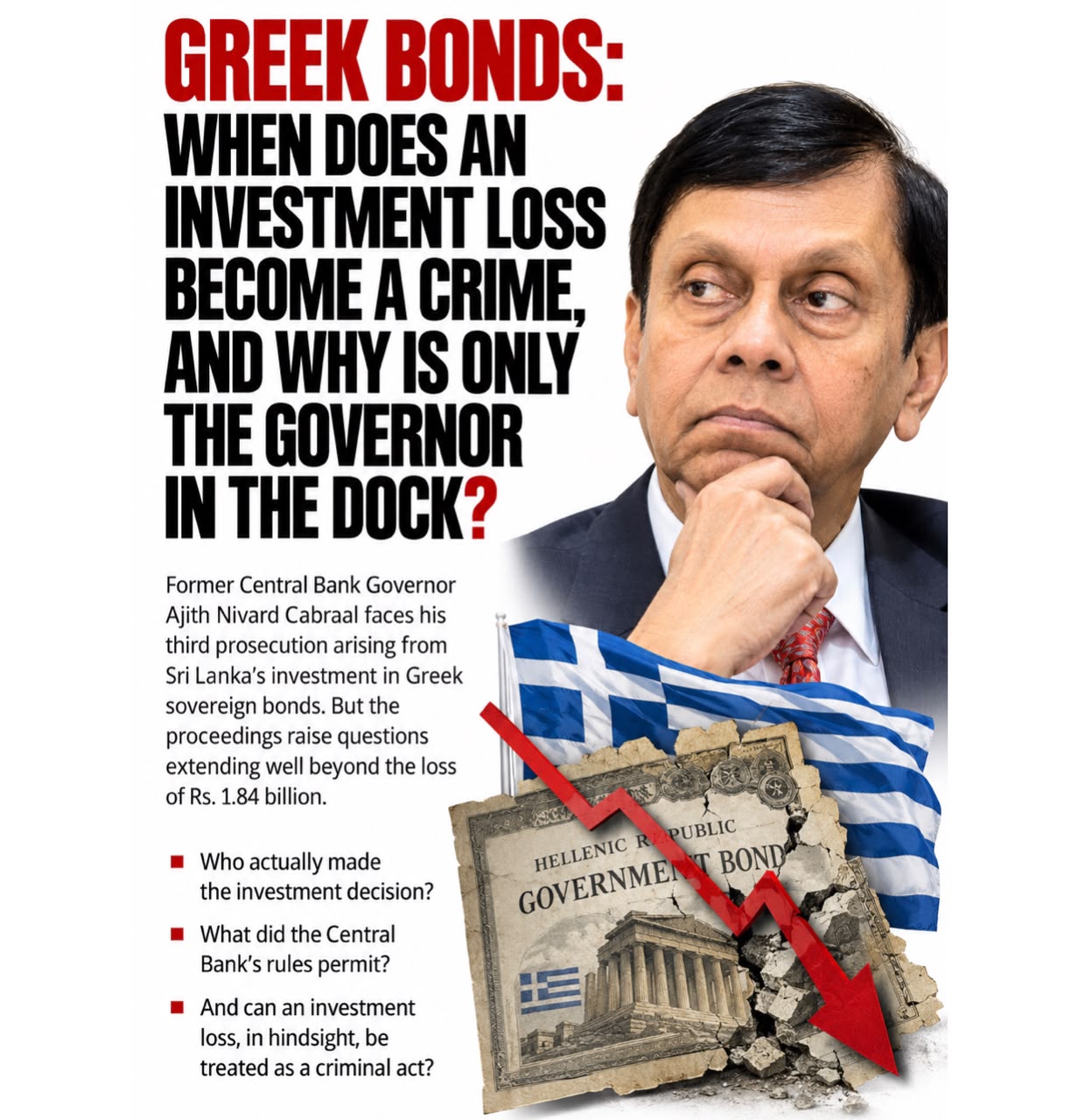
Former Central Bank Governor Ajith Nivard Cabraal faces his third prosecution arising from Sri Lanka’s investment in Greek sovereign bonds. But the proceedings raise questions extending well beyond the loss of Rs. 1.84 billion. Who actually made the investment decision? What did the Central Bank’s rules permit? And can an investment that subsequently loses money automatically become evidence of criminal wrongdoing?
There is a fundamental principle of justice that deserves particular attention as former Central Bank Governor Ajith Nivard Cabraal prepares to give evidence before a three-judge High Court Trial-at-Bar on Monday.
Justice must not only be done. It must manifestly and undoubtedly be seen to be done.
Submit Your Press Release
Get your company news, announcements, launches, appointments and events in front of a wider audience.


This is the third occasion on which Cabraal has faced charges arising from the Central Bank’s investment in Greek government bonds in 2011. The latest proceedings, however, appear to have one striking distinction. While an earlier prosecution included four other Central Bank officials, the present indictment names Cabraal alone.
Why?
This is not a question intended to establish Cabraal’s innocence. Nor is it an attempt to undermine the authority of the Commission to Investigate Allegations of Bribery or Corruption. It is a question about the consistency, transparency and fairness of criminal accountability.
The Central Bank of Sri Lanka is not an investment boutique operated from the Governor’s private office. Its foreign reserve investments were governed by an institutional framework involving the Monetary Board, delegated authority, investment guidelines and a Foreign Reserve Management Committee.
Under the Monetary Law Act then in force, responsibility for managing international reserves rested with the Monetary Board. The Governor possessed delegated powers, but investment operations were conducted within an established administrative and professional structure.
Indeed, the Supreme Court’s earlier examination of the Greek bond controversy expressly referred to the Governor’s delegated authority under the Foreign Reserve Management Guidelines.
If the investment was the product of an institutional process, the public is entitled to understand precisely what Cabraal is alleged to have done individually that amounted to corruption.
Was an established procedure deliberately violated? Was professional advice disregarded? Was an investment authorised outside the permitted framework? Was there evidence of dishonesty, abuse of authority or some other legally established element of the alleged offence?
These are questions for the prosecution to establish through evidence, not assumptions.
There is another dimension that deserves examination.
When the Central Bank purchased Greek government bonds in April 2011, Greece carried a Fitch sovereign credit rating of BB+. That rating was already below investment grade, indicating material credit risk, but it was nevertheless several notches above CCC, a rating associated with substantially greater default vulnerability.
Greece was subsequently downgraded to B+ in May and CCC in July as the European sovereign debt crisis deepened.
Could Cabraal, or indeed the Central Bank’s investment professionals, reasonably have predicted the precise timing and severity of that deterioration?
A BB+ rating was certainly not a guarantee of safety. Greece’s debt difficulties were already public knowledge. A responsible investment decision therefore required serious consideration of the risks.
But there is a considerable difference between accepting an identifiable investment risk and committing a criminal offence.
Sri Lanka itself has experienced periods of exceptionally weak sovereign credit ratings. If a foreign central bank purchased Sri Lankan sovereign bonds when those securities carried a CCC rating, and subsequently suffered a loss, would that automatically establish corruption by the foreign central bank’s governor?
Clearly not.
The appropriate questions would concern the investment mandate, risk limits, information available at the time, compliance with established procedures and the reasons for making the investment.
Exactly the same standards should apply to Sri Lanka’s own Central Bank.
There is also the matter of proportion.
The Greek bond exposure represented approximately 0.6 percent of Sri Lanka’s foreign reserve portfolio. The Central Bank subsequently reported that its overall reserve-management operations generated approximately US$430 million in profits during 2011, after accounting for the Greek bond losses.
That does not make the losses irrelevant. Public money must be managed responsibly, regardless of whether the wider portfolio produces a profit.
But an investment decision should be evaluated within its proper financial and institutional context.
Perhaps most significantly, the Supreme Court considered the Greek bond controversy in earlier fundamental-rights proceedings and declined to find the investment decision unreasonable.
That determination should not be confused with an acquittal on criminal charges. Different proceedings involve different legal questions and evidentiary requirements.
Nevertheless, the earlier judicial findings form part of the history of this matter. The public deserves to understand how they relate to the present prosecution.
The latest case has already survived preliminary legal objections, and the High Court has directed the defence to present evidence after declining an application to discharge Cabraal at the close of the prosecution’s case.
That procedural decision is not a finding of guilt.
The presumption of innocence remains fundamental.
Equally, the prosecution must be afforded the opportunity to establish its allegations according to law.
What concerns us is the possibility that the public may come to regard the existence of an investment loss as sufficient proof of criminal misconduct.
It is not.
A loss can result from negligence, an error of judgment, an unforeseeable market development, an excessive appetite for risk or deliberate wrongdoing. Those possibilities are not legally interchangeable.
And if the allegation is that Cabraal personally abused his authority, the public should be told how that alleged abuse is distinguished from the responsibilities exercised by the other officials involved in the investment process.
Why were four other officials included in an earlier indictment but apparently excluded from the present prosecution? Were they cleared by the evidence? Were their responsibilities materially different? Or has the prosecution adopted a different legal theory?
There may be entirely legitimate answers. But those answers matter.
The prosecution of a former Central Bank Governor is a serious matter. So too is the possibility of allowing an individual to carry criminal responsibility for what may have been an institutionally authorised decision without clearly establishing the basis for individual culpability.
Sri Lanka has suffered enormously from failures of financial governance. Those responsible for corruption must face the consequences, irrespective of their political connections or former positions.
But accountability cannot be built upon hindsight alone.
The law must distinguish between a bad investment, a negligent decision and a corrupt act.
Be that as it may, the ultimate test is not whether the State can prosecute a former Governor three times over the same investment. It is whether the evidence can establish wrongdoing beyond reasonable doubt, through a process that is fair, consistent and visibly just.
That is the standard Cabraal deserves.
It is also the standard the Sri Lankan public deserves.



