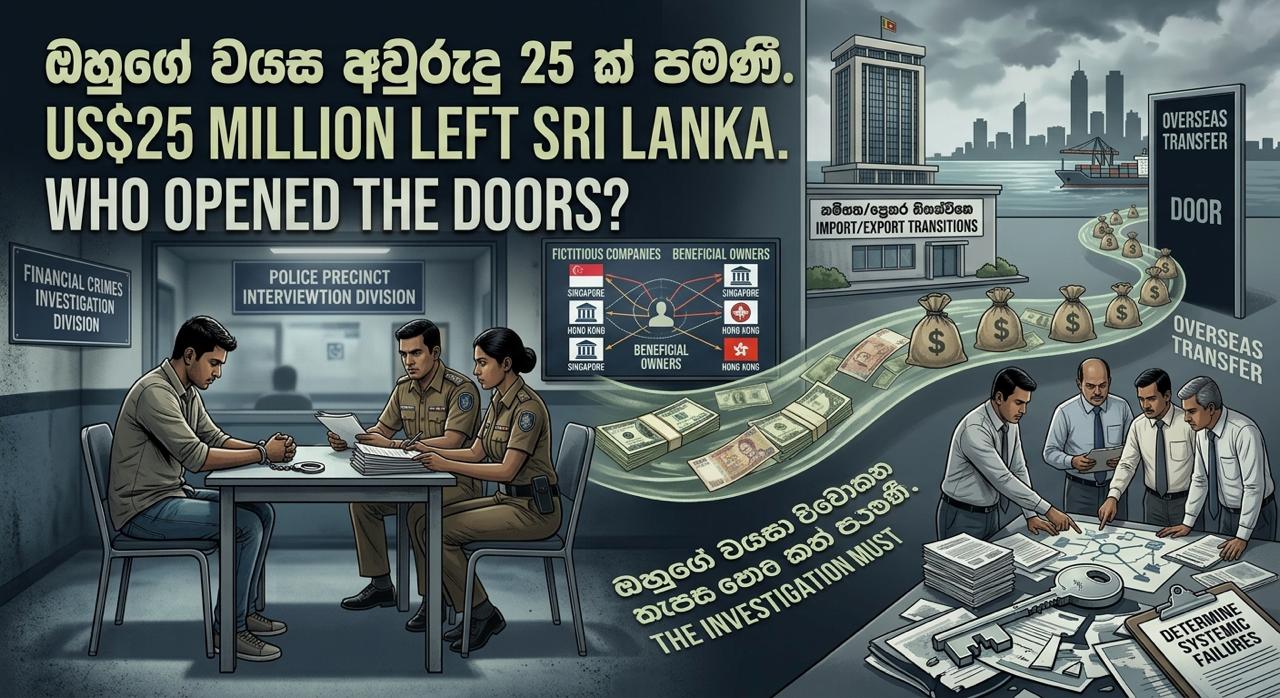
A 25-year-old has been remanded over allegations that US$25 million, approximately Rs. 7.5 billion, was transferred overseas through fictitious companies and import transactions that apparently never resulted in goods arriving in Sri Lanka. The arrest raises questions extending well beyond the young suspect to the banking system, Customs and the regulatory institutions responsible for protecting the country’s foreign exchange.
A 25-year-old resident of Wellampitiya has been arrested by the Financial Crimes Investigation Division over allegations that he participated in transferring approximately US$25 million out of Sri Lanka between January 2024 and July 2025. Investigators allege that six fictitious companies were used to facilitate the transactions, with money sent overseas under the pretence of paying for imported goods.
The suspect has been remanded until 15 October. He remains entitled to the presumption of innocence, and the allegations against him must be established through the judicial process.
Submit Your Press Release
Get your company news, announcements, launches, appointments and events in front of a wider audience.


But the investigation raises questions that extend considerably beyond the conduct of one young man.
US$25 million is an extraordinary amount of money. At approximately Rs. 7.5 billion, it represents a sum beyond the imagination of most Sri Lankan households. Yet investigators believe that money of this magnitude could have moved through established banking channels against commercial transactions for which the corresponding imports never materialised.
How?
Sri Lanka operates a regulated banking system. Commercial banks are required to observe customer identification procedures, monitor transactions and comply with anti-money-laundering obligations. Import payments generate documentary records, while Customs maintains information concerning goods entering the country.
These systems are supposed to communicate sufficiently to identify suspicious activity.
If investigators’ allegations are ultimately established, the question becomes whether the warning signs were missed, ignored or concealed.
Were the six companies properly registered? Who were their beneficial owners? What business histories did they possess? Which banks processed the payments? What documents were presented? Were the overseas recipients genuine suppliers, and in which jurisdictions were their accounts maintained?
More importantly, when payments were made for imports that never arrived, what happened to the corresponding banking and Customs records?
This is not the first investigation involving allegedly fictitious imports and the movement of substantial foreign exchange overseas. Other inquiries have examined considerably larger transactions, including allegations involving numerous companies and commercial banking institutions.
The latest arrest therefore deserves examination within the wider pattern rather than as an isolated criminal allegation.
There is also an important distinction between the person who operates a company, the person who controls its finances and the ultimate beneficiary of a transaction. Investigators must establish those relationships rather than assume that the individual appearing before court necessarily represents the full extent of the operation.
Sri Lanka has spent years struggling with foreign exchange shortages, import restrictions, external debt and the economic consequences of insufficient reserves.
Against that background, allegations that millions of dollars may have been transferred abroad through fraudulent commercial documentation demand a particularly thorough investigation.
The responsibility does not rest exclusively with the Police. The Central Bank, commercial banks, Customs, company registration authorities and financial intelligence institutions all have questions to answer about the safeguards operating during the period concerned.
If the transactions were fraudulent, identifying the alleged perpetrators will be only one part of the necessary response. Establishing whether the money can be traced or recovered, and determining how the regulatory system might have failed, are equally important.
The investigation must follow the money, establish the ownership and control of the companies involved, identify the institutions through which the payments passed and determine whether any other parties knowingly facilitated unlawful transactions.
A successful prosecution would address criminal responsibility. A successful investigation should also explain how the transactions became possible.
Sri Lanka needs both answers.