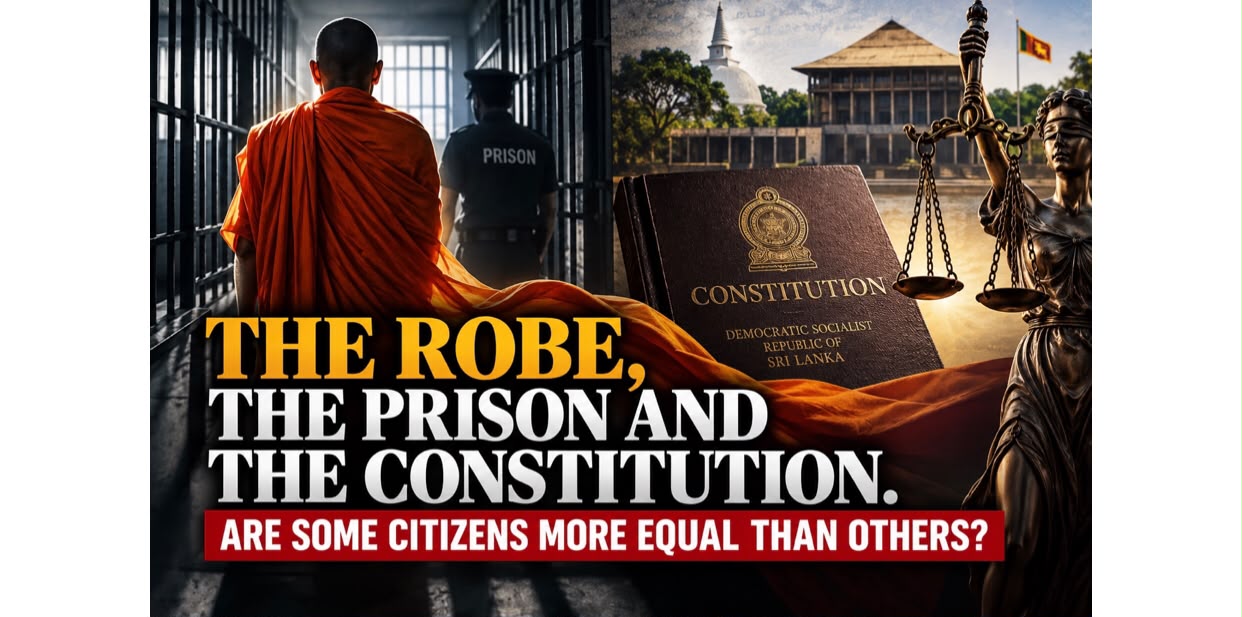
President Anura Kumara Dissanayake has initiated a review of prison regulations following objections to the removal of Buddhist robes from a convicted monk. Religious dignity deserves respect, but the proposed changes raise a fundamental constitutional question: can the State accommodate religious practice without creating unequal treatment under the law?
Sri Lanka is preparing to reconsider the rules governing the treatment and clothing of Buddhist monks serving prison sentences. More to the point it is not what they wear within the prison but rather when they are moved out of prison temporarily to attend court, health care and so on. The initiative follows controversy over the appearance of Galagoda Aththe Gnanasara in prison-issued clothing rather than his customary robes.
The President has announced that a committee comprising relevant government and legal authorities will examine the existing framework and recommend changes. The committee is expected to complete its work within two weeks.
Submit Your Press Release
Get your company news, announcements, launches, appointments and events in front of a wider audience.


The controversy has produced two competing arguments, both deserving serious consideration.
Senior Buddhist clergy maintain that the authority to determine whether a monk should cease wearing religious robes belongs to the recognised institutions of the Buddhist Sangha. From that perspective, prison officials requiring a monk to wear ordinary prison clothing may be seen as intruding into an area of religious discipline and identity.
The opposing argument concerns equality before the law.
Article 12(1) of Sri Lanka’s Constitution declares that all persons are equal before the law and entitled to its equal protection. Article 12(2) prohibits discrimination on specified grounds, including religion, while the Constitution also protects freedom of thought, conscience and religion.
Those provisions must be considered together.
The Constitution gives Buddhism the foremost place and requires the State to protect and foster the Buddha Sasana. It does not, however, establish a general exemption from criminal law for Buddhist monks, nor does it declare that religious office places any individual beyond the ordinary consequences of conviction.
The distinction matters.
A monk does not cease to possess religious convictions upon entering prison. Neither does a Christian priest, Muslim cleric, Hindu religious leader or any other prisoner whose faith includes distinctive clothing or observances.
The legitimate question is whether reasonable accommodation of religious identity can be provided consistently with prison discipline, security and equal treatment.
There may be perfectly defensible reasons for allowing religious clothing in particular circumstances. There may also be practical reasons for requiring standard prison attire, particularly where identification, security or the conditions of imprisonment are concerned.
But any proposed amendment must explain why a particular accommodation is necessary and whether comparable consideration would be available to prisoners belonging to other religions.
Otherwise, a measure presented as respect for religion risks becoming a distinction based upon religious status.
The President has made an important point in declining to issue an individual direction simply to resolve the controversy surrounding one prisoner. Where existing rules are considered inadequate, changing the law through the proper process is preferable to granting personal exceptions.
That approach deserves recognition. It can be construed to be part and parcel of the reforms he promised the people.
Nevertheless, changing legislation does not automatically resolve the constitutional question.
Parliament cannot assume that a measure becomes compatible with equality merely because it has been enacted through the ordinary legislative process. Its substance, purpose and consequences must also withstand constitutional scrutiny.
There is a further issue concerning the meaning of imprisonment.
A sentence imposed by a court is a legal consequence of criminal conduct established through due process. Prison administration must respect the dignity of every prisoner, but dignity does not necessarily require the preservation of every outward distinction associated with that person’s former position in society.
A minister, military officer, judge, business leader and religious dignitary may enter prison carrying very different social identities. The criminal justice system must nevertheless apply lawful standards without favouritism.
Sri Lanka should therefore resist reducing this debate to whether Buddhist monks deserve respect. They do, as do members of every other religious community and every person deprived of liberty.
The issue is how that respect can be reconciled with a constitutional order founded upon equal protection.
If religious clothing can be accommodated without compromising prison administration, there is a serious argument for permitting it. But that argument should be developed through clear, consistent and constitutionally defensible rules rather than special treatment determined by influence or public pressure.
The Government has an opportunity to modernise an old prison framework while strengthening religious freedom and equality.
It also has an obligation not to confuse the two.
The Constitution protects religion. It protects equality. Good legislation should be capable of respecting both.