
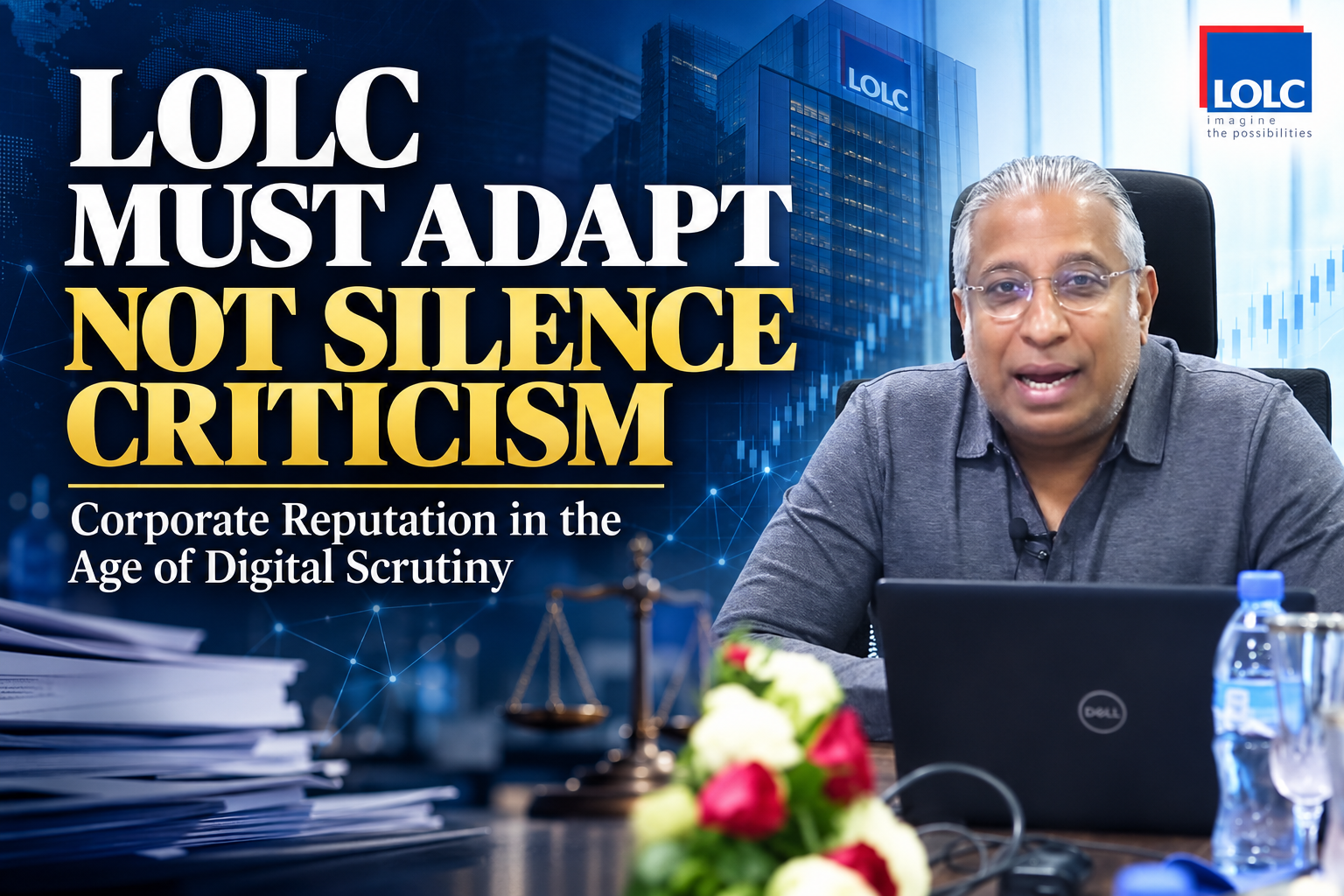
A corporate reputation cannot be protected by restricting public debate
The reported decision by the Colombo Magistrate’s Court to issue a conditional order concerning online content about LOLC Holdings PLC raises an important question for Sri Lanka’s corporate sector: should companies respond to uncomfortable public criticism by seeking to restrict access to online material, or should they adapt to an environment in which businesses are increasingly scrutinised by investors, journalists, analysts and the public?
LOLC Holdings PLC is entitled to protect its reputation, challenge demonstrably false allegations and pursue legitimate legal remedies. However, the reported move to block specified online URLs under the Online Safety Act No. 9 of 2024 deserves careful scrutiny because its implications extend beyond one company or one dispute.
The position is straightforward: LOLC should adapt to digital scrutiny rather than rely on access restrictions as a means of managing its public image. Where statements are inaccurate, the preferred first response should be verifiable evidence, transparent disclosure and a substantive rebuttal. Restricting access to online content should be a narrowly applied legal remedy for genuinely unlawful material, not a substitute for answering legitimate questions.
Submit Your Press Release
Get your company news, announcements, launches, appointments and events in front of a wider audience.


A conditional order is not the same as a final determination
According to the report published on 24 October 2026, LOLC initiated proceedings on 16 October, and a conditional order was issued on 23 October requiring access to specified URLs to be blocked unless reasons were presented for allowing the content to remain available.
The distinction between a conditional order and a final determination matters. The reported order should not, by itself, be interpreted as conclusive proof that every disputed statement is false, that the publisher acted maliciously or that all public discussion of the underlying subject is unlawful.
Section 24 of the Online Safety Act permits an affected person to apply to a Magistrate’s Court for an order to prevent the circulation of prohibited statements. It also provides for conditional orders. The existence of this legal procedure does not eliminate the need to examine the specific statements, the evidence supporting the application, the scope of the restrictions and the opportunity available to affected parties to respond.
The public deserves clarity about precisely what content is being challenged, which legal provisions apply and why blocking access is considered necessary. Without that context, it is difficult for investors, publishers and the wider public to assess the proportionality of the remedy.
The public interest cannot be reduced to corporate reputation
LOLC is a major corporate group with extensive business interests. Questions concerning its financial arrangements, banking relationships, governance, risk management and disclosures can have implications for shareholders, creditors, customers and other stakeholders.
That does not mean every allegation circulating on social media deserves to be believed. Unverified rumours can mislead investors, damage reputations and create unnecessary uncertainty. Deliberately fabricated claims should not be protected merely because they are published online.
But the opposite principle is equally important: a company’s description of a statement as false or misleading should not automatically end public discussion of the subject.
There is a fundamental difference between inventing facts, knowingly spreading falsehoods and raising questions about a transaction using publicly available information. There is also a difference between personal attacks and good-faith criticism of corporate conduct.
Responsible journalism and legitimate financial analysis must be able to examine corporate disclosures, identify inconsistencies, question explanations and ask follow-up questions without facing the prospect that an entire discussion will disappear from public view.
The appropriate response to inaccurate reporting is to establish what is wrong, provide supporting documents and correct the record. Where legal action is necessary, it should address the specific unlawful conduct rather than unnecessarily restrict broader debate.
The Online Safety Act requires careful application
Article 14(1)(a) of Sri Lanka’s Constitution recognises freedom of speech and expression, including publication. That right is subject to constitutional limitations, including those set out in Article 15; it is not an unrestricted licence to defame others or publish unlawful material. Nevertheless, restrictions on expression must be approached with care.
The Online Safety Act provides a mechanism through which affected parties can seek judicial intervention against prohibited statements. The central concern is not whether a company should be able to approach a court. It should. The concern is whether the use of an access-blocking remedy is sufficiently precise, proportionate and protective of legitimate expression.
Freedom House has previously raised concerns about the breadth of the Act and its potential implications for online expression and self-censorship. Those concerns are relevant when assessing how the law is applied in individual cases. Freedom House: Sri Lanka Freedom on the Net.
If publishers and independent analysts conclude that questioning a powerful corporate group could expose them to costly proceedings or restrictions on their work, they may choose to avoid legitimate subjects altogether. Such self-censorship would harm not only the media but also the quality of information available to investors.
The answer is not to exempt companies from the law. It is to ensure that legal remedies are used against demonstrably unlawful content, with appropriate safeguards for due process, proportionality and public-interest reporting.
LOLC’s own clarification illustrates a better approach
The controversy follows LOLC’s public clarification concerning a banking facility involving People’s Bank.
In its disclosure submitted to the Colombo Stock Exchange on 14 October 2026, LOLC stated that the local-currency borrowing was fully secured against a US-dollar deposit maintained with People’s Bank. The company argued that the arrangement was part of its treasury and foreign-exchange risk-management practices and rejected suggestions that the facility represented unsecured exposure of public funds.
That explanation was reported by EconomyNext and other Sri Lankan media outlets. EconomyNext’s report and LOLC’s clarification.
This is precisely the kind of issue on which documentary evidence and transparent disclosure can improve public understanding. If a facility is fully cash-secured, relevant documentation and clear explanations of the security arrangements can help demonstrate that position. If questions remain, those questions should be addressed with evidence rather than assumptions from either side.
LOLC’s published explanation is the company’s stated position; independent verification of the underlying arrangements is a separate matter. Neither unsubstantiated allegations nor corporate assurances should automatically replace a careful examination of the available evidence.
The company has every right to correct the record. But the publication of a rebuttal and the restriction of access to criticism are not equivalent responses. The former adds information to the public domain. The latter can remove information from it.
Investors need more transparency, not less
The Colombo Stock Exchange depends on credible disclosures, informed investors and confidence in the integrity of corporate information. Market participants must be able to distinguish between verified facts, management explanations, analytical opinions and unsubstantiated rumours.
When a controversy arises, the most effective way for a listed company to protect shareholder value is to provide timely and accurate information through appropriate disclosure channels, explain material transactions, answer reasonable questions and correct errors openly.
A court order concerning selected online content does not resolve every question investors may have about the underlying subject. Nor should it be treated as a substitute for the disclosure obligations that apply to listed companies.
The wider corporate sector should recognise that digital scrutiny is now a permanent feature of modern capital markets. Businesses operate in an environment where financial analysts, journalists, shareholders and members of the public can discuss transactions almost immediately. Companies that respond with evidence and openness are better placed to build durable credibility than those that allow a dispute over information to become a wider controversy about transparency.
Adapt, LOLC: credibility is stronger than censorship
LOLC should use this episode as an opportunity to strengthen its public communication strategy.
First, publish clear, evidence-backed explanations of material transactions and address legitimate questions directly.
Second, distinguish demonstrably false factual allegations from opinion, interpretation and good-faith criticism.
Third, use legal proceedings where there is a sound legal basis, but ensure that the requested relief is confined to the specific unlawful material and does not unnecessarily restrict lawful reporting or public debate.
Fourth, maintain a transparent channel through which shareholders, analysts and journalists can request clarification of material matters.
Finally, avoid creating the impression that criticism itself is being treated as misconduct. A company can strongly reject an allegation without seeking to eliminate every online discussion in which it appears.
These measures would serve LOLC’s own long-term interests. A strong corporate reputation is built through consistent conduct, reliable disclosure and public confidence. It cannot be secured simply by limiting the circulation of unfavourable commentary.
The precedent matters beyond LOLC
This issue is not about endorsing rumours or granting publishers immunity from the law. It is about preserving the distinction between protecting people and businesses from unlawful falsehoods and suppressing legitimate scrutiny.
If access restrictions become a routine first response whenever a corporate group disputes online criticism, the consequences could extend to independent financial research, investigative reporting and public-interest discussion of companies with substantial economic influence.
That would be a poor outcome for Sri Lanka’s investment climate. Investors need reliable information, but they also need the freedom to ask questions and evaluate competing explanations. A healthy market cannot function on corporate statements alone, just as it cannot function on rumours alone.
The right balance is evidence, disclosure, accountability and proportionate legal remedies.
LOLC has the right to defend itself. The public has a legitimate interest in scrutinising powerful businesses. The courts have a responsibility to apply the law. None of these principles should be used to undermine the others.
The message to LOLC is therefore clear: adapt to the age of digital accountability. Answer criticism with facts. Correct misinformation with evidence. Pursue genuinely unlawful conduct through proportionate legal channels. Do not allow a dispute over particular online statements to become a broader restriction on legitimate public debate.
In the long run, transparency builds trust. Blocking access to criticism risks doing the opposite.



